
Fun facts
Chamaeleon constellation: Chamaeleon is a small constellation in the deep southern sky. It is named after the Chamaeleon, a kind of lizard. It was first defined in the 16th century.
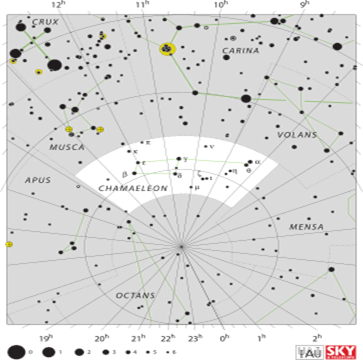
STARS: There are four bright stars in Chamaeleon that form a compact diamond-shape approximately 10 degrees from the south celestial pole and about 15 degrees south of Acrux, along the axis formed by Acrux and Gamma Crucis. Alpha Chamaeleontis is a white-hued star of magnitude 4.1, 63 light-years from Earth. Beta Chamaeleontis is a blue-white hued star of magnitude 4.2, 271 light-years from Earth. Gamma Chamaeleontis is a red-hued giant star of magnitude 4.1, 413 light-years from Earth. The other bright star in Chamaeleon is Delta Chamaeleontis, a wide double star. The brighter star is Delta2 Chamaeleontis, a blue-hued star of magnitude 4.4. Delta1 Chamaeleontis, the dimmer component, is an orange-hued giant star of magnitude 5.5. They both lie about 350 light years away.
DSOs: The constellation contains several molecular clouds (the Chamaeleon dark clouds) that are forming low-mass T Tauri stars. The cloud complex lies some 400 to 600 light years from Earth and contains tens of thousands of solar masses of gas and dust. The most prominent cluster of T Tauri stars and young B-type stars are in the Chamaeleon I cloud, and are associated with the reflection nebula IC 2631. Chamaeleon contains one planetary nebula, NGC 3195, which is fairly faint. It appears in a telescope at about the same apparent size as Jupiter. {From: https://en.wikipedia.org/wiki/Chamaeleon}
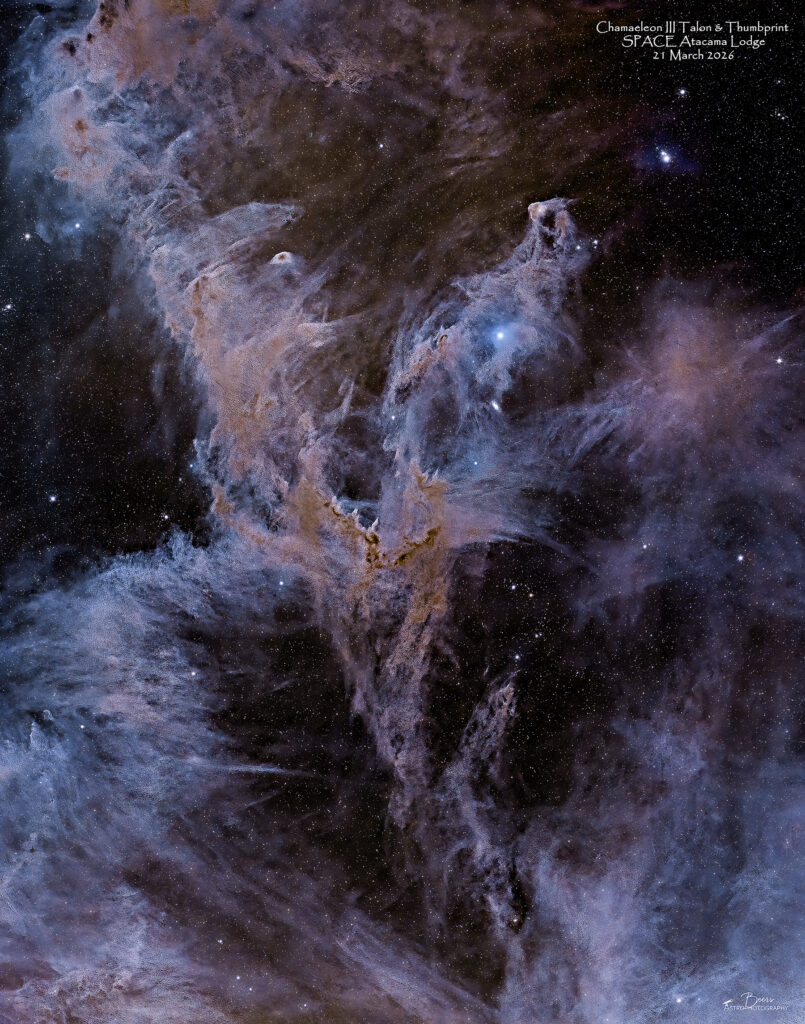
Chamaeleon III: Talon and Thumbprint Nebulae: In the northern region of Cha III we can find the bright/dark nebula the Thumbprint. The Thumbprint Nebula was first coined by David Malin back in the late 1970’s. Visible in large telescopes it still takes a very transparent sky to show this small object at all. The Thumbprint covers 5.5’ x 3.3’.
Looking at the wider view and considering the nearby Haast Eagle, we have dubbed this stream of streaky dust, the Talon. The shaft of the talon stretches up from the south and appears to be reaching to pluck the Thumbprint out of the sky!
The condensations of Cha III have the lowest density of any in the region and are not expected to produce stars. The area is covered with long filaments and the major condensations often consist of clumps of material loosely bound and held mainly by electromagnetism along the filament lines. These nebulae lie approximately 1600 light years from the Sun. {From: Imaging the Southern Sky; Stephen Chadwick and Ian Cooper; pp. 269-271}
Distance: 1600 light years
Apparent dimensions: (Field size of Chadwick&Cooper images)
Thumbprint: 5.5’ x 3.3’
Talon and Thumbprint Nebulae: 1.7° x 1.4°
Constellation: Chamaeleon
Other Designations: Chamaeleon Molecular Cloud Region
{From: Imaging the Southern Sky; Stephen Chadwick and Ian Cooper; pp. 269-274}
Capture & Processing Notes
The 21 March 2026 night’s plan (as I was nearing the end of DSO imaging nights on the trip) was to capture two 2-tile mosaics – first, the Chamaeleon III Talon & Thumbprint Nebula. Then, when it was due for its meridian flip at approximately 02:00, switch to the two tile mosaic of IC4604 Rho Ophiuchi.
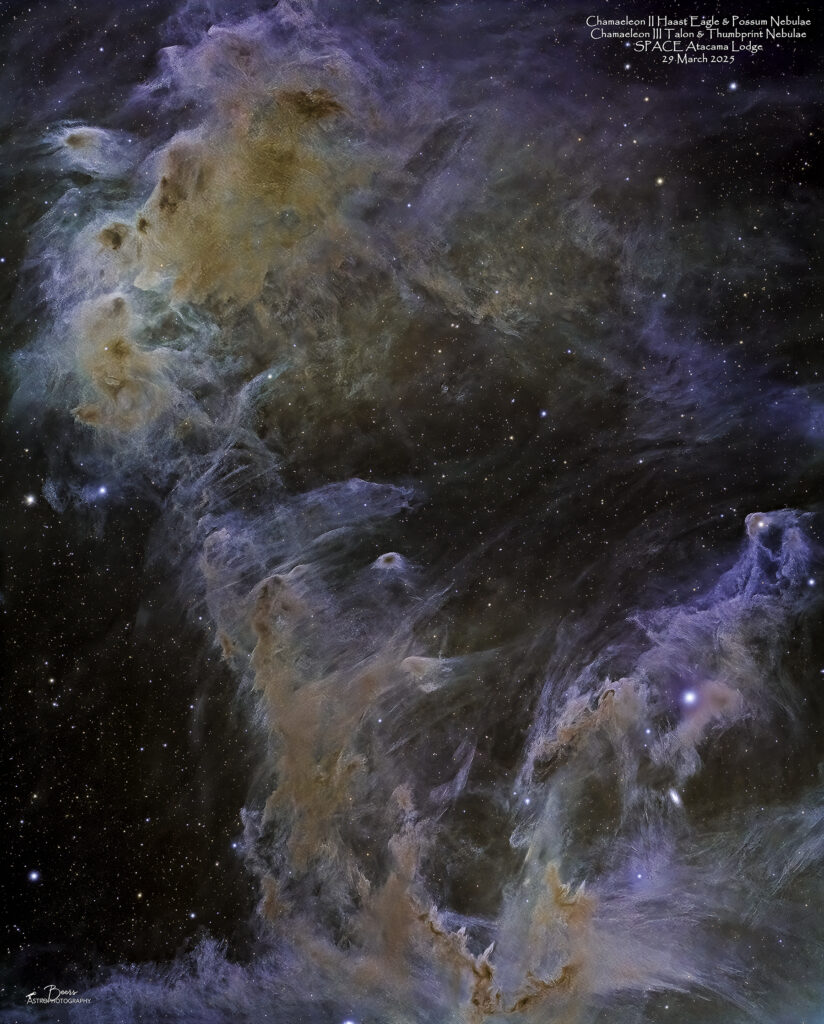
For the next trip, I need to find a way (like with the Vela SNR) to do a better job of mapping out the regions in the Chamaeleon constellation. This image is very similar to the Haast Eagle & Possum’s framing and to the 2025 image shown below, while I feel there are likely portions of the area that I haven’t yet captured by depending on the coordinates, object identification, and field of views from the Chadwick&Cooper book.
Although I had imaged NGC6188 Fighting Dragons on the previous night at a camera angle of ~3.2° and captured calibration frames (albeit at gain 300 vs. gain 158 that the images were captured with) following that session, I decided to rotate the camera angle to attempt to get closer than 3° to the planned/desired 0° camera angle, so as to not have issues when the plate solving deviated to bust the 5° limit. I started at about 19:30 with that camera rotation and collecting new calibration and 5-minute dark frames – confirming that the camera was set for G158 (the sequence had 1×1 binning set for G300??)
I started the polar alignment at 20:25 and had the polar alignment done by 20:27 – picked out Sigma Octantis right away and had to make only miniscule changes to the mount’s position!
I started up SGP at 20:32 ran through its: EAF#1 (5938 to 6184), plate solve (2.20° from 0°, 1082.5px; second run was 56.2px, resolved on the third attempt), started the autoguider (no calibration, 5.00HFD, 120.7 SNR), EAF#2 (6184 to 6161) and started the sequence at 20:40 CDT.
At 23:16, came outside to witness the tile swap. Tile #1 was on 29/30 subframes, so I changed the total to 29 so the swap would occur without my having to sit outside for an additional 30 minutes or without pausing and restarting the sequence. The mount slewed to the Tile#2 position (not much movement) plate solve (2.08° from 180°, 278 px, resolved on the second attempt), resume autoguider, EAF (6054 to 6037) and started Tile#2 at 23:21 CDT. Came out at 01:50 to switch targets.
Sequence plan: Gain 158, Offset 30, Temp 0°C; 2-tile mosaic:
- Tile#1: 29x5min, 145min (2:25hrs); Collected 21Mar2026, 20:40 – 23:16 CDT.
- Tile#2: 28x5min, 140min (2:20hrs); Collected 21Mar2026, 23:20 – 22Mar2026, 01:52 CDT
Processing summary: Captured in SGP, stacked tiles and then created mosaic in APP (Adaptive Airy), star removal with Starnet++, processing with LR/PS
Equipment
Equipment: All equipment controlled by HP Probook (DSO CTRL1) running Sequence Generator Pro v4.4.0.1441.
- Imaging (ASI2400-SC420): ZWO ASI2400MC imaging camera; (Southern Cross) Askar FRA600 108mm; f/5.6 Quintuplet Petzval Flat-Field Astrograph with Askar 0.7x reducer for FRA600
- Mount: Rainbow Astro RST-135E (controlled by iHubo ASCOM driver)
- Polar alignment: QHYCCD camera (controlled by Polemaster for polar alignment)
- Autoguiding: Orion 60mm Multi-Use Guide Scope with ZWO ASI120MM mini mono camera (controlled by PHD2)
- Autofocuser: ZWO EAF Electronic Automatic Focuser (EAF-5V-STD)
Summary
Captured: 21Mar2026, 20:40CDT – 22Mar2026, 01:52. 2-tile mosaic: Tile#1 – 29x5min, 145min (2:25hrs); Tile#2 – 28x5min, 140min (2:20hrs); Total: 57x5min, 285min (4:45hrs).
Shooting location: San Pedro de Atacama Celestial Explorations (SPACE) Atacama Lodge, Chile
Equipment: ZWO ASI2400MC imaging camera; (Southern Cross-420mm) Askar FRA600 108mm; f/5.6 Quintuplet Petzval Flat-Field Astrograph with Askar 0.7x reducer for FRA600 on Rainbow Astro RST-135E
Processing summary: Captured in SGP, stacked tiles and then mosaiced in APP (Adaptive Airy), star removal with Starnet++, processing with LR/PS
Previous captures of Chamaeleon III Talon & Thumbprint Nebulae
Capture & Processing Notes
This was the image captured on Saturday night before Jan and Dave’s departure for Patagonia and a drive to the Calama airport early in the morning to drop them off. I went back to the Chamaeleon constellation targets because they are up all night, with a single meridian flip in the early morning hours (in this case 01:48), then didn’t set until after astronomical twilight began (i.e., I could let the sequence run while we were gone on the drive to the airport).
Captured as a 2-tile mosaic with the Haast Eagle & Possum and Thumbprint & Talon together in the mosaic. Again, as with the Rippling Flames & Moa 2-tile mosaic, I could switch between tiles and do the meridian flip in a single step. Not only was this important from the perspective of letting the sequence run while we were away, but it minimized the number of wake-ups during the night – the night following the 6+ hour polar alignment adventure (?) on Friday night when I got virtually no sleep because I was so frozen that when I did finally get to bed (~0300), I couldn’t sleep.
I conducted the RST-135E hand controller actions before dark (including ensuring I had the Southern Hemisphere parking location selected and stored in the mount’s firmware (spoiler alert – it STILL parked facing to the west every time!).
When it got dark enough (I thought) to start the polar alignment – I learned one more lesson about polar aligning in the Southern Hemisphere. Unlike our lovely bright Polaris, that you can polar align to during civil twilight, to align with Sigma Octantis (σ Oct) or Polaris Australis one must wait until astronomical twilight has fully set in (i.e., it’s dark, dark) so that the gain and exposure time on the Polemaster software can be turned to almost the maximum (300ms, 90 gain) so that you can see the stars making up the trapezium with σ Oct clearly on the screen. Once I was “patient enough” (?) to wait that long (until about 20:30CDT), I found the stars making up the Southern Hemisphere Polemaster template and successfully completed the polar alignment! I disassembled the Polemaster camera, stowed it, and connected the cabling; getting the SGP sequence actions started at 20:48CDT. The rest of the sequence start-up went well with the first subframe capture starting at 20:57CDT…and went inside to join Jan and Dave for a glass of wine to toast their next leg of their adventure and the fun that we’d had together on this leg.
At 01:48, I got up to do the meridian flip and switch to tile#2. The sequence had completed 55 subframes on tile#1. I was satisfied with that amount of data (on the Haast Eagle & Possum) so I executed the plan of flipping and switching by ending the sequence, disconnecting equipment, recycling power, deselecting tile#1, and restarting the sequence on tile#2 for the rest of the night.
I got back from the run to the airport at 07:44CDT and completed the calibration frames, packed up the cabling, and wrapped SC in her daytime garb (Danita’s covers and a white tablecloth to protect her from the Atacama desert sun.
Sequence Plan (29Mar2025): Gain 158, Offset 30, Temp 0°C;
Tile#1: 55x5min. Captured 29Mar2025, 20:57CDT – 30Mar2025, 01:55CDT. Total: 4:35hrs.
Tile#2: 50x5min. Captured 30Mar2025, 02:08CDT – 06:40CDT. Total: 4:10hrs.
Mosaic: 105x5min. Captured 29Mar2025, 20:57CDT – 30Mar2025, 06:40CDT. Total: 8:45hrs.
Processing summary: Captured in SGP, stacked tiles and then created mosaic in APP (Adaptive Airy), star removal with Starnet++, processing with LR/PS
Equipment
Equipment: All equipment controlled by HP Probook (DSO CTRL1) running Sequence Generator Pro v4.4.0.1441.
- Imaging (ASI2400-SC): ZWO ASI2400MC imaging camera; (Southern Cross) Askar FRA600 108mm f/5.6 Quintuplet Petzval Flat-Field Astrograph
- Autofocuser: ZWO EAF Electronic Automatic Focuser – Standard (EAF-5V-STD)
- Mount: Rainbow Astro RST-135E (controlled by iHubo ASCOM driver)
- Polar alignment: QHYCCD camera (controlled by Polemaster for polar alignment)
- Autoguiding: Orion 60mm Multi-Use Guide Scope with Orion StarShoot AutoGuider Pro Mono Astrophotography Camera (controlled by PHD2)
Summary
Captured: 29Mar2025, 20:57CDT – 30Mar2025, 06:40CDT. Total: 8:45hrs
Shooting location: San Pedro de Atacama Celestial Explorations (SPACE) Atacama Lodge, Chile
Equipment: Southern Cross on Rainbow Astro RST-135E
Processing summary: Captured in SGP, stacked tiles and then mosaiced in APP (Adaptive Airy), star removal with Starnet++, processing with LR/PS