
Fun facts
Chamaeleon constellation: Chamaeleon is a small constellation in the deep southern sky. It is named after the Chamaeleon, a kind of lizard. It was first defined in the 16th century.
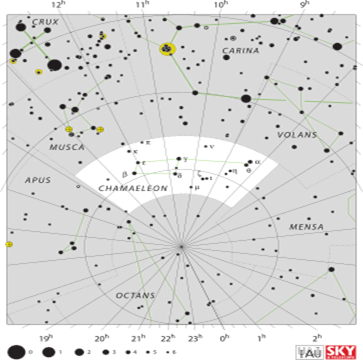
STARS: There are four bright stars in Chamaeleon that form a compact diamond-shape approximately 10 degrees from the south celestial pole and about 15 degrees south of Acrux, along the axis formed by Acrux and Gamma Crucis. Alpha Chamaeleontis is a white-hued star of magnitude 4.1, 63 light-years from Earth. Beta Chamaeleontis is a blue-white hued star of magnitude 4.2, 271 light-years from Earth. Gamma Chamaeleontis is a red-hued giant star of magnitude 4.1, 413 light-years from Earth. The other bright star in Chamaeleon is Delta Chamaeleontis, a wide double star. The brighter star is Delta2 Chamaeleontis, a blue-hued star of magnitude 4.4. Delta1 Chamaeleontis, the dimmer component, is an orange-hued giant star of magnitude 5.5. They both lie about 350 light years away.
DSOs: The constellation contains several molecular clouds (the Chamaeleon dark clouds) that are forming low-mass T Tauri stars. The cloud complex lies some 400 to 600 light years from Earth and contains tens of thousands of solar masses of gas and dust. The most prominent cluster of T Tauri stars and young B-type stars are in the Chamaeleon I cloud, and are associated with the reflection nebula IC 2631. Chamaeleon contains one planetary nebula, NGC 3195, which is fairly faint. It appears in a telescope at about the same apparent size as Jupiter. {From: https://en.wikipedia.org/wiki/Chamaeleon}
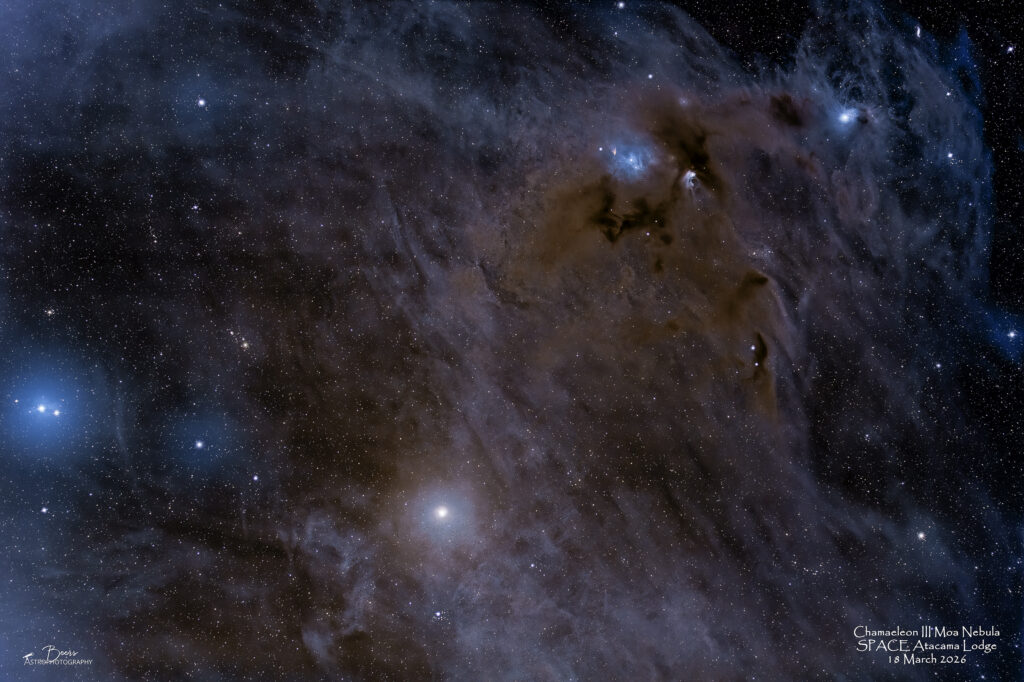
Moa Nebula; Chamaeleon III Molecular Cloud: The Moa is the brightest and easiest of the Chamaeleon II and III nebulae to find. The chest is marked by Beta Chamaeleontis while the head is marked by the magnitude 8.0 star HD 106248. The Moa’s cranium is a well defined edge like a shockwave front that tapers off to form the beak.
The Moa’s back curves off in another apparent shock front to the east of Beta Cha. IC3104, a small elliptical galaxy just south of Beta Cha, makes the perfect Moa’s egg. Similar in appearance to the other great southern birds the Emu, Rhea and Ostrich, the Moa lived in magnificent isolation to become the largest bird that ever lived. {From: Imaging the Southern Sky; Stephen Chadwick and Ian Cooper; pp. 275-277}
Distance: 650 light years
Apparent dimensions: (Field size of Chadwick&Cooper images)
Moa Nebula: 1.7° x 1.4°
Constellation: Chamaeleon
Other Designations: Chamaeleon Molecular Cloud Region
{From: Imaging the Southern Sky; Stephen Chadwick and Ian Cooper; pp. 275-280}
Capture & Processing Notes
I ended the night’s first target (LMC) at 01:10CDT, disconnected the equipment from SGP, unplugged/replugged the autoguider cable (for good measure), pulled up the ChaIII Moa sequence and got an “exception error.” So, I restarted SGP (rebooted the laptop), recycled the power on the mount, unplugged/replugged the imaging camera. Once I’d done that reboot, I restarted SGP and the sequence came up without issue. I homed the telescope, connected the equipment and got the sequence started. Again, SGP ran through its standard sequence – EAF#1 (6044 to 6011), plate solve (2.45° delta from 90°, 874px), resume AG (no calibration – calibration and dark library green, HFD 4.67, SNR 107.5), EAF#2 (6011 to 6007), AG settle. Chameleon III Moa Event1/Frame1 started at 01:24. The sequence ran successfully until I came out and ended the sequence at 06:46CDT. I ended up marking the last frame bad – as it was in the midst of astronomical twilight and too bright (and with two separate satellite trails running through it).
Sequence plan: Gain 158, Offset 30, Temp 0°C; 59x5min, 295min (4:55min); Collected 19Mar2026, 01:24 Chilean Daytime Time (CDT) – 19Mar2026, 06:46CDT.
Processing summary: Captured in SGP, stacked in APP (Adaptive Airy), star removal with Starnet++, processing with LR/PS
Equipment
Equipment: All equipment controlled by HP Probook running Sequence Generator Pro v4.4.0.1441.
- Imaging (ASI2400-SC420): ZWO ASI2400MC imaging camera; (Southern Cross) Askar FRA600 108mm; f/5.6 Quintuplet Petzval Flat-Field Astrograph with Askar 0.7x reducer for FRA600
- Mount: Rainbow Astro RST-135E (controlled by iHubo ASCOM driver)
- Polar alignment: QHYCCD camera (controlled by Polemaster for polar alignment)
- Autoguiding: Orion 60mm Multi-Use Guide Scope with ZWO ASI120MM mini mono camera (controlled by PHD2)
- Autofocuser: ZWO EAF Electronic Automatic Focuser (EAF-5V-STD)
Summary
Captured: 19Mar2026, 01:24 – 06:46 CDT. 59x5min, 295min (4:55hrs).
Shooting location: San Pedro de Atacama Celestial Explorations (SPACE) Atacama Lodge, Chile
Equipment: ZWO ASI2400MC imaging camera; (Southern Cross-420mm) Askar FRA600 108mm; f/5.6 Quintuplet Petzval Flat-Field Astrograph with Askar 0.7x reducer for FRA600 on Rainbow Astro RST-135E mount
Processing summary: Captured in SGP, stacked in APP (Adaptive Airy), star removal with Starnet++, processing with LR/PS