
Fun facts
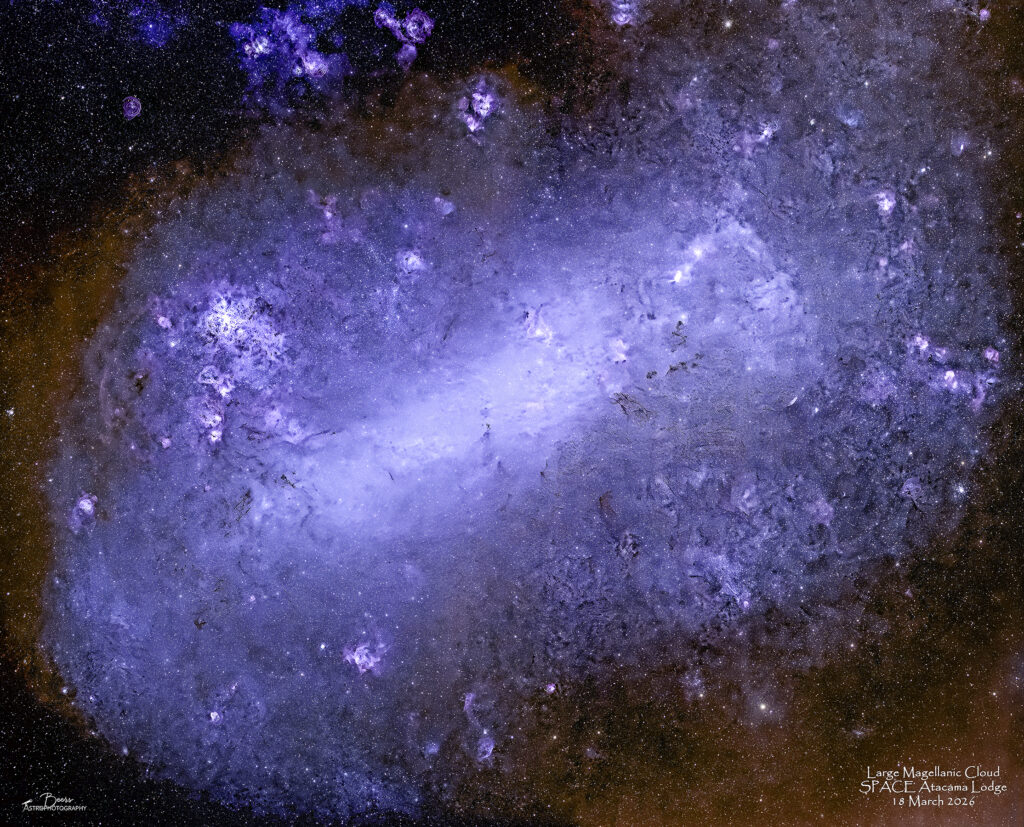
The Large Magellanic Cloud (LMC) is a dwarf galaxy and satellite galaxy of the Milky Way. At a distance of around 50 kiloparsecs (163,000 light-years), the LMC is the second- or third-closest galaxy to the Milky Way, after the Sagittarius Dwarf Spheroidal (c. 16 kiloparsecs (52,000 light-years) away) and the possible dwarf irregular galaxy called the Canis Major Overdensity. It is about 9.86 kiloparsecs (32,200 light-years) across, and has roughly one-hundredth the mass of the Milky Way making it the fourth-largest galaxy in the Local Group, after the Andromeda Galaxy (M31), the Milky Way, and the Triangulum Galaxy (M33).
The LMC is classified as a Magellanic spiral. It contains a stellar bar that is geometrically off-center, suggesting that it was once a barred dwarf spiral galaxy before its spiral arms were disrupted, likely by tidal interactions from the nearby Small Magellanic Cloud (SMC) and the Milky Way’s gravity. The LMC is predicted to merge with the Milky Way in approximately 2.4 billion years.
With a declination of about −70°, the LMC is visible as a faint “cloud” from the Southern Hemisphere of the Earth and from as far north as 20° N. It straddles the constellations Dorado and Mensa and has an apparent length of about 10° to the naked eye, 20 times the Moon’s diameter, from dark sites away from light pollution.
{ From: https://en.wikipedia.org/wiki/Large_Magellanic_Cloud }
Capture & Processing Notes
As Danita said “practice makes perfect” and she was certainly correct! I started the polar alignment at 20:25 – not quite dark enough to have much contrast in the FOV of the Polemaster – but I could pick out Sigma Octantis and the template around it quite easily. I had the polar alignment done by 20:29! The turbulence in the air had the images jumping around, so I put on my best patience hat and waited until 20:33 to repeat the polar alignment process. I was done by 20:35! …and ended up not changing anything from the turbulent (small) adjustment.
I disconnected the Polemaster, ensured all my cables were firmly connected (especially the autoguider cable) and got the sequence started. After my conversation with Bruce from PHD2, I’d changed the SGP configuration (unchecked the recalibrate at target change). That ended up having no PHD2 conduct no calibrations – but PHD2 came up green with both the dark library and calibration (and working very well except when the targets got close to the horizon – and then the tight grouping dispersed a bit).
SGP ran through its: EAF#1 (5958 to 6154), plate solve (2.37° from 90°, 701.3px), started the autoguider (no calibration), EAF#2 (6154 to 6141) and started the sequence at 20:47.
My plan was to let LMC run until it set at 01:36 and I had an alarm set to go outside and end the sequence. I woke up at 01:00 and decided to make the target swap at that point, rather than lay in bed thinking about it. So, I ended the sequence at 01:10CDT and switched to the night’s second target Chameleon III Moa Nebula.
The data collection went very well, but the mosaicking during processing was a bit of a challenge – the two tiles were at a very strange angle to each other, making cropping (and maintaining as much of the image, that was filling the frame(s), as possible) a challenge. This will likely have to be on the target list for subsequent trips – now that SGP has fixed the camera rotation angle issue (theoretically) and potentially with a larger mosaic (i.e., 4-tiles instead of 2-tile to give some breathing room around the LMC).
Processing update (12Apr2026): The version of the LMC image that I’d originally posted was my “field processed” (i.e., the version of the image that I processed on my laptop while I was still in Chile). I did that because the version that I’d processed once I got home on my “big” DSO Desktop processing computer had an exaggerated gray area that I had accepted in my original processing frenzy, but was growing more and more dissatisfied with, the longer I looked at it. So, with all the processing (except the Vela SNR Frankenstein mosaic), posting, and Newsletter writing done, I had time to go back and reprocess. The image shown here, now, uses a hybrid of the processing steps and settings I used in the field and home versions…and (at least at this point) I’m more satisfied with the result.
Sequence plan: Gain 158, Offset 30, Temp 0°C; 2-tile mosaic:
- Tile 1: 45x3min, 135min (2:15hrs); Collected 18Mar2026, 20:47 – 23:17 CDT.
- Tile 2: 33x3min, 99min (1:39hrs); Collected 18Mar2026, 23:21 CDT – 19Mar2026, 01:09CDT
Processing summary: Captured in SGP, stacked individual tiles and mosaicked in APP (Adaptive Airy), star removal with Starnet++, processing with LR/PS
Equipment
Equipment: All equipment controlled by HP Probook running Sequence Generator Pro v4.4.0.1441.
- Imaging (ASI2400-SC420): ZWO ASI2400MC imaging camera; (Southern Cross) Askar FRA600 108mm; f/5.6 Quintuplet Petzval Flat-Field Astrograph with Askar 0.7x reducer for FRA600
- Mount: Rainbow Astro RST-135E (controlled by iHubo ASCOM driver)
- Polar alignment: QHYCCD camera (controlled by Polemaster for polar alignment)
- Autoguiding: Orion 60mm Multi-Use Guide Scope with ZWO ASI120MM mini mono camera (controlled by PHD2)
- Autofocuser: ZWO EAF Electronic Automatic Focuser (EAF-5V-STD)
Summary
Captured: 18Mar2026, 20:47 (CDT) – 19Mar2026, 01:09CDT. Two-tile mosaic: Tile#1 – 45x3min, 135min (2:15hrs); Tile #2 – 33x3min, 99min (1:39hrs).
Shooting location: SPACE Atacama Lodge, San Pedro de Atacama, Chile
Equipment: ZWO ASI2400MC imaging camera; (Southern Cross-420mm) Askar FRA600 108mm; f/5.6 Quintuplet Petzval Flat-Field Astrograph with Askar 0.7x reducer for FRA600 on Rainbow Astro RST-135E mount
Processing summary: Captured in SGP, stacked and mosaicked in APP (Adaptive Airy), star removal with Starnet++, processing with LR/PS