
Fun facts
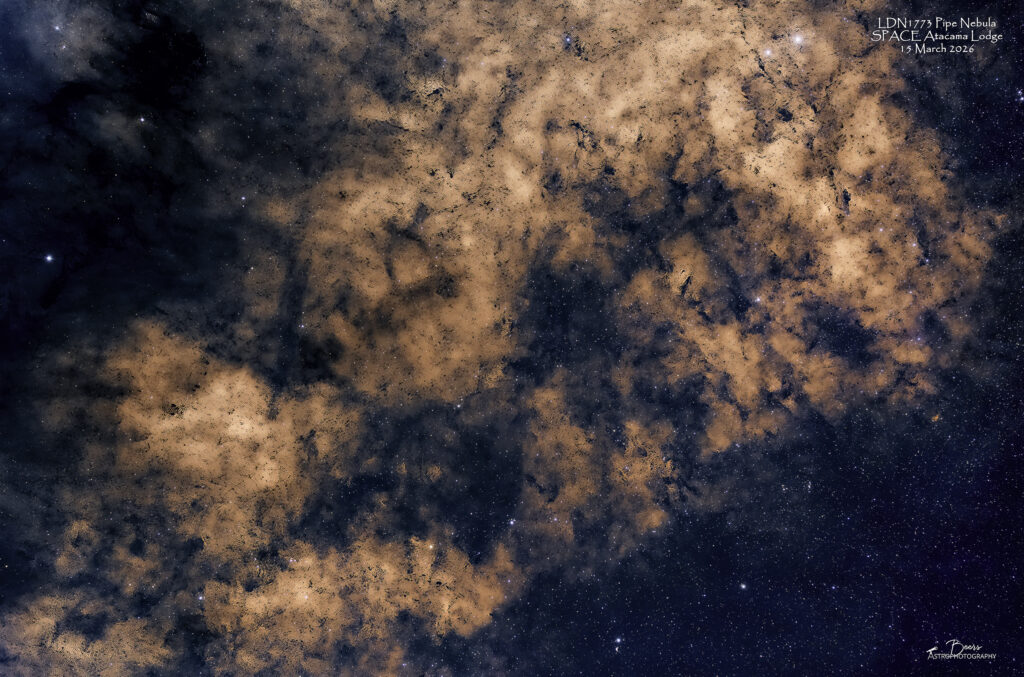
In keeping with the tradition of bird constellations in the southern sky and birds made from dark-lanes as with the Emu, a few decades ago a southern observer noticed a familiar shape sitting in amongst the bright star clouds near the galactic center. It was none other than the flightless bird the Kiwi! This Milky Way Kiwi has a head and beak made of the familiar dark nebula known as the Pipe Nebula. The stem of the Pipe is the long beak, while the bowl of the pipe represents the head. The mottled, round star cloud just to the norths is a perfect match for the dense but fine coat of Kiwi feathers. A pair of curving, dark-lanes makes up the legs and feet of the stubby ground-dwelling forest bird.
{From: Imaging the Southern Sky; Stephen Chadwick and Ian Cooper; p. 186}
The Pipe Nebula (also known as Barnard 59, 65–67, and 78) is a dark nebula in the Ophiuchus constellation and a part of the Dark Horse Nebula. It is a large but readily apparent smoking pipe-shaped dust lane that obscures the Milky Way star clouds behind it.
The nebula has two main parts: the Pipe Stem with an opacity of 6 which is composed of Barnard 59, 65, 66, and 67 (also known as LDN 1773) 300′ x 60′ RA: 17h 21m Dec: −27° 23′; and the Bowl of the Pipe with an opacity of 5 which is composed of Barnard 78 (also known as LDN 42) 200′ x 140′ RA: 17h 33m Dec: −26° 30′.
Other Catalog Designations: Barnard 59, 65–67, & 78; LDN 1773; LDN 42
Subtype: Dark Nebula
Distance from Earth: 600 to 700 ly (180 to 220 pc)
Apparent Size: Pipe Stem: 300′ × 60′; Pipe Bowl 200′ × 140′
Constellation: Ophiuchus
{From: https://en.wikipedia.org/wiki/Pipe_Nebula}
Capture & Processing Notes
On my first night of imaging during the 2026 Atacama Desert AP trip, when I came out for the meridian flip on ChaII Haast Eagle, I switched to LDN1776. I disconnected the equipment (shut down PHD2), pulled up the sequence and started it. At 03:00 I started the sequence. It ran through the full start up routine: EAF#1, plate solve 1.76° delta from the 90° plan, autoguider calibration, EAF#2. Event 1, Frame 1 started at 03:09CDT. At 0630, I ended the sequence, captured calibration frames, disassembled the cabling, covered the telescope, and came inside for a couple of hours’ sleep.
Sequence plan: Gain 158, Offset 30, Temp 0°C; 60x3min, 180min (3:00hrs); Collected 16Mar2026, 03:08 Chilean Daytime Time (CDT) – 16Mar2026, 06:29CDT.
Processing summary: Captured in SGP, stacked in APP (Adaptive Airy), star removal with Starnet++, processing with LR/PS
Equipment
Equipment: All equipment controlled by HP Probook running Sequence Generator Pro v4.4.0.1441.
- Imaging (ASI2400-SC420): ZWO ASI2400MC imaging camera; (Southern Cross) Askar FRA600 108mm; f/5.6 Quintuplet Petzval Flat-Field Astrograph with Askar 0.7x reducer for FRA600
- Mount: Rainbow Astro RST-135E (controlled by iHubo ASCOM driver)
- Polar alignment: QHYCCD camera (controlled by Polemaster for polar alignment)
- Autoguiding: Orion 60mm Multi-Use Guide Scope with ZWO ASI120MM mini mono camera (controlled by PHD2)
- Autofocuser: ZWO EAF Electronic Automatic Focuser (EAF-5V-STD)
Summary
Captured: 16 March 2026, 03:08 Chilean Daytime Time (CDT) – 06:29CDT. 60x3min,180min (3:00hrs).
Shooting location: SPACE Atacama Lodge, San Pedro de Atacama, Chile
Equipment: ZWO ASI2400MC imaging camera; (Southern Cross-420mm) Askar FRA600 108mm; f/5.6 Quintuplet Petzval Flat-Field Astrograph with Askar 0.7x reducer for FRA600; Rainbow Astro 135E mount
Processing summary: Captured in SGP, stacked in APP (Adaptive Airy), star removal with Starnet++, processing with LR/PS