
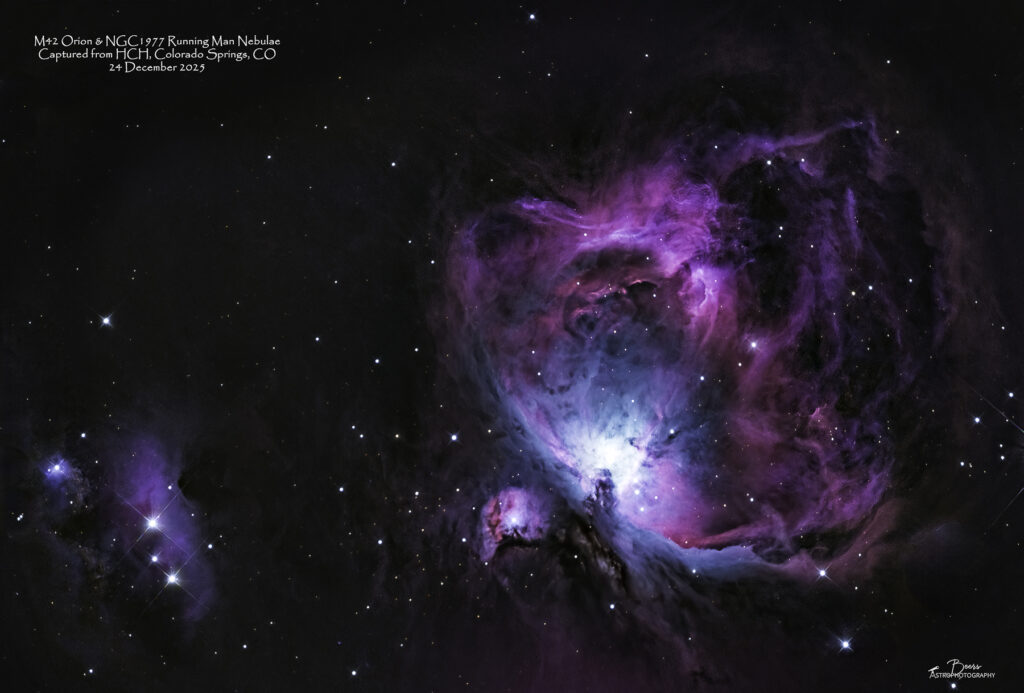
M42 Orion & NGC1975 Running Man Nebula; captured with BB-Mono from HCH Colorado Springs, Colorado on 24Dec2025 and 29-30Jan2026
FUN FACTS
The Orion Nebula (also known as Messier 42, M42, or NGC 1976) is a diffuse nebula in the Milky Way situated south of Orion’s Belt in the constellation of Orion, and is known as the middle “star” in the “sword” of Orion. It is one of the brightest nebulae and is visible to the naked eye in the night sky with an apparent magnitude of 4.0. It is 1,344 ± 20 light-years (412.1 ± 6.1 pc) away[3][6] and is the closest region of massive star formation to Earth. M42 is estimated to be 25 light-years across (so its apparent size from Earth is approximately 1 degree). It has a mass of about 2,000 times that of the Sun. Older texts frequently refer to the Orion Nebula as the Great Nebula in Orion or the Great Orion Nebula.
The Orion Nebula is one of the most scrutinized and photographed objects in the night sky and is among the most intensely studied celestial features. The nebula has revealed much about the process of how stars and planetary systems are formed from collapsing clouds of gas and dust. Astronomers have directly observed protoplanetary disks and brown dwarfs within the nebula, intense and turbulent motions of the gas, and the photo-ionizing effects of massive nearby stars in the nebula.
Physical characteristics: The Orion Nebula is visible with the naked eye even from areas affected by light pollution. It is seen as the middle “star” in the “sword” of Orion, which are the three stars located south of Orion’s Belt. The “star” appears fuzzy to sharp-eyed observers, and the nebulosity is obvious through binoculars or a small telescope. The peak surface brightness of the central region of M42 is about 17 Mag/arcsec2 and the outer bluish glow has a peak surface brightness of 21.3 Mag/arcsec2.
The Orion Nebula contains a very young open cluster, known as the Trapezium Cluster due to the asterism of its primary four stars within a diameter of 1.5 light years. Two of these can be resolved into their component binary systems on nights with good seeing, giving a total of six stars. The stars of the Trapezium Cluster, along with many other stars, are still in their early years. The Trapezium Cluster is a component of the much larger Orion Nebula cluster, an association of about 2,800 stars within a diameter of 20 light years. The Orion Nebula is in turn surrounded by the much larger Orion molecular cloud complex, which is hundreds of light years across, spanning the whole Orion Constellation. Two million years ago the Orion Nebula cluster may have been the home of the runaway stars AE Aurigae, 53 Arietis, and Mu Columbae, which are currently moving away from the nebula at speeds greater than 100 km/s (62 mi/s).
Coloration: Observers have long noted a distinctive greenish tint to the nebula, in addition to regions of red and of blue-violet. The red hue is a result of the Hα recombination line radiation at a wavelength of 656.3 nm. The blue-violet coloration is the reflected radiation from the massive O-class stars at the core of the nebula.
The green hue was a puzzle for astronomers in the early part of the 20th century because none of the known spectral lines at that time could explain it. There was some speculation that the lines were caused by a new element, and the name nebulium was coined for this mysterious material. With better understanding of atomic physics, however, it was later determined that the green spectrum was caused by a low-probability electron transition in doubly ionized oxygen, a so-called “forbidden transition”. This radiation was impossible to reproduce in the laboratory at the time, because it depended on the quiescent and nearly collision-free environment found in the high vacuum of deep space.[12]
Other Catalog Designations: NGC1976, M42, LBN974, Sharpless 281
Subtype: Reflection / Emission
Distance from Earth: 1,344+/- 20 light years
Size: 13 light year radius
Magnitude: -4.1
Constellation: Orion
{Target information derived from: https://en.wikipedia.org/wiki/Orion_Nebula }
EQUIPMENT
Equipment: All equipment controlled by HP Probook (DSO-CTRL1) running Sequence Generator Pro v4.4.1.1441.
- Imaging: (Big Bertha) Orion 8″ f/8 Ritchey-Chretien Astrograph Telescope
- (Mono camera & filter wheel with field flattener) ZWO ASI6200MM Pro Monochrome imaging camera; ZWO – EFW 7×2” Filter Wheel with installed filters (1=SII, 2=Ha, 3=OIII, 4=Lum, 5=Red, 6=Grn, 7=Blue): Svbony SV227 2” Narrow-Band – SII, Ha, OIII; Optolong LRGB Filter Set (2”); Teleskop Service Flattener 1.0x for RC Telescopes (TS-RCFLAT2)
- Mount: Rainbow Astro RST-300 (controlled by iHubo ASCOM driver)
- Polar alignment: QHYCCD camera (controlled by Polemaster for polar alignment)
- Autoguiding: Orion 60mm Multi-Use Guide Scope with Orion StarShoot AutoGuider Pro Mono Astrophotography Camera (controlled by PHD2)
- Auto Focuser: ZWO EAF Electronic Automatic Focuser – Standard (New 5V Version) (EAF-5V-STD)
CAPTURE & PROCESSING NOTES
Capture Notes: During the January mono imaging extravaganza, near the end of the month, when I felt like I’d gathered enough data on IC434 Horsehead Nebula, I decided to go back and collect a bit more on M42 Orion to combine it with the data I’d gathered on Christmas Eve (and produced a passable image). Capture notes from the 24Dec2025 imaging are in the 2025 Journal (not to be repeated here…and foreshadowed the data download issue I experienced with the new ZWO ASI6200MM until 27Jan2026 when ZWO’s Dev Team, Mei, loaded new firmware and new FPGA software into the camera, via a remote connection with TeamViewer.
29Jan2026: Because of the moon reflections in the IC434 images (including a comment by Ann about how Telescopius doesn’t recommend imaging IC434 because it is so close to the moon), I decided to gather more data on M42 Orion. It too, was not recommended by Telescopius – nothing on my target list was! But I felt like I’d gathered enough data on IC434 and was ready to move on (back) to gathering more data on other targets. The data collect went well, except for the AG camera disconnecting and producing extremely traily stars (and attempting to recover) during the period of 23:15MST – 23:54MST. I woke up and checked the laptop at about 23:30 and discovered the issue, stopped the sequence, reconnected the AG camera – that was completely “off” with a warning in PHD2 stating that it had been turned off after not responding after 16seconds. I may need to investigate getting another autoguide camera – since the Orion SSAG Pro is not being very reliable, is not made anymore, and is no longer supported with ASCOM updates.
30Jan2026: When I stacked the M42 data from 29Jan2026, there were no moon reflections, so even though Telescopius discouraged it, I went ahead and decided to gather more data on M42. The skies were clear at the beginning of the night, forecast to cloud up at about 23:00. Jan and Dave came over for dinner, as we were fixing the meal I rudely went outside to get the sequence going. Everything seemed to be going well, then again, as I randomly checked on the progress as I was heading to bed, I discovered that the AG camera had disconnected and the subframes captured between 19:28 – 20:37 were unusable. At that point, I manually stopped, disconnected, and restarted everything. I marked as “BAD” the two subframes that I witnessed, then when I did an image review in Seti Astro, I flagged several other due to star trails from capturing without the AG running.
At 20:57 I accomplished the meridian flip. The clouds were rolling in, but the area around Orion was still clear, so I thought I’d see how much longer I could image. Turned out to be less than 20 minutes! By the time I got cleaned up and was heading to bed, the clouds had fully blanketed the sky, PHD2 was beeping that it had lost its guide star (this time with good reason)… I ended the sequence for the night. I went out to disconnect the cables. I had planned to leave BB outside (covered) for the night to image on Saturday night, which was forecast to be completely clear. But when I stepped outside and felt the cold dampness, I decided against that idea. I disconnected and brought everything in, including BB. Good thing – I woke in the morning to all the trees covered with hoarfrost – beautiful sight, but not the best for AP equipment to be out in!
Processing Notes: In early June, back from my travel to Chile (astrophotography trip) and Australia (work trip) I began collecting data on the front patio on my spring/summer target SH2-129/Ou4. I processed and posted the multi-session image at the end of May. As I was updating my journal, I realized that I had never returned to process the data I’d captured with the mono camera on the front patio in January…so in a cloudy break in the action on SH2-129/Ou4, I went back and processed the CTB1 and M42 data mono data.
I decided that, rather than the “hunt and peck” method I’d been using to this point in combining the individual mono images into a single color image for further processing, I would take the time to run through all the APP RGB Combine algorithms. I wanted to understand what each formula’s result looked like with this combined 24Dec2025, 29&30Jan2026 data. I captured the results in an Appendix to my journal (hopefully, soon to be turned into an instruction/training database for easier reference) and then proceeded with the processing. Although the 24Dec2025 result was vibrant and unique in its coloration – I was really striving for a more “realistic” color palette – which I was able to achieve here with the RGBHOO APP RGB Combine formula!
Sequence plan (Mono Data– 24Dec2025): Gain 100, Offset 50, Temp 0°C. Captured 24Dec 20:37 – 25Dec 03:12MST (6:35 min). Total imaging time: 45x30sec, 141x2min; 304.5min; 5:04.5 hours.
- Red 15x30sec; 24Dec 20:37 – 20:47MST
- Green 15x30sec, 24Dec 20:48 – 20:59MST
- Blue 15x30sec, 24Dec 20:59 – 21:10MST
- Ha 55x2min, 24Dec 21:10 – 23:21MST
- SII 45x2min, 24Dec2025 23:35 – 25Dec2025 01:19MST
- OIII 41x2min, 25Dec 01:19 – 03:12MST
Sequence plan (Mono Data– 29Jan2026): Gain 100, Offset 50, Temp 0°C. Sequence ran: 29Jan2026 18:38MST – 30Jan2026 01:03MST (385min, 6:25hrs). Total data capture time: 63x2min, 45x1min, 33x3min = 270min (4:30hrs). 70% efficiency.
- Ha: 63x2min; 29Jan2026, 18:38MST – 21:03MST (145min elapsed, 126min data: 87% efficiency)
- Meridian flip at 21:03MST, decided to change to Ha 1min subframes to capture some detail in the trapezium area (Meridian flip actions: plate solve, AG, EAF: 21:03 – 21:16 (13min))
- Ha: 45x1min, 29Jan2026, 21:16MST – 22:21MST (65min elapsed, 45min data: 69% efficiency)
- SII: 33x3min; 29Jan2026, 22:25MST – 30Jan26, 01:03 (158min elapsed, 99min data: 63%)
- Capture between 23:11 – 23:41 flagged bad in Seti Astro (and 23:31:48 image I marked bad when I woke up to discover that AG camera had failed.
Sequence plan (Mono Data– 30Jan2026): Gain 100, Offset 50, Temp 0°C. Sequence ran: 30Jan2026 18:26MST – 21:27MST (181min, 3:01hrs). Total data capture time: 47x3min = 141min (2:21hrs). 78% efficiency.
- SII: 47x3min; 30Jan2026 18:26MST – 21:27MST (181min elapsed, 141min data, 78%efficiency).
- Capture between 19:28 – 20:37 flagged bad in Seti Astro and 201218, 201527 images marked bad when discovered that AG camera had failed (66min captured 16x3min (48min data), 73% efficiency)
- Meridian flip between 20:57 and 21:08 (11min lost)
- Overall efficiency of good frames, without time for meridian flip: 100min elapsed, 31x3min data; 93% efficiency.
Total data in image: 715.5 minutes (11:55.5 hrs). {24Dec2025: 45x30sec, 141x2min = 304.5min (5:04.5 hrs); 29Jan2026: 63x2min, 45x1min, 33x3min = 270min (4:30hrs); 30Jan2026: 47x3min = 141min (2:21hrs).}
Shooting location: HCH front patio, Colorado Springs, CO
Processing: Image review with Seti Astro Blink Comparator; Stack with Astro Pixel Processor (APP); Combine mono images using APP RGB Combine Tool; Star removal with Starnet++; Image processing with Photoshop/Lightroom
Previously Captured Images of M42 Orion Nebula
Early BB-mono imaging data collection & processing
EQUIPMENT
Equipment: All equipment controlled by HP Probook (DSO-CTRL1) running Sequence Generator Pro v4.4.1.1441.
- Imaging: (Big Bertha) Orion 8″ f/8 Ritchey-Chretien Astrograph Telescope
- (Mono camera & filter wheel with field flattener) ZWO ASI6200MM Pro Monochrome imaging camera; ZWO – EFW 7×2” Filter Wheel with installed filters (1=SII, 2=Ha, 3=OIII, 4=Lum, 5=Red, 6=Grn, 7=Blue): Svbony SV227 2” Narrow-Band – SII, Ha, OIII; Optolong LRGB Filter Set (2”); Teleskop Service Flattener 1.0x for RC Telescopes (TS-RCFLAT2)
- Mount: Rainbow Astro RST-300 (controlled by iHubo ASCOM driver)
- Polar alignment: QHYCCD camera (controlled by Polemaster for polar alignment)
- Autoguiding: Orion 60mm Multi-Use Guide Scope with Orion StarShoot AutoGuider Pro Mono Astrophotography Camera (controlled by PHD2)
- Auto Focuser: ZWO EAF Electronic Automatic Focuser – Standard (New 5V Version) (EAF-5V-STD)
CAPTURE & PROCESSING NOTES
Capture Notes: After a mostly cloudy month, Mother Nature gave us a Christmas gift of clear skies starting during the week of Christmas. On Sunday, 21 December we were forecast to have clear skies, so I decided I would switch the new ZWO ASI6200MM and filter wheel to Big Bertha to capture some of the winter constellations (e.g., Orion) that are better suited for BB’s field of view than the larger Southern Cross. It took most of the day on Sunday to configure the new equipment on Big Bertha, including a bit of time spent self-doubting that I had the correct back focus from the field flattener. Finally, at the end of the day, I wheeled BB out onto the front patio with her first chance at first light with the mono camera.
I began the night struggling with the electronic auto focuser (EAF) algorithm. I’d become accustomed to the EAF issue with the mono camera on the Southern Cross when I spent a full night (luckily using the Baye-Aire remote control set-up so I wasn’t sitting outside) as I attempted to determine the proper step size and number of steps for the new equipment. After abandoning the EAF to go “old school” focusing with the Bahtinov lens, I discovered that I need not have worried about the field flattener, but instead the number of extension tubes I had attached to Big Bertha. The 5” of extension tubes was at least 1” too much. While I was able to achieve focus with the Bahtinov lens on Rigel, the telescope’s focuser has pressed up against its zero point (i.e., had no more inward travel available). When I discovered this issue (close to midnight on a “school” night) I decided to call it a night. I was going to have to disassemble the camera from the telescope, take off part of the extension tube assembly, reassemble the camera onto the telescope (all while hoping this really was the issue and its solution) – after being outside for a couple hours late on a night that I had to get up to go to work (and of course, swim before that!).
Christmas Eve night was our next clear night. By then, I had verified with my mentors (Ann Chavtur and Nico Carver) that removing an inch of the extension tube would likely solve the problem – and had done the disassembly and reassembly (in the comfort of inside temperatures and the confidence afforded by daylight). I began the evening, as I had on Sunday, with a manual focusing exercise – this time on the star Betelgeuse (which is not quite as bright as Rigel, thus easier to tell if you have it in focus with the Bahtinov lens). I got the rig into near focus manually, then ran the Betelgeuse sequence; allowing me to watch the sequence start-up procedure (that includes two runs of the autofocus routine).
The EAF completed its routine successfully and began collecting 5×15 second subframes on the SII, Ha, and OIII filters. …and gave me “Error capturing frame” messages! (ARGH – it’s always something!!). I chose to ignore the frame capture errors (for now) get the M42 Orion Nebula sequence started (to foreshadow issues to come it turned out, that the “capture errors” were signaling an issue with camera downloads).
I got the sequence started at 20:37, came back out at 23:20 for the meridian flip, and ended the sequence at 03:12 when Orion set below 20°. To further highlight the “capture error” issue I was about to have deal with, when I copied the data off the control laptop, I discovered that during the sequence run time (6:35 hours) I had only gathered approximately 5 hours of data. I reached out to SGP (the control SW developer) – who pointed me to ASCOM (ASCOM (Astronomy Common Object Model) the API, or abstraction layer, that allows different astronomy hardware (mounts, cameras, focusers) to communicate with various software (SGP, PHD2) using a consistent interface, removing device-specific coding and ensuring interoperability, especially on Windows). Both SGP and ASCOM denied any responsibility for the issue I was having and offered “helpful” (NOT) advice like make sure my cables were not frayed (on my brand-new camera that had been used twice??). More on this topic in future entries (specifically 28Dec2025 when I finally discovered/fixed the issue).
Processing Notes: Then came the mono processing challenge… This was my second attempt at mono processing (after SH2-240 Spaghetti Nebula). So, I was still leaning heavily on, asking questions of, and admiring finished products from Ann Chavtur. I had used her recommendations on APP’s RGB Combine Tool and was coming up with an image that was pinker than I wanted. During an email exchange with her after I’d resigned myself to go with the least of the evil pink Orions – she mentioned the value of RGB data because it combines into a “natural” RGB image so easily. I had RGB data that I’d taken to use to produce the star field. Orion is so bright, the stacks that were comprised of 30 second RGB subframes had quite a bit of nebulosity in them… Hmmmm…what if I use the blue and deep reds in the RGB stack in conjunction with my SHO data? Okay, one more combination and then I’ll get to processing!
I started with RGB2 combination – to understand the percentages of each red, green, and blue that are assigned to each R, G, B channel to create a realistic RGB image. (It’s Red: R=100, G=20, B=10; Green: R=20, G=100, B=20; Blue: R=10, G=20, B=100). Then I changed the RGB Combine formula to HaRGB, added my Ha data in with the Red proportions. Then, I changed the formula to RGBHOO, added my SII data (because it’s stronger than the OIII data) in with Blue proportions. Finally, I played around with strength of red and blue predominant channels, made slight tweaks of B, G, R in the other channels and got something that had a modicum of the colors I was hoping to achieve. I saved the RGB-turned HaRGB-turned RGBHOO result and performed a light pollution removal. Within Photoshop I blended the pure RGB with the RGB-turned HaRGB-turned RGBHOO to create the “final” image.
Sequence plan (Mono Data– 24Dec2025): Gain 100, Offset 50, Temp 0°C. Captured 24Dec 20:37 – 25Dec 03:12MST (6:35 min). Total imaging time: 45x30sec, 141x2min; 304.5min; 5:04.5 hours.
- Red 15x30sec; 24Dec 20:37 – 20:47MST
- Green 15x30sec, 24Dec 20:48 – 20:59MST
- Blue 15x30sec, 24Dec 20:59 – 21:10MST
- Ha 55x2min, 24Dec 21:10 – 23:21MST
- SII 45x2min, 24Dec2025 23:35 – 25Dec2025 01:19MST
- OIII 41x2min, 25Dec 01:19 – 03:12MST
Shooting location: HCH front patio, Colorado Springs, CO
Processing: Image review with Seti Astro Blink Comparator; Stack with Astro Pixel Processor (APP); Combine mono images using APP RGB Combine Tool; Star removal with Starnet++; Image processing with Photoshop/Lightroom
Early “career” Dark Skies (still my favorite image of all!)
EQUIPMENT
Imaging Stream: Orion 8″ f/8 Ritchey-Chretien Astrograph Telescope, Canon EOS Ra
Mount: Sky-Watcher EQ6-R Pro Equatorial Mount
Autoguider: Orion 60mm Multi-Use Guide Scope, Orion StarShoot AutoGuider Pro Mono Astrophotography Camera
Equipment controlled by HP Probook running Sequence Generator Pro v3.2.0.660
CAPTURE & PROCESSING NOTES
Sequence plan: ISO1600; 40x180sec + 25x5sec; Total = 2:02 hours
Capture: 29Jan2022, 2250MST – 30Jan2022, 0110MST
Shooting location: Kiowa National Grasslands, New Mexico
Processing: Stacked (3minute and 5 second exposures separately) in Astro Pixel Processor (APP). Processed as layers in Photoshop.
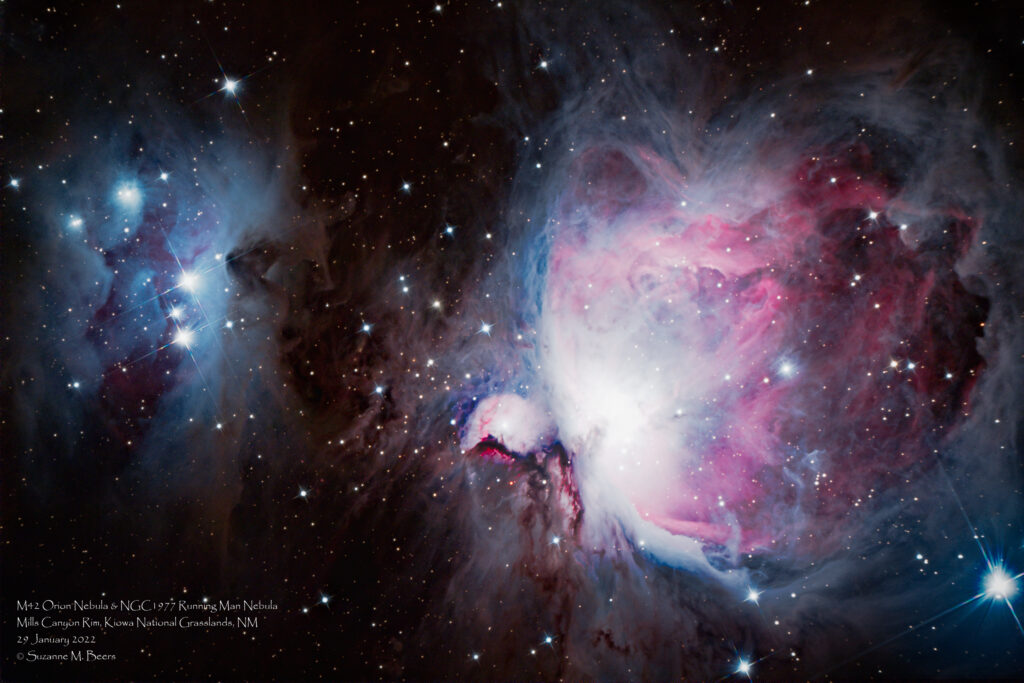
Other random notes: After running a series of “experiments” with various light pollution filters from my (Bortle Class 6) home in Colorado Springs, CO – this image convinced me that dark skies ARE better!
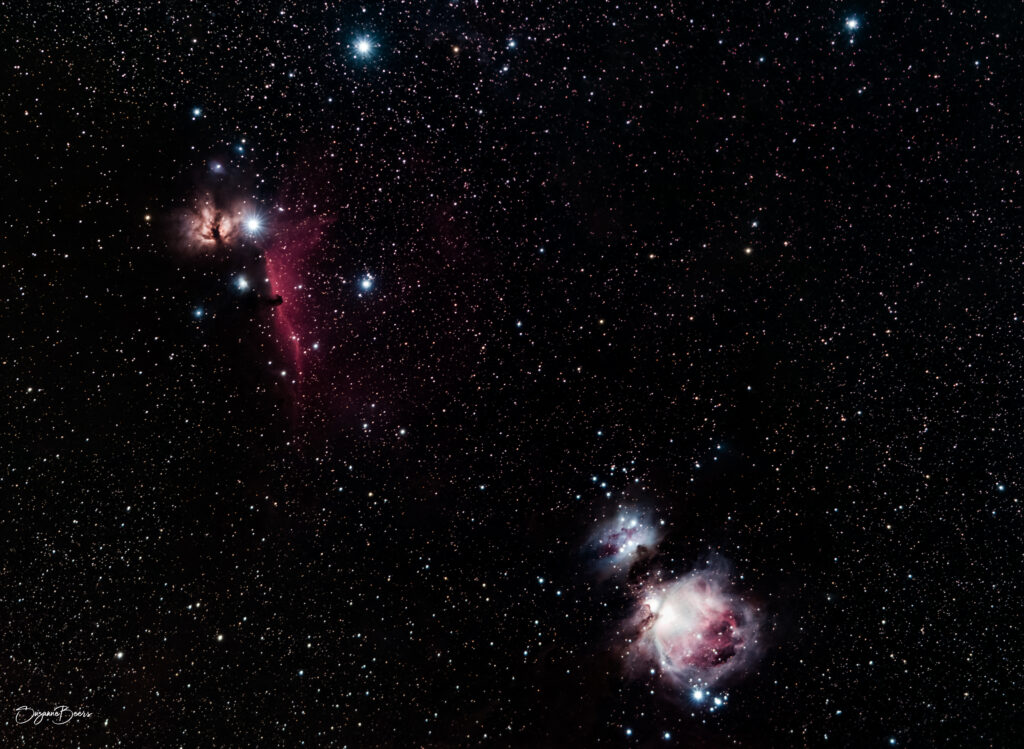
Wide field of view image
This image was captured early in my astrophotography practice – before I mastered the art of using an equatorial mount and telescope for imaging. This image was captured in the dark skies of the Kiowa National Grasslands of NE New Mexico with my Canon EOS 60D astro-modified camera and a 135mm lens. The camera was on a star tracker, controlled with a remote shutter release.
Light Pollution Filter Test
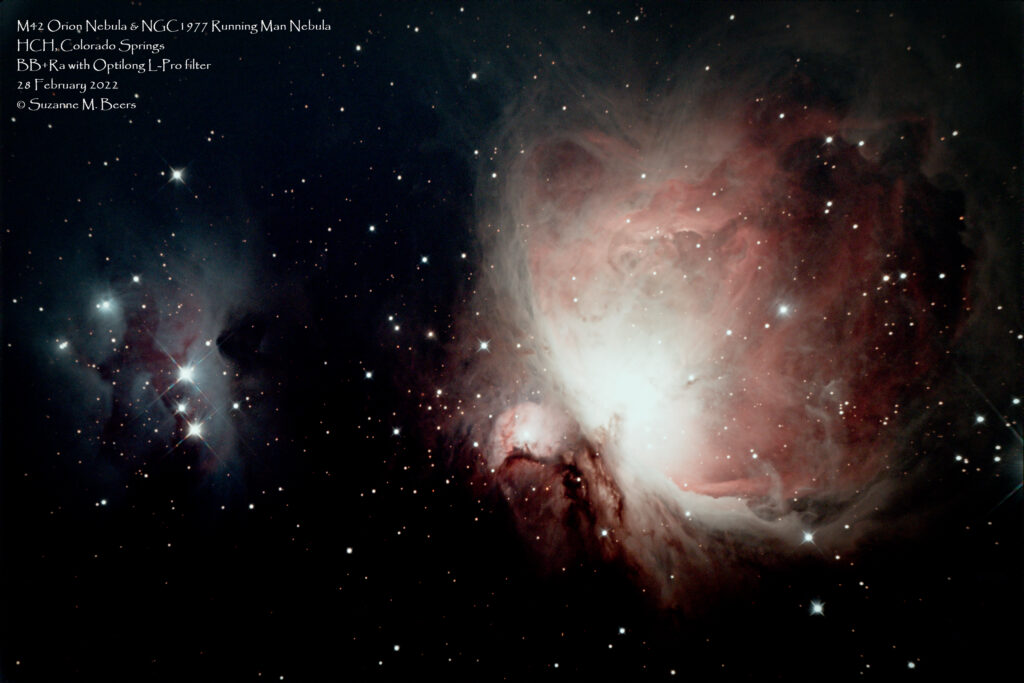
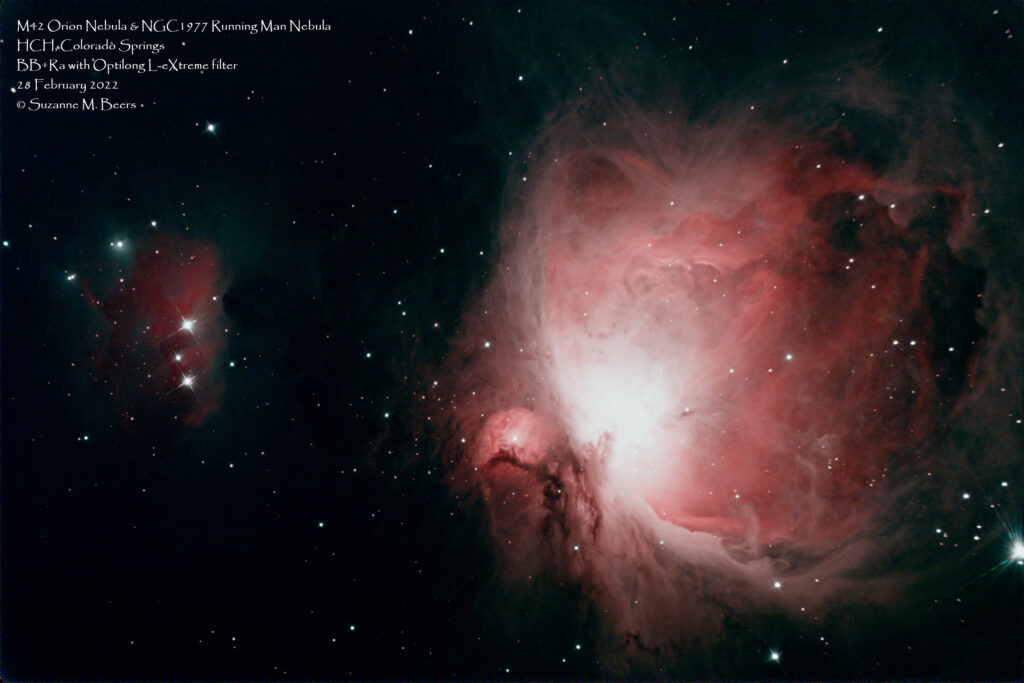
After getting two Optolong light pollution filters, executed a test to evaluate the image quality with each on a “known” object. These two images of M42 Orion were taken from the front patio of my house in Bortle 6 Colorado Springs, Colorado with the Canon EOS Ra camera, 8″ R-C telescope and the Optolong light pollution filter noted in the image caption.