
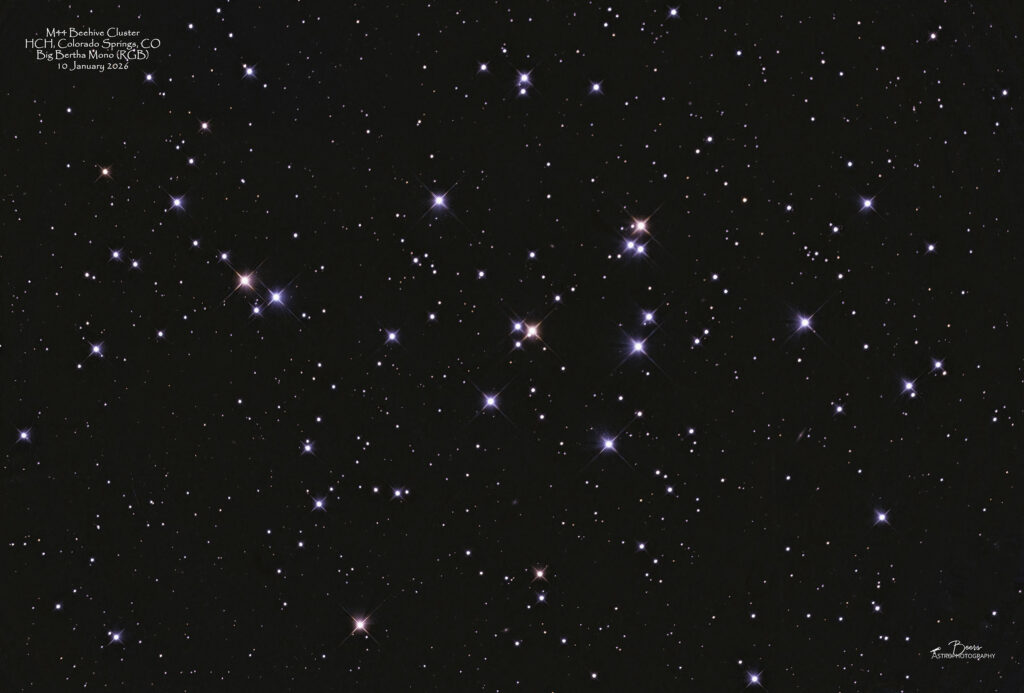
Fun facts
The Beehive Cluster (also known as Praesepe (Latin for “manger”, “cot” or “crib”), M44, NGC 2632, or Cr 189) is an open cluster in the constellation Cancer. One of the nearest open clusters to Earth, it contains a larger population of stars than other nearby bright open clusters holding around 1,000 stars. Under dark skies, the Beehive Cluster looks like a small nebulous object to the naked eye and has been known since ancient times. Classical astronomer Ptolemy described it as a “nebulous mass in the breast of Cancer”. It was among the first objects that Galileo studied with his telescope.
Its age and proper motion coincide with those of the Hyades, suggesting they may share similar origins. Both clusters also contain red giants and white dwarfs, which represent later stages of stellar evolution, along with many main sequence stars.
The distance to M44 is often cited to be between 160 and 187 parsecs (520–610 light years), but the revised Hipparcos parallaxes (2009) for Praesepe members and the latest infrared color-magnitude diagram favors an analogous distance of 182 pc. There are better age estimates of around 600 million years (compared to about 625 million years for the Hyades). The diameter of the bright inner cluster core is about 7.0 parsecs (23 light years).
History
In 1609, Galileo first telescopically observed the Beehive and was able to resolve it into 40 stars. Charles Messier added it to his famous catalog in 1769 after precisely measuring its position in the sky. Along with the Orion Nebula and the Pleiades cluster, Messier’s inclusion of the Beehive has been noted as curious, as most of Messier’s objects were much fainter and more easily confused with comets. Another possibility is that Messier simply wanted to have a larger catalog than his scientific rival Lacaille, whose 1755 catalog contained 42 objects, and so he added some well-known bright objects to boost his list.
Ancient Greeks and Romans saw this object as a manger from which two donkeys, the adjacent stars Asellus Borealis and Asellus Australis, are eating; these are the donkeys that Dionysos and Silenus rode into battle against the Titans.
Morphology and composition
Like many star clusters of all kinds, Praesepe has experienced mass segregation. This means that bright massive stars are concentrated in the cluster’s core, while dimmer and less massive stars populate its halo (sometimes called the corona). The cluster’s core radius is estimated at 3.5 parsecs (11.4 light years); its half-mass radius is about 3.9 parsecs (12.7 light years); and its tidal radius is about 12 parsecs (39 light years). However, the tidal radius also includes many stars that are merely “passing through” and not bona fide cluster members.
Altogether, the cluster contains at least 1000 gravitationally bound stars, for a total mass of about 500–600 Solar masses. A recent survey counts 1010 high-probability members, of which 68% are M dwarfs, 30% are Sun-like stars of spectral classes F, G, and K, and about 2% are bright stars of spectral class A. Also present are five giant stars, four of which have spectral class K0 III and the fifth G0 III.
So far, eleven white dwarfs have been identified, representing the final evolutionary phase of the cluster’s most massive stars, which originally belonged to spectral type B. Brown dwarfs, however, are rare in this cluster, probably because they have been lost by tidal stripping from the halo. A brown dwarf has been found in the eclipsing binary system AD 3116.
The cluster has a visual brightness of magnitude 3.7. Its brightest stars are blue-white and of magnitude 6 to 6.5. 42 Cancri is a confirmed member.
Planets
In September 2012, two planets which orbit separate stars were discovered in the Beehive Cluster. The finding was significant for being the first planets detected orbiting stars like Earth’s Sun that were situated in stellar clusters. Planets had previously been detected in such clusters, but not orbiting stars like the Sun.
The planets have been designated Pr0201 b and Pr0211 b. The ‘b’ at the end of their names indicates that the bodies are planets. The discoveries are what have been termed hot Jupiters, massive gas giants that, unlike the planet Jupiter, orbit very close to their parent stars.
In 2016 additional observations found a second planet in the Pr0211 system, Pr0211 c. This made Pr0211 the first multi-planet system to be discovered in an open cluster.
The Kepler space telescope, in its K2 mission, discovered planets around several more stars in the Beehive Cluster. The stars K2-95, K2-100, K2-101, K2-102, K2-103, and K2-104 host a single planet each, and K2-264 has a two-planet system.
{From: https://en.wikipedia.org/wiki/Beehive_Cluster}
- Other Catalog Designations: Praesepe, M44, NGC 2632, Cr 189
- Subtype: Open star cluster
- Distance from Earth: 610 light years (187 parsecs)
- Apparent magnitude: 3.7
- Radius: 11.42 light years
- Estimated age: ~600-700 million years
- Mass: ~500 – 600 solar masses
- Constellation: Cancer
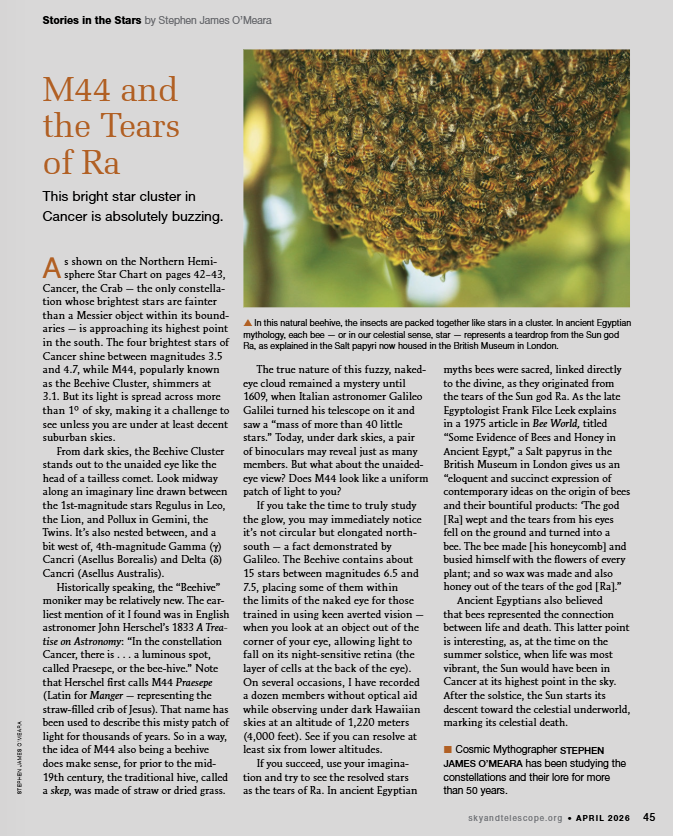
Ironically, to add to the fun facts, the April 2026 version of Sky & Telescope magazine had an article about M44…
Capture & Processing Notes
This was the third object imaged on the night of 10Jan2026, starting it when NGC1579 Northern Trifid set and imaging it until the beginning of astronomical twilight at 06:00MST. Even though I’ve imaged M44 before, and I’m not a huge fan of star clusters, since there are very few targets on my January list that haven’t already set by 03:00 and I didn’t want to waste the rest of the clear night (on a weekend) without imaging anything… Then after reading the “fun facts” – especially the part about the planets within the cluster – I’m glad that I chose to image it again!
Sequence plan (Mono Data– 10Jan2026): Gain 100, Offset 50, Temp 0°C. Plan was: 60x1min RGB, but changed when downloads were taking longer than expected. Captured 10Jan2026 18:21MST – 23:14MST (4:53 hrs). Total imaging time: 142x1min = 181 min; 3:01hrs.
- Red 60x1min, 11Jan2026, 02:33MST – 03:58MST (1:25hr elapsed, 60min data (wEAF likely explaining a ~5min delay 03:30 end – 03:34:48 start))
- Blue 42x1min, 11Jan2026, 04:01MST – 04:48MST (47min elapsed, 42min data)
- Green 43x1min, 11Jan2026, 05:02MST – 06:02MST (60min elapsed, 43min data)
Processing summary:
Image culling with Seti Astro Suite Blink Comparator; captured in SGP; stacked in APP creating individual FITS files for each R-G-B filter; APP combine tool: RGB2; processed with LR/PS
Equipment
Equipment: All equipment controlled by HP Probook (DSO-CTRL1) running Sequence Generator Pro v4.4.1.1441.
- Imaging: (Big Bertha) Orion 8″ f/8 Ritchey-Chretien Astrograph Telescope, (Mono camera & filter wheel with field flattener) ZWO ASI6200MM Pro Monochrome imaging camera; ZWO – EFW 7×2” Filter Wheel with installed filters (1=SII, 2=Ha, 3=OIII, 4=Lum, 5=Red, 6=Grn, 7=Blue): Svbony SV227 2” Narrow-Band – SII, Ha, OIII; Optolong LRGB Filter Set (2”); Teleskop Service Flattener 1.0x for RC Telescopes (TS-RCFLAT2)
- Mount: Rainbow Astro RST-300 (controlled by iHubo ASCOM driver)
- Polar alignment: QHYCCD camera (controlled by Polemaster for polar alignment)
- Autoguiding: Orion 60mm Multi-Use Guide Scope with Orion StarShoot AutoGuider Pro Mono Astrophotography Camera (controlled by PHD2)
- Auto Focuser: ZWO EAF Electronic Automatic Focuser – Standard (New 5V Version) (EAF-5V-STD)
Summary
Captured: 10Jan2026 18:21MST – 23:14MST (4:53 hrs). Total imaging time: 142x1min = 142min (2:22 hrs)
Shooting location: HCH, Colorado Springs, Colorado
Equipment: ZWO ASI6200MM mono camera, R-G-B filters; Big Bertha on Rainbow Astro RST-300
Processing summary: Captured in SGP, stacked in APP, channels combined with APP combine tool, processing with LR/PS