
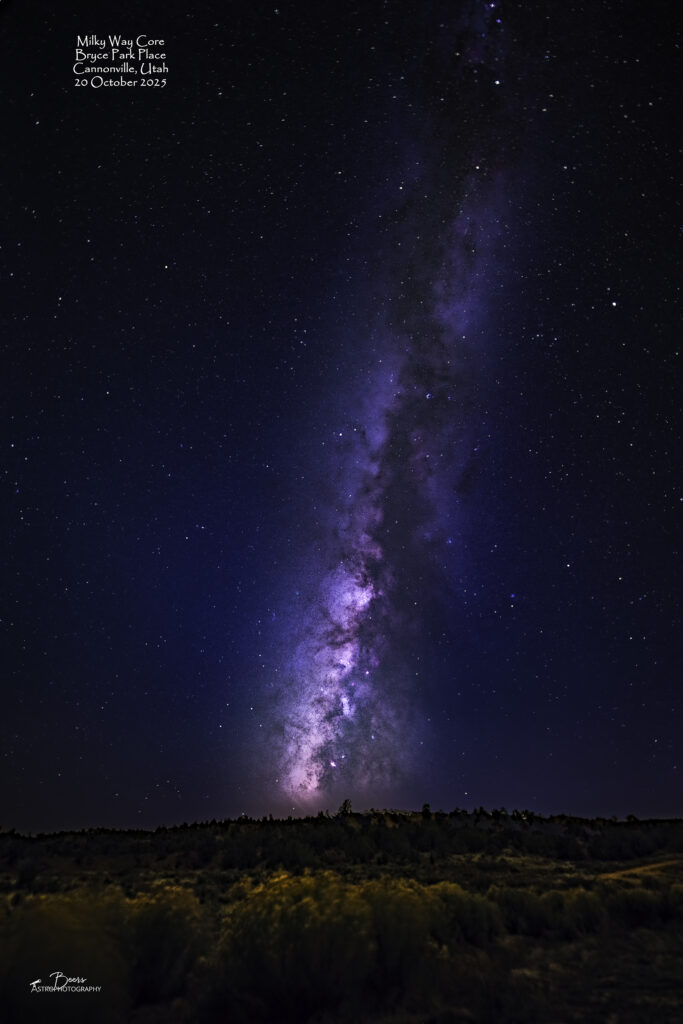
I spent one night during our Bryce Canyon trip imaging the Milky Way, Orionids Meteor shower, and Comet C-2025 Lemmon with the EOS Ra and Sigma 14mm lens on a static tripod, taking 15 second exposures throughout. Attempts at capturing images of both the meteor shower and comet were a bust – but the Milky Way Core image saved the night!
Capture Notes
I spent one night during our Bryce Canyon trip imaging the Milky Way, Orionids Meteor shower, and Comet C-2025 Lemmon with the EOS Ra and Sigma 14mm lens on a static tripod, taking 15 second exposures throughout. I realized as I was closing out my 2025 AP journal, that I’d never processed (or even looked at the images to see if I’d captured anything). So, I spent a bit of time in early January (17Jan2026) looking through and seeing if there was anything worth processing.
Comet C-2025: I set up the camera/tripod on the west side of our Bryce Park Place cabin, pointing toward the west. Captured 102x15sec exposures, 20Oct2025, 19:14MDT – 20:43MDT. After importing the 102 captured images into LR and using the “develop” module as my culling mechanism, there were ZERO images with the comet – but I did discover that is a very active flight path, as there were airplane trails throughout most of the images.
Milky Way Core: After I finished my (unsuccessful) capture of the comet, I moved the camera/tripod to the east side of our cabin, pointing toward the southeast. Captured 128x15sec exposures, 20Oct2025, 20:46MDT – 21:33MDT of the Milky Way Core.
Orionids Meteor Shower: Early the next morning, when the meteor shower was to be at its peak, I set up the camera/tripod on the west side of our Bryce Park Place cabin, pointing toward the southwest. Captured 219x15sec exposures, 21Oct2025, 05:18MDT – 06:35MDT. After importing the 219 captured images into LR and using the “develop” module as my culling mechanism, there were 28 images that had meteors (or in one case the comet!) captured. I stacked those 28 images in Sequator, which eliminated all the meteors to create its single stacked image (of the Milky Way, but not the core). I then attempted to register those images in APP, so I could bring them into PS and stack them – only 21 images would successfully register. When I brought those 21 registered .tiff files into LR, for subsequent movement as layers into PS, they were so dark/dim – that again, the meteors were lost. Integrating the registered frames in APP, again, lost all the meteors. That’s where my patience ran out…I gave up on the idea of processing the meteor shower images (for now…until I have some free time with nothing to do!).
Equipment
Imaging stream: Canon EOS Ra. Sigma 14mm 1:1.8 DG lens, manual focus, f2.0.
Sequence Control: Pixel Pro TW-283 N3 Wireless Shutter Remote Control Timer and Shutter Release
Capture & Processing
Sequence plan: ISO 1600, f2.0, 128 x 15sec. Captured 128x15sec exposures, 20Oct2025, 20:46MDT – 21:33MDT
Capture: 20 October 2025
Shooting location: Bryce Park Place, Cannonville, Utah
Processing: Stacked all the captured images using Sequator. Created a STARLESS version using Starnet++. Processed STARLESS in LR (using AW presets and custom mask actions). Used PS to bring the STARS and STARLESS back together.