
Capture Notes
I imaged the Milky Way on two separate nights during the 2026 Chile AP trip.
First, on the night of 17 March 2026, with Victoria. She was was awed and enthralled with the Milky Way’s (and the Southern Hemisphere’s sky’s) beauty, so was interested in being a part of the capture process. The second was my last night in San Pedro – ironically, just like 2025, I debated with myself about doing DSO imaging on the last night and decided (wisely) to pack up my DSO equipment during the day and spend my last night imaging the Milky Way to facilitate an on-time departure for the Calama airport.
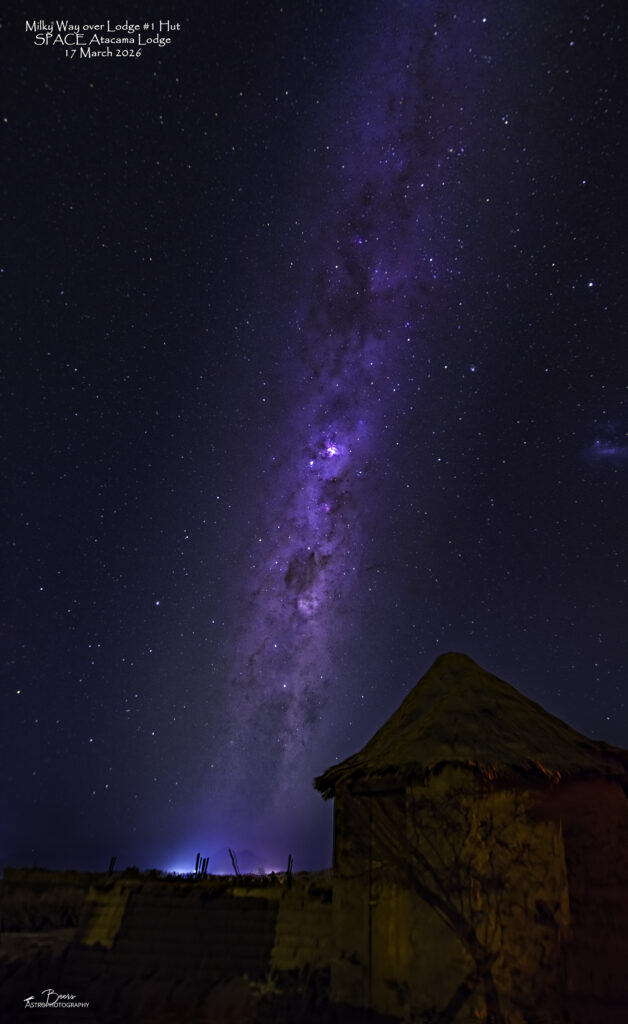
On the evening of 17 March 2026, once I got the Southern Cross going capturing the Southern Cross (yes!), we assembled the Milky Way capture equipment (Canon EOS Ra camera with 14mm lens on a tripod controlled with a hand-held remote). We set up outside our Lodge facing toward the little hut in its backyard with the Milky Way framed vertically to its east. We captured about 100 x 15 second subframes to create the image shown above.
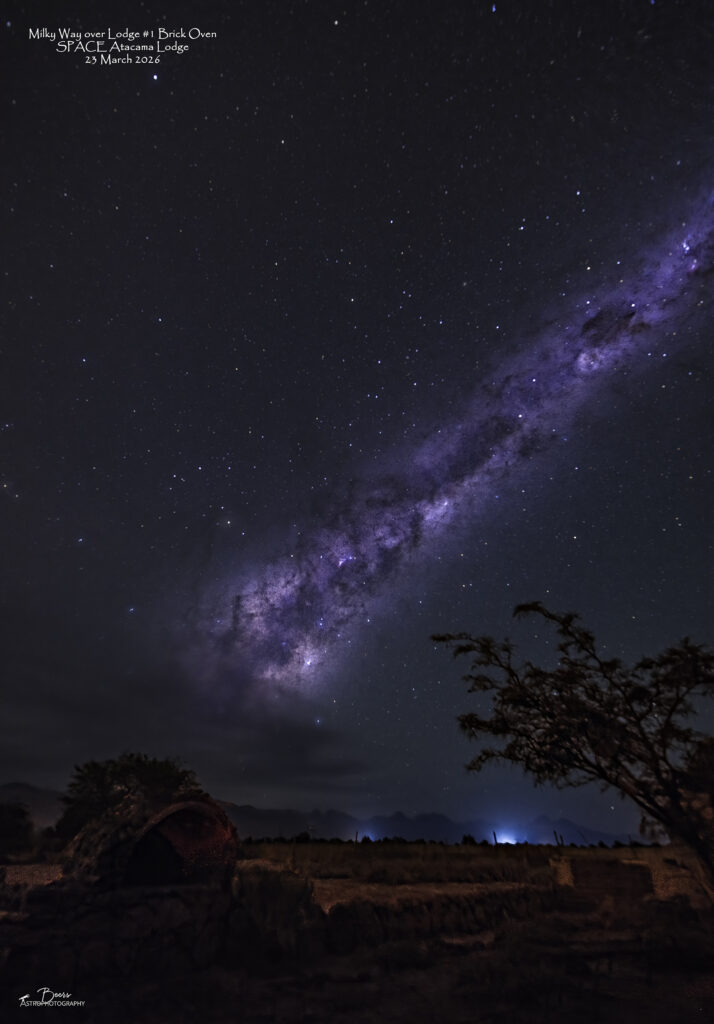
On the last night of the 2026 Chile AP trip, I planned (and took some framing shots during the day) an image of the Milky Way over the brick oven behind Lodge #1 & #2. When I started imaging that framing after dark, with the Milky Way in it, I found it wasn’t what I’d envisioned (using PhotoPills Night AR). So, I only took 3 images and switched to a different framing. After processing the brick oven image, I wished I had taken more subframes! I really like the brick oven as the foreground, so that will be on next year’s capture list!
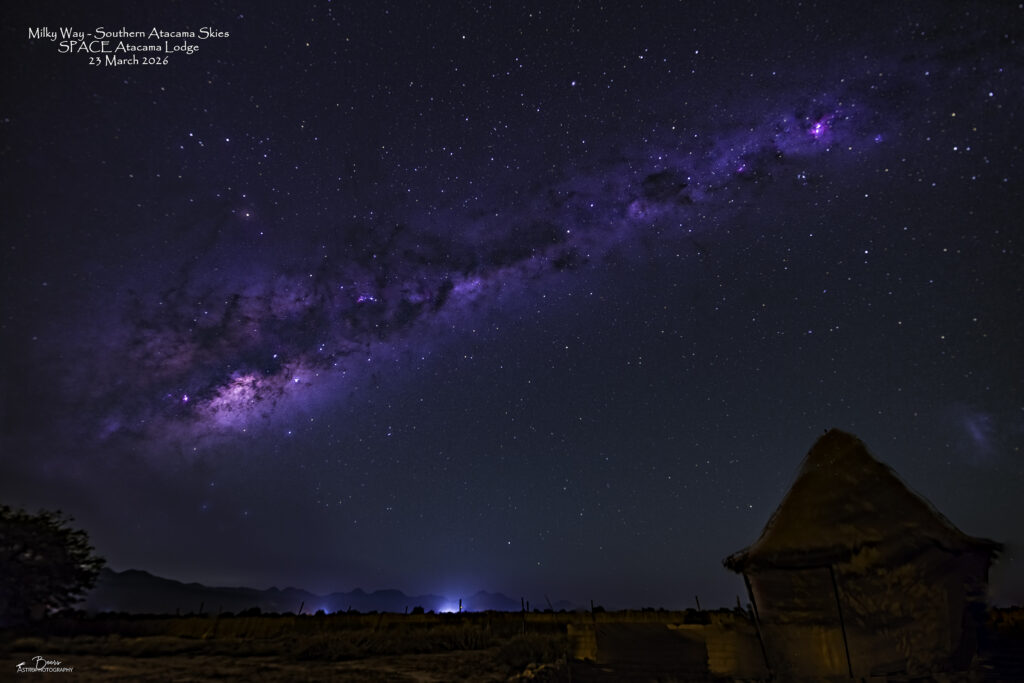
The second framing and the one that I concentrated the night’s efforts on, was similar to my 2024 image looking to the south, with the MW filling the frame horizontally.
Equipment
Imaging stream: Canon EOS Ra mirrrorless camera, Sigma 14mm 1:1.8 DG lens, manual focus, f2.8.
Sequence Control: Pixel Pro TW-283 N3 Wireless Shutter Remote Control Timer and Shutter Release
Capture & Processing
All images, based upon PhotoPills “point stars” advice were: ISO 3200, f/2.8, 15sec exposures.
Sequence plan (17Mar2026): ISO 3200, f2.8, 106 x 15sec. Captured 17Mar2026, 21:40 – 22:23CDT. Total exposure time: 26.5 minutes.
Sequence plan (23Mar2026, Brick Oven foreground): ISO 3200, f2.8, 3 x 15sec. Captured 24Mar2026, 01:46 – 01:47CDT. Total exposure time: 45 seconds.
Sequence plan (23Mar2026, Southern sky view): ISO 3200, f2.8, 157 x 15sec. Captured 24Mar2026, 01:49 – 02:54CDT. Total exposure time: 39.5 minutes.
Processing:
Stacked individual subframes in Sequator (freeze ground (vs. star accumulation), partial sky); star removal in Starnet++; Processed in LR/PS (including Perspective Warp of structures in foreground)
Summary
Capture: Nights of 17Mar2026 and 23Mar2026
Shooting location: San Pedro de Atacama Celestial Explorations (SPACE) Atacama Lodge, Chile
Processing: Stacked using Sequator. Removed stars with Starnet++. Processed in LR/PS.