
Fun facts
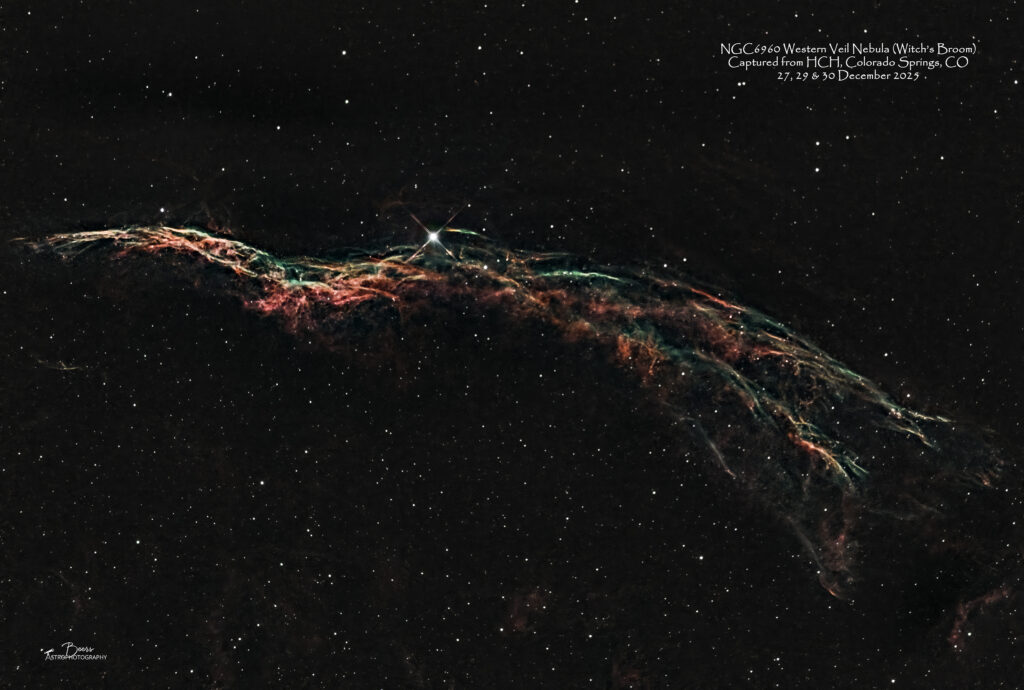
The Veil Nebula is a cloud of heated and ionized gas and dust in the constellation Cygnus. NGC6960, the Western Veil’s Witch’s Broom Nebula spans about 35 light-years. The bright star in the frame is 52 Cygni, visible with the unaided eye from a dark location but unrelated to the ancient supernova remnant.
The full Veil Nebula constitutes the visible portions of the Cygnus Loop, a supernova remnant. The source supernova was a star 20 times more massive than the Sun which exploded between 10,000 and 20,000 years ago. At the time of explosion, the supernova would have appeared brighter than Venus in the sky, and visible in daytime. The remnants have since expanded to cover an area of the sky roughly 3 degrees in diameter (about 6 times the diameter, and 36 times the area, of the full Moon). While previous distance estimates have ranged from 1200 to 5800 light-years, a recent determination of 2400 light-years is based on direct astrometric measurements.
The Hubble Space Telescope captured several images of the nebula. The analysis of the emissions from the nebula indicates the presence of oxygen, sulfur, and hydrogen. The Cygnus Loop is also a strong emitter of radio waves and x-rays.
Components: In modern usage, the names Veil Nebula, Cirrus Nebula, and Filamentary Nebula generally refer to the brightest part of the visible structure of the remnant, or even to the entire loop itself. The structure is so large that several NGC numbers were assigned to various arcs of the nebula. There are three main visual components:
- The Western Veil (also known as Caldwell 34), consisting of NGC 6960 (the “Witch’s Broom”, Lacework Nebula, “Filamentary Nebula”) near the foreground star 52 Cygni
- The Eastern Veil (also known as Caldwell 33), whose brightest area is NGC 6992, trailing off farther south into NGC 6995 (together with NGC 6992 also known as “Network Nebula”) and IC 1340
- Pickering’s Triangle (or Pickering’s Triangular Wisp), brightest at the north central edge of the loop, but visible in photographs continuing toward the central area of the loop.
- NGC 6974 and NGC 6979 are luminous knots in a fainter patch of nebulosity on the northern rim between NGC 6992 and Pickering’s Triangle.
Other Catalog Designations: (Veil Nebula) NGC 6960, 6992, 6995, 6974, and 6979, IC 1340, Cygnus Loop, Cirrus Nebula, Filamentary Nebula, Witch’s Broom Nebula (NGC 6960), Caldwell 33/34
Subtype: Super Nova Remnant (SNR)
Distance from Earth: 2,400 light years
Size: 50-65 light years (radius)
Apparent Size: 3°
Apparent Magnitude: 7.0
Constellation: Cygnus
{Target information derived from: https://en.wikipedia.org/wiki/Veil_Nebula}
Equipment
All equipment controlled by HP Probook (DSO-CTRL1) running Sequence Generator Pro v4.4.1.1441.
- Imaging: (Big Bertha) Orion 8″ f/8 Ritchey-Chretien Astrograph Telescope, (Mono camera & filter wheel with field flattener) ZWO ASI6200MM Pro Monochrome imaging camera; ZWO – EFW 7×2” Filter Wheel with installed filters (1=SII, 2=Ha, 3=OIII, 4=Lum, 5=Red, 6=Grn, 7=Blue): Svbony SV227 2” Narrow-Band – SII, Ha, OIII; Optolong LRGB Filter Set (2”); Teleskop Service Flattener 1.0x for RC Telescopes (TS-RCFLAT2)
- Mount: Rainbow Astro RST-300 (controlled by iHubo ASCOM driver)
- Polar alignment: QHYCCD camera (controlled by Polemaster for polar alignment)
- Autoguiding: Orion 60mm Multi-Use Guide Scope with Orion StarShoot AutoGuider Pro Mono Astrophotography Camera (controlled by PHD2)
- Auto Focuser: ZWO EAF Electronic Automatic Focuser – Standard (New 5V Version) (EAF-5V-STD)
Capture & processing notes
Each night during the Christmas 2025 mono camera imaging extravaganza, while I waited for the “main” target to rise (on most nights that was the NGC2264 Cone Nebula), I grabbed a bit of data on the NGC6960 Western Veil (Witch’s Broom) Nebula. NGC6960 had visibility at astronomical twilight and beyond and set just as the main targets were rising at about 19:00MST. The data collection each of those nights suffered from the same data download and focusing issues I’d been dealing with throughout the period, described below. The processing of mono images comes with a brand new set of challenges. Thanks to Ann Chavtur’s mentoring along the way – by the time I got to this image, my third in the extravaganza’s playlist, I was starting to develop a somewhat repeatable workflow.
The focus issue was two-fold: 1) learning the correct exposure length for the focus frames with the narrowband filters (turned out to be 20 seconds – probably could be longer, since I’m still not getting SGP to recognize all stars that I know are in the frame – but I don’t have the patience to increase it any more); and 2) learning how to get the EAF algorithm to stop failing with its requirement for a 90% curve fit to the focus points. That curve fit was making most of the EAF runs failing – which was fine for when I was sitting watching and could tell it to go on with the next step. But completely impractical for hourly or at filter change EAF runs. After putting in a Help Ticket to SGP on 30Nov2025, which two users responded too saying they were giving up on SGP and/or their EAF because of the same issue, Ken finally responded with a “fix” (workaround for now – there will be a place to input the parameter in v4.5…
“It’s not in the UI, but you can override what you consider to be a good (minimum) fit.
- In v4.4:
- Expand the equipment area in the sequencing form
- At the bottom, in the Variables field add quadratic_fit_min_quality=0.7 or whatever you want (that example allows a min fit of 70%)
- In v4.5
- Open the Control PanelOn the left scroll down to Variables
- Enter quadratic_fit_min_quality=0.7 in the text area on its own line”
The data collection issue bounced back and forth between SGP and ASCOM – each blaming the other (or my frayed cables). Until, on Saturday night (27Dec2025 – while I was experiencing the download issue in spades) it dawned on me that perhaps all this was being caused by a camera firmware issue. As silly as that sounds – I’ve had several other brand-new pieces of equipment arrive in immediate need of a firmware update! So, after spending the time to document the issue (identifying the number of hours spent vs. the number of hours of data gathered) and putting in a Help Ticket to SGP, I checked the ZWO website. They have a firmware updater – but it comes with a bold warning “Do not use this if you are not having problems.” The warning went on to say “if you think you need to update your firmware, email us to get the latest version for your equipment.” So, I downloaded the firmware (as well as updated native and ASCOM camera drivers that were available) while I was on their website. I sent an email describing the issue I was having (as directed) …and then unzipped the firmware updater package. As I was reading the “readme.txt” (I am a rule-follower AND an instruction reader!) I discovered it was meant for their autofocuser (EAF) and filter wheel (EFW), not their cameras. Since I’m not having “firmware driven” issues with either the EAF or the EFW, I decided to just load the updated camera drivers and hold off until I heard back from them on my firmware theory.
I imaged on Sunday night (28Dec2025) with the updated camera drivers in place – and it seems to have solved the problem! Instead of “download a 5-min exposure, wait 5-minutes then begin the next exposure” the only pauses during the sequence run on 28Dec2025 was for the EAF routine or the meridian flip!!
The processing is starting to come together (the Witch’s Broom image took me about 3 hours from start to finish to process; compared to the Spaghetti Nebula that took the waking hours of 2-3 days and the Orion Nebula that took one full day)…with a melded old-new tools workflow that I never could have come up to without Ann’s help! She turned me on to Seti Astro, which I am now using to do the image review and culling of the images before I stack them. She also reminded me of the APP RGB Combine Tool and gave me tips on the combinations and slider values she’s been using in her processing.
To summarize my mono image workflow:
- Review and cull images using Seti Astro’s Blink Comparator (visually and then using their star metrics)
- Stack the good images using APP (Ann also let me in on the secret that APP is smart enough to separate the files, by filter, using the header data in the .FITS files – saving me the time and effort I’d been spending on doing that by hand)
- Use APP’s RGB Combine Tool to create a color image
- Remove stars from the combines images using Starnet++
- Take the STARLESS and Nebula+Stars images into Lightroom and Photoshop and process as normal
Sequence Plans
Sequence plan (Mono Data– 27Dec2025): Gain 100, Offset 50, Temp 0°C. Captured 25x2min; 27Dec 18:18 – 19:24MST (54min). Total imaging time: 25x2min; 50 minutes.
- Ha 10x2min, 27Dec 18:18 – 18:40MST
- SII 10x2min, 27Dec 18:40 – 19:07MST
- OIII 5x2min, 27Dec 19:07 – 19:24MST
Sequence plan (Mono Data– 29Dec2025): Gain 100, Offset 50, Temp 0°C. Captured 13x2min; 29Dec 18:40 – 19:16MST (36min). Total imaging time: 13x2min; 26 minutes.
- OIII 10x2min, 29Dec 18:40 – 19:03MST
- SII 3x2min, 29Dec 19:09 – 19:16MST
Sequence plan (Mono Data– 30Dec2025): Gain 100, Offset 50, Temp 0°C. Captured 20x2min; 30Dec 18:19 – 19:12MST (53min). Total imaging time: 20x2min; 40 minutes.
- Ha 10x2min, 30Dec 18:19 – 19:42MST
- SII 10x2min, 30Dec 18:48 – 19:12MST
Summary
Data capture: Total over three nights (27, 29, and 30 December 2025): Total imaging time: 58x2min, 1:56 hours spread across Ha, SII, and OIII filters.
Sequence plan (Mono Data– 27Dec2025): Gain 100, Offset 50, Temp 0°C. Captured 25x2min; 27Dec 18:18 – 19:24MST (54min).
Sequence plan (Mono Data– 29Dec2025): Gain 100, Offset 50, Temp 0°C. Captured 13x2min; 29Dec 18:40 – 19:16MST (36min). Total imaging time: 13x2min; 26 minutes.
Sequence plan (Mono Data– 30Dec2025): Gain 100, Offset 50, Temp 0°C. Captured 20x2min; 30Dec 18:19 – 19:12MST (53min). Total imaging time: 20x2min; 40 minutes.
Shooting location: HCH front patio, Colorado Springs, Colorado
Processing: Capture with SGP. Review/cull subframes with Seti Astro’s Blink Comparator. Stack with APP. Combine mono images into RGB/HSO with APP’s RGB Combine. Star removal with Starnet++. Process in PS/LR.
Other images of NGC6960 Western Veil (Witch’s Broom) Nebula
Equipment
All equipment controlled by HP Probook running Sequence Generator Pro v3.2.0.660.
Polar alignment: QHYCCD camera (controlled by Polemaster)
Imaging stream: Orion 10″ f/8 Ritchey-Chretien Astrograph Telescope; Canon EOS Ra with with Teleskop Service Flattener 1.0x for RC Telescopes (TS-RCFLAT2) and Optilong L-Pro light pollution filter
Mount: Sky-Watcher EQ6-R Pro Equatorial Mount (controlled by EQMOD)
Autoguider: Orion 60mm Multi-Use Guide Scope, Orion StarShoot AutoGuider Pro Mono Astrophotography Camera (controlled by PHD2)
Capture & processing notes
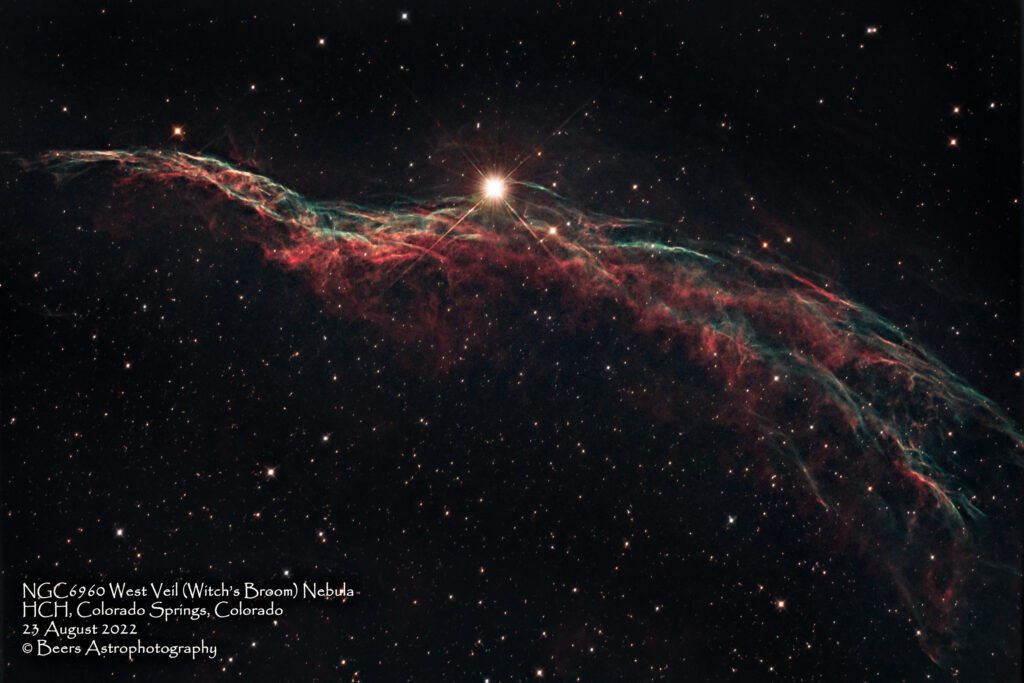
Sequence plan: ISO1600; 68x300sec; captured 23Aug 21:24MDT – 24Aug 03:45MDT. Total exposure time: 5:40 hrs.
Capture: 23 August 2022
Shooting location: Colorado Springs, Colorado
Processing: Stacked in APP using 99% of subframes, processed in LR/PS.