
Fun facts
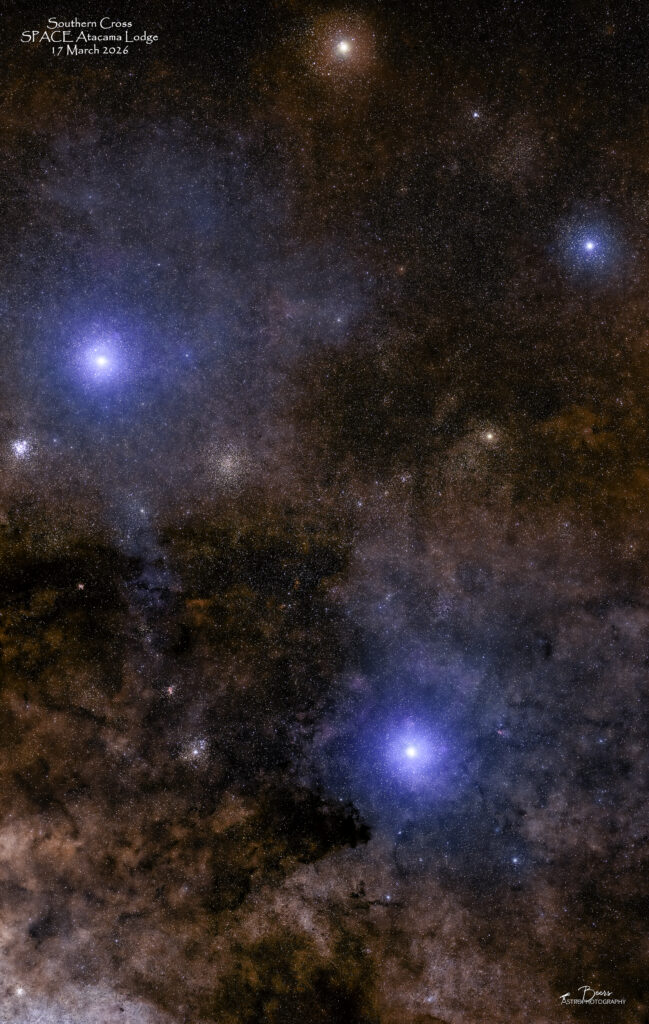
Crux (/krʌks/ KRUKS) is a constellation of the southern sky that is centered on four bright stars in a cross-shaped asterism commonly known as the Southern Cross. It lies on the southern end of the Milky Way’s visible band. The name Crux is Latin for cross. Though it is the smallest of all 88 modern constellations, Crux is among the most easily distinguished, as each of its four main stars has an apparent visual magnitude brighter than +2.8. It has attained a high level of cultural significance in many Southern Hemisphere states and nations.
Key Coordinates
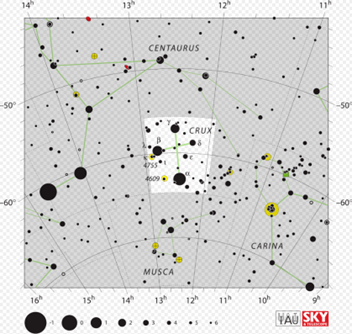
- Right Ascension (RA): 11h 56m to 12h 57m.
- Declination (Dec): -55.7° to -64.7°.
- Central Coordinate: ~12h 30m RA / -60° Dec.
Key Stars within Crux
- Acrux (Alpha Crucis): Brightest star, ~12h 26m, -63° 05′.
- Mimosa (Beta Crucis): Second brightest, ~12h 47m, -59° 41′.
- Gacrux (Gamma Crucis): Third brightest, ~12h 31m, -57° 06′.
- Imai (Delta Crucis): ~12h 15m, -58° 44′.
- Ginan (Epsilon Crucis): ~12h 21m, -60° 24′.
Blue-white α Crucis (Acrux) is the most southerly member of the constellation, and at magnitude 0.8, the brightest. The three other stars of the cross appear clockwise and in order of lessening magnitude: β Crucis (Mimosa), γ Crucis (Gacrux), and δ Crucis (Imai). ε Crucis (Ginan) also lies within the cross asterism. Many of these brighter stars are members of the Scorpius–Centaurus association, a large but loose group of hot, blue-white stars that appear to share common origins and motion across the southern Milky Way.
Crux contains four Cepheid variables, each visible to the naked eye under optimum conditions. Crux also contains the bright and colorful open cluster known as the Jewel Box (NGC 4755) on its eastern border. Nearby to the southeast is a large dark nebula spanning 7° by 5° known as the Coalsack Nebula, portions of which are mapped in the neighboring constellations of Centaurus and Musca.
Characteristics: Crux is bordered by the constellations Centaurus (which surrounds it on three sides) on the east, north, and west, and Musca to the south. Covering 68 square degrees and 0.165% of the night sky, it is the smallest of the 88 constellations. The three-letter abbreviation for the constellation, as adopted by the International Astronomical Union in 1922, is “Cru”. The official constellation boundaries, as set by Belgian astronomer Eugène Delporte in 1930, are defined by a polygon of four segments. In the equatorial coordinate system, the right ascension coordinates of these borders lie between 11h 56.13m and 12h 57.45m, while the declination coordinates are between −55.68° and −64.70°.[39] Its totality figures at least part of the year south of the 25th parallel north.
In tropical regions, Crux can be seen in the sky from April to June. Crux is exactly opposite to Cassiopeia on the celestial sphere, so it cannot appear in the sky with the latter at the same time. In this era, south of Cape Town, Adelaide, and Buenos Aires (the 34th parallel south), Crux is circumpolar, thus always appears in the sky.
Crux is sometimes confused with the nearby False Cross asterism by stargazers. The False Cross consists of stars in Carina and Vela, is larger and dimmer, does not have a fifth star, and lacks the two prominent nearby “Pointer Stars”. Between the two is the even larger and dimmer Diamond Cross.
Visibility: Crux is easily visible from the Southern Hemisphere, south of 35th parallel at practically any time of year as circumpolar. It is also visible near the horizon from tropical latitudes of the Northern Hemisphere for a few hours every night during the northern winter and spring. For instance, it is visible from Cancún or any other place at latitude 25° N or less at around 10 pm at the end of April. There are 5 main stars. Due to precession, Crux will move closer to the South Pole in the next few millennia, up to 67° south declination for the middle of the constellation. However, by the year 14,000, Crux will be visible for most parts of Europe and the continental United States. Its visibility will extend to Northern Europe by 18,000, when it will be less than 30° south declination.
Use in navigation: In the Southern Hemisphere, the Southern Cross is frequently used for navigation in much the same way that Polaris is used in the Northern Hemisphere. Projecting a line from γ to α Crucis (the foot of the crucifix) about 4+1⁄2 times beyond gives a point close to the Southern Celestial Pole which is also, coincidentally, where it intersects a perpendicular line taken southwards from the east–west axis of Alpha Centauri to Beta Centauri, which are stars at an alike declination to Crux and of a similar width as the cross, but higher magnitude. Argentine gauchos are documented as using Crux for night orientation in the Pampas and Patagonia.
Alpha and Beta Centauri are of similar declinations (thus distance from the pole) and are often referred as the “Southern Pointers” or just “the Pointers”, allowing people to easily identify the Southern Cross, the constellation of Crux. Very few bright stars lie between Crux and the pole itself, although the constellation Musca is fairly easily recognized immediately south of Crux.
The four main stars that form the asterism are Alpha, Beta, Gamma, and Delta Crucis.
- α Crucis or Acrux is a triple star 321 light-years from Earth. A rich blue in colour, with a visual magnitude 0.8 to the unaided eye, it has two close components of a similar magnitude, 1.3 and 1.8, respectively, plus another much wider component of the fifth magnitude. The two close components are resolved in a small amateur telescope and the wide component is readily visible in a pair of binoculars.
- β Crucis or Mimosa is a blue-hued giant star of magnitude 1.3, and lies 353 light-years from Earth. It is a Beta Cephei-type variable star with a variation of less than 0.1 magnitudes.
- γ Crucis or Gacrux is an optical double star. The primary is a red-hued giant star of magnitude 1.6, 88 light-years from Earth, and is one of the closest red giants to Earth. Its secondary component is magnitude 6.5, 264 light-years from Earth.
- δ Crucis (Imai) is a magnitude 2.8, blue-white hued star about 345 light-years from Earth.[4] Like Mimosa, it is a Beta Cepheid variable.
Also, a fifth star is often included with the Southern Cross.
- ε Crucis (Ginan) is an orange-hued giant star of magnitude 3.6, 228 light-years from Earth.
{From: https://en.wikipedia.org/wiki/Crux}
Capture & Processing Notes
The back story… This target was a “last minute” add to my target list, on-site, motivated by a couple of friend’s comments. First, Pat Swanson had commented before I left about having seen the Southern Cross and being completely mesmerized by it (hoping to be able to see it again at some point – Pat this is for you!). Second, while Victoria and I were out together early in the trip, she was equally mesmerized by the Southern Cross. The next morning we had a discussion about the Cross-Stills-Nash vs. the Jimmy Buffet version of the song and (at least I) learned a bit about the meaning of the song {From: https://americansongwriter.com/meaning-behind-southern-cross-lyrics-by-crosby-stills-nash/}
“Southern Cross” by Crosby, Stills & Nash is a 1982 rock song about using a long sailing voyage across the South Pacific to heal from a painful divorce, finding solace in nature and perspective on lost love.
The lyrics blend nautical adventure with the metaphor of the Crux constellation (Southern Cross) as a guiding light to navigate emotional darkness, signaling a quest for peace and new beginnings.”
The capture story… I planned to image a 4-tile mosaic (at 90° camera angle) throughout the night, spending ~2.25hours on each tile (equating to 45x3min exposures). The start-up went well – the polar alignment was accomplished from 20:32 – 20:39. At 20:45, started the sequence with SGP running through its standard: EAF#1 (5924 to 6172), plate solve (1.88° delta from 90°, 884 px error, resolved on second attempt, PHD2 autoguider calibration (5.27 HFD, 129.5 SNR), and EAF#2 (6172 to 6150). Tile#1, Event1/Frame1 started at 20:54.
The Tile#1 to Tile#2 was scheduled to occur at 23:06, so I came out at 23:15 to supervise it (even though the tile switch has never posed a problem for SGP operations). At 23:15 Tile#1 was capturing frame #42/45, so I changed the number of subframes to 42, so I wouldn’t have to sit and watch the remaining three being captured. The tile switch went flawlessly: mount moved to new position, plate solved, AG calibration, EAF (6089 to 6073).
Tile#2 E1/F1 started at 23:20. Satisfied that I didn’t need to come back out again to supervise the tile swap, I came out at 02:35 to conduct the meridian flip. To my dismay, the mount was parked. The sequence had aborted with the last frame being captured at 00:42-00:45. I’d just lost two hours of data collection time. As I was disconnecting the equipment and getting ready to do the meridian flip (shutting down PHD2), I noticed the error in the banner at the top of the PHD2 screen: “ASCOM Camera2_2 (AG camera ASCOM driver) had disconnected.”
At 02:44, I restarted the sequence from a cold equipment start (did not reboot the laptop – but disconnected and reconnected all the equipment from SGP, recycled the power on the mount, and disconnected/reconnected the ASI120MM autoguide camera cable. The sequence restart went as planned: Plate solve (1.99° delta (from 270° didn’t notice that at the time??), autoguider calibration, EAF (6055 to 5963). The sequence started with Tile#3 E1/F1 at 02:50CDT.
At 05:03 I came outside to supervise the Tile#3-Tile#4 switch. (I had come out at 04:30 and it was on 32/40 – since the #1 and #4 tiles were those below the Southern Cross with the Coalsack Nebula, I decided to let Tile#3 run to fruition and cheat Tile#4). Again, the tile swap went fine: plate solve (1.74° delta from 270°??), EAF (5954 to 5966).
Tile #4 E1/F1 started at 05:09CDT and ran successfully until I ended the sequence at the middle of astronomical twilight at 06:42CDT.
I submitted a “Help Ticket” to the PHD2 and SGP Forums. PHD2 Guiding Forum’s Bruce Waddington was very helpful throughout the next couple of days in giving me advice (e.g., WHY are you doing all those re-calibrations and wasting good imaging time?); ultimately pointing to a cable disconnect issue that likely caused the problem. Throughout the trip, I ensured I checked the cable connection to the guiding camera for a secure connection (and may buy a better cable than was provided by ZWO for the future).
Sequence plan: Original plan was: Gain 158, Offset 30, Temp 0°C; 4tiles x 45x3min exposures. Due to the AG camera disconnect issue and slight delays caused by EAF, drizzle, etc. the actual collection ended up being:
- Tile#1: 42x3min; captured 17Mar2026, 20:54CDT – 23:14CDT
- Tile#2: 26x3min; captured 17Mar2026, 23:19CDT – 18Mar2026, 00:45CDT (when sequence aborted)
- Tile#3: 40x3min; captured 18Mar2026, 02:50CDT – 05:04CDT
- Tile#4: 28x3min; captured 18Mar2026, 05:09CDT – 06:42CDT (astronomical twilight)
Processing summary: Captured in SGP, stacked individual tile and mosacked in APP (Adaptive Airy), star removal with Starnet++, processing with LR/PS
Equipment
Equipment: All equipment controlled by HP Probook running Sequence Generator Pro v4.4.0.1441.
- Imaging (ASI2400-SC420): ZWO ASI2400MC imaging camera; (Southern Cross-420mm) Askar FRA600 108mm; f/5.6 Quintuplet Petzval Flat-Field Astrograph with Askar 0.7x reducer for FRA600
- Mount: Rainbow Astro RST-135E (controlled by iHubo ASCOM driver)
- Polar alignment: QHYCCD camera (controlled by Polemaster for polar alignment)
- Autoguiding: Orion 60mm Multi-Use Guide Scope with ZWO ASI120MM mini mono camera (controlled by PHD2)
- Autofocuser: ZWO EAF Electronic Automatic Focuser (EAF-5V-STD)
Summary
Captured: Four tile mosaic, 17Mar2026, 20:54CDT – 18Mar2026, 06:42. Tile#1: 42x3min, 126min (2:06hrs); Tile#2: 26x3min, 78min (1:18hrs); Tile#3: 40x3min, 120min (2:00hrs); Tile#4: 28x3min, 84min (1:24hrs). Total: 136x3min, 408min (6:48hrs).
Shooting location: SPACE Atacama Lodge, San Pedro de Atacama, Chile
Equipment: ZWO ASI2400MC imaging camera; (Southern Cross-420mm) Askar FRA600 108mm; f/5.6 Quintuplet Petzval Flat-Field Astrograph with Askar 0.7x reducer for FRA600 on Rainbow Astro RST-135E mount
Processing summary: Captured in SGP, stacked individual tiles and mosacked in APP (Adaptive Airy), star removal with Starnet++, processing with LR/PS