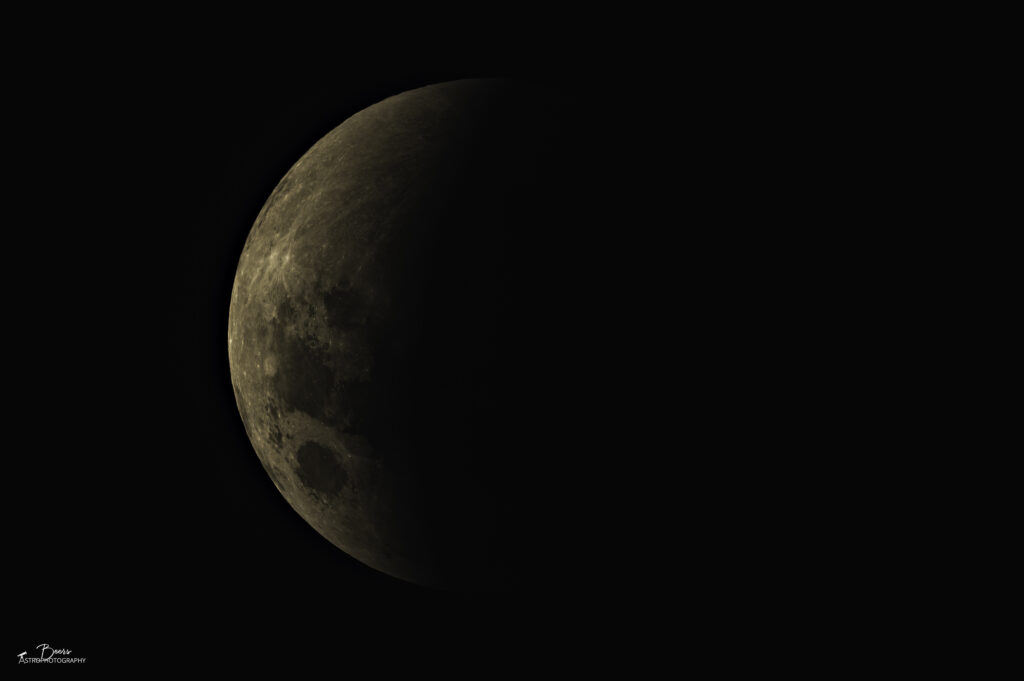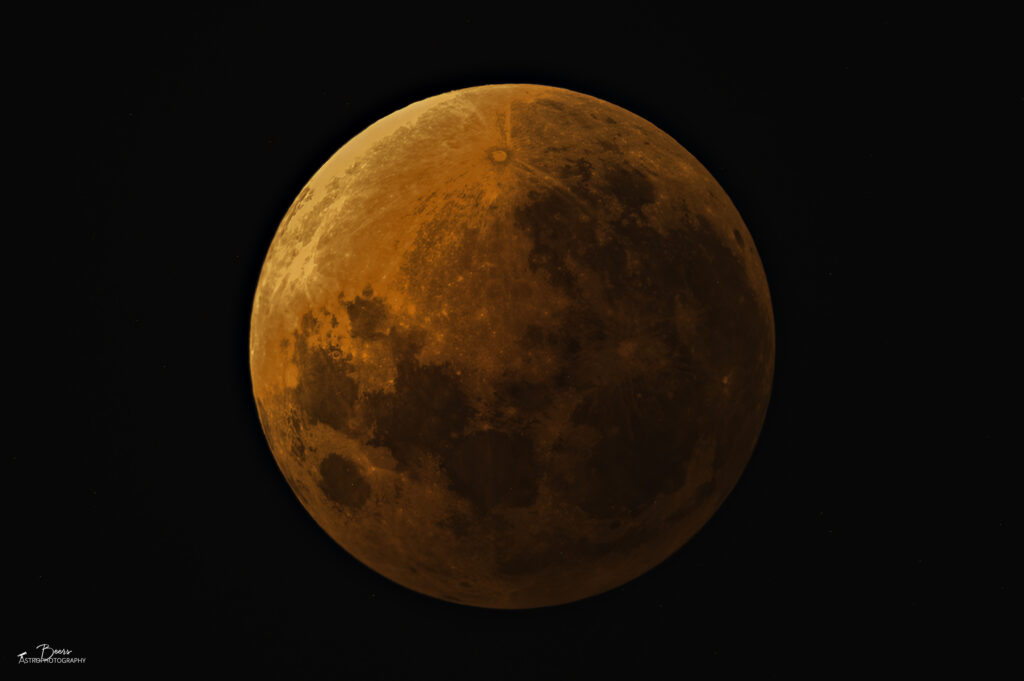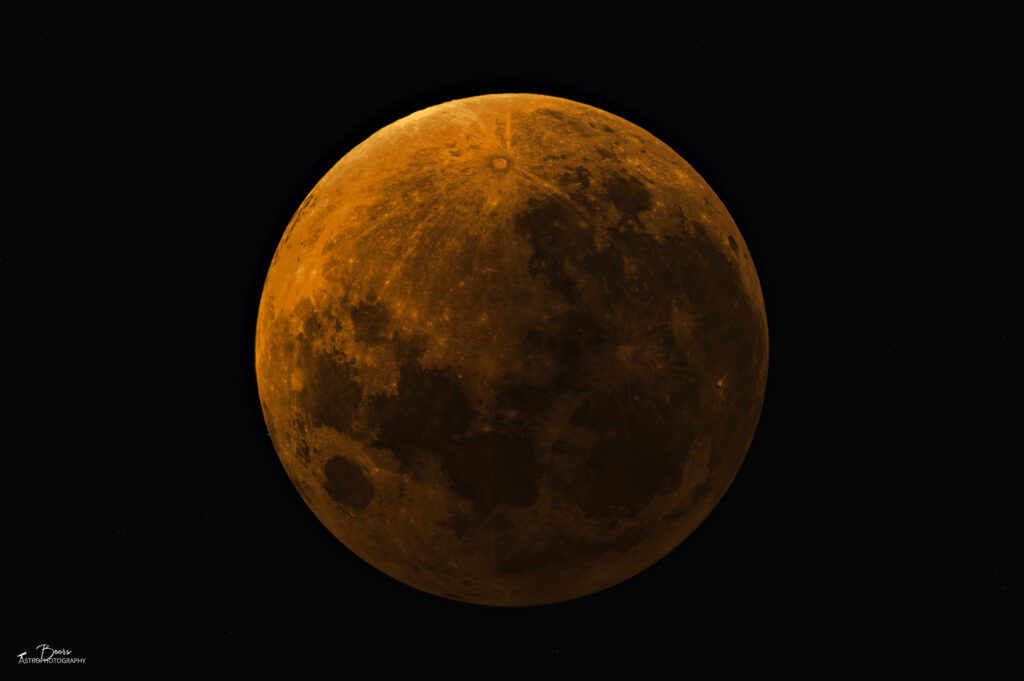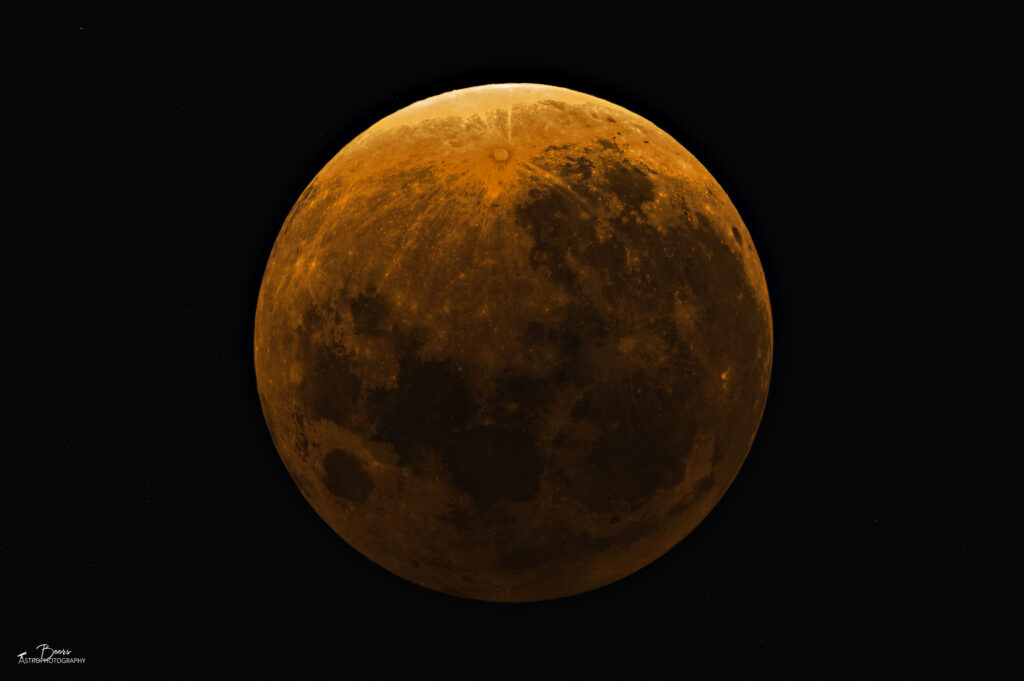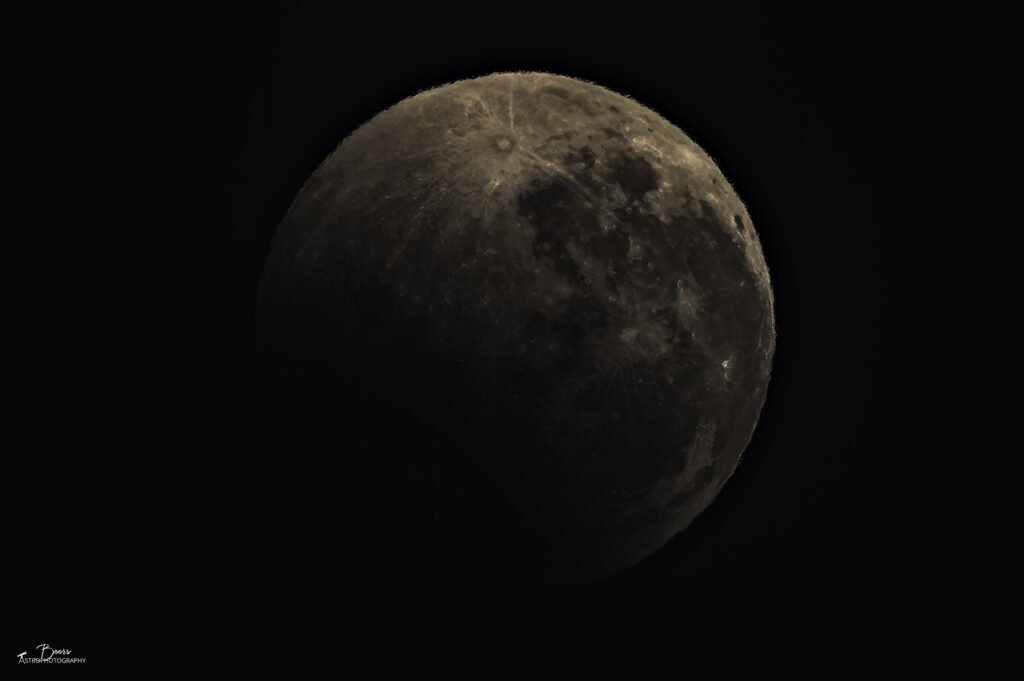
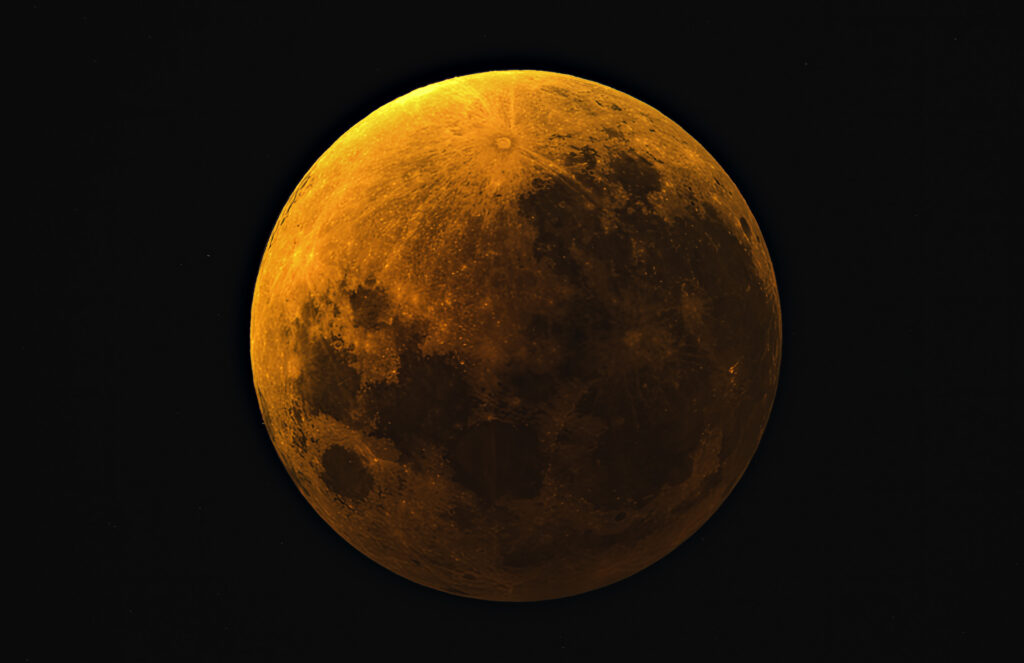
Total Lunar Eclipse phase Max; Captured from HCH, Colorado Springs, Colorado on 3 March 2026, 04:36:36MDT; with Big Bertha, ASI2400MC, Gain 158, Exposure 14 seconds.
Total Eclipse of the Blood Moon – Colorado Springs – March 2026
Fun facts
A total lunar eclipse occurred at the Moon’s descending node of orbit on Tuesday, March 3, 2026 with an umbral magnitude of 1.1507. A lunar eclipse occurs when the Moon’s near side entirely passes into the Earth’s umbral shadow, causing the Moon to be darkened. Unlike a solar eclipse, which can only be viewed from a relatively small area of the world, a lunar eclipse may be viewed from anywhere on the night side of Earth. A total lunar eclipse can last up to nearly two hours, while a total solar eclipse lasts only a few minutes at any given place, because the Moon’s shadow is smaller. The Moon’s apparent diameter was near the average, as it occurred 6.7 days after perigee (on February 24, 2026, at 18:15 UTC) and 6.9 days before apogee (on March 10, 2026, at 09:45 UTC).
This lunar eclipse was the third of an almost tetrad, with the others being on March 14, 2025 (total); September 8, 2025 (total); and August 28, 2026 (partial).
This eclipse fell on the Lantern Festival (https://en.wikipedia.org/wiki/Lantern_Festival), the first since February 11, 2017. It was completely visible over northeast Asia, northwestern North America, and the central Pacific Ocean, seen rising over much of Asia and Australia and setting over North and South America.
{ From: https://en.wikipedia.org/wiki/March_2026_lunar_eclipse }
Equipment
Equipment: All equipment controlled by HP Probook (DSO-CTRL1) running Sequence Generator Pro v4.4.1.1441.
- Telescope: (Big Bertha) Orion 8″ f/8 Ritchey-Chretien Astrograph Telescope
- Camera: (OSC) ZWO ASI2400MC
- Mount: Rainbow Astro RST-300 (controlled by iHubo ASCOM driver)
- Polar alignment: QHYCCD camera (controlled by Polemaster for polar alignment)
- Auto Focuser: ZWO EAF Electronic Automatic Focuser – Standard (New 5V Version) (EAF-5V-STD) (used for initial focusing, not during the sequence execution)
Capture & processing notes
Just like everything you do infrequently – once every three to five years – no muscle memory has been built to guide you through the actions. Compound that with: 1) deciding to try imaging the eclipse with a dedicated astrophotography camera (at least it was the one-shot color and not the mono!!) instead of my DSLR that I’ve used in the past; and 2) doing the capture planning at absolutely the last minute (after getting home from work on Monday late afternoon, when the eclipse started at 01:45MST on Tuesday morning). Recipe for disaster? …maybe not complete disaster – but it was the recipe for a very long, cold night!
I got up at 01:00MST, thinking that would give me enough time to set up before the 01:45MST eclipse start…not so much. I got the polar alignment done, the mount set to moon tracking rate and pointed to the moon (with the hand controller), then I attempted to start the SGP sequence – and for the next hour+ struggled with that simple task of asking Sequence Generator Pro to “start taking the pictures!”
At first, SGPro kept insisting that I needed a telescope and none was selected. You’re right! No telescope is selected (intentionally!) because I don’t know how to select moon tracking rate in SGP or through the ASCOM driver…just take the pictures! I fiddled around with the settings (mind you, I’m sitting outside in ~35°F temperatures) and managed to overwrite all the sequences that I’d built. ARGH! Then finally, something happened/changed (I have no idea what!) and SGPro decided it would cooperate and start capturing images without the telescope being a part of the sequence. WHEW!
To address the ARGH (overwriting all the capture events I’d built), I quickly rebuilt the sequences – a separate event within the sequence for each phase of the eclipse due to the differing exposure times and their rate of change. I finally got the image capture going, with the first image captured in the P1 to U1 phase of the eclipse at 03:05MST (yes – 2:00 hours from when I started and 1:20 hours into the eclipse!)
Okay, now I’ve got the sequence going, I can go lay down and get a bit of rest (it is a “school night” after all!), right? Wrong! There are many aspects of SGPro and my standard DSO equipment set-up that are not made for eclipse photography. For example, first, the mount’s moon tracking rate does an okay job of tracking the moon but not enough to trust it for more than 15-20 minutes before a manual readjustment to bring the moon back into the center of the frame is required. Second, recall that I made the (foolish) decision to use my astrophotography camera versus my DSLR, so I wasn’t certain about the exposure times (additionally, each eclipse is slightly different in its brightness contributing to this exposure length uncertainty), so each time the exposure changed I needed to verify (and adjust) to make sure it was capturing good data for that phase of the eclipse {especially challenging during the Max +/- 12 minutes period when lighting is changing very quickly}. Finally, although I’d done a pretty good job during my initial planning (inside the house, sitting at the kitchen counter, with a mouse and calculator) of calculating the precise times of the phase shifts; the actual lighting of the shifts were not precise and in my rush to recreate the sequences (outside on the front patio, sitting on my camp stool in front of the telescope, using the laptops touchpad (with my frozen fingers) and my middle of the night math brain) I most likely wasn’t as precise.
All that to say – I was up and outside in the cold from 01:00, when I started powering up the equipment, until 06:30, when I brought the equipment in at the conclusion of the eclipse’s show, with only brief periods (~5 minutes at a time) spent inside warming up – a long, cold night.
Speaking of bringing the equipment in at 06:30, as I was rolling Big Bertha inside the realization of what a bad idea it was to use my AP one-shot color (OSC) camera struck me! Although the camera has a color sensor (like a DSLR does), it captures the data in a .FITS format that needs to be debayered (have the pixels assigned to their red-green-blue color on the sensor) to create a color image – otherwise the image is mono (black-and-white – so much for the eclipse’s lovely shades of orange and red). That debayering process is done automatically in the AP stacking software, but I had no idea how to do it for a single image; let alone how to accomplish a bulk process for the 711 images I captured throughout the night! ARGH!
After a bit of searching on “how do I” debayer and convert from .FITS to .TIFF and experimentation with various software solutions – I discovered that Astro Pixel Processor ((APP) – the SW I use for DSO stacking) had me covered (YEAH APP!!). I debayered using the APP Tools: batch modify FITS metadata/CFA; then I batch converted from .FITS and saved as .TIFF using the APP Tools: batch save. Once I discovered those processes, determined the correct settings to use, and executed those two commands – I could continue with my normal processing of culling the images in Adobe Bridge and processing them in Lightroom and Photoshop.
I’ve documented these capture and processing steps in an Appendix of my 2026 AP Journal (if you think these descriptions are long…you do NOT want to read my Journal!!). However, I probably will NOT repeat this (not so bright) idea of using my OSC for eclipse imaging in the future. I learned after the fact, the additional clarity and detail that I thought I could capture by using my AP OSC vs my DSLR camera was never going to happen. Both those cameras have the same pixel size (the main factor in image resolution). Until (if/when(?)) I buy an upgraded OSC camera, I’ll never get more resolution than with my DSLR…
So many lessons learned – but, will I remember them during the next eclipse??
Sequence plans: All data collected at Gain: 158, Offset: 30, Temp 0°C. Individual sequences developed in SGPro for similar portions of the eclipse WRT exposure rate/amount of change.
- P1 – U1: 14 images captured: 3Mar2026, 03:05MST – 03:13MST
- U1 – U2: 34 images captured: 3Mar2026, 03:14MST – 03:35MST
- U2 – Max-12min: 125 images captured: 3Mar2026, 03:35MST – 03:54MST
- Max (=Max-12min to Max+24min): 275 images captured: 3Mar2026, 03:54MST – 05:07MST
- U3: 191 images captured: 3Mar2026, 05:07MST – 05:50MST
- U3end: 71 images captured: 3Mar2026, 05:50MST – 06:11MST
Processing:
Debayer & Convert to TIFF with APP Tools: batch modify FITS metadata/CFA; APP Tools: batch save; Cull through TIFF images in Adobe Bridge; Process in LR/PS
Summary
Capture: 3 March 2026; 03:05 – 06:11MST
Shooting location: Colorado Springs, Colorado
Processing: Captured in SGP; initial image processing (debayer, FITS to TIFF) in APP, processed in LR/PS
March 2026 Total Lunar Eclipse Images
A select sample (9 of 711) of the images from the major phases of the eclipse are shown below.