
Back from Chile (astrophotography trip, 13-24Mar2026) and back from Australia (work trip, 24Apr-8May2026), the May 2026 New Moon weekend, partially clear at home, allowed me to dust off the mono imaging camera and take the new version of Sequence Generator Pro (SGP v4.5.0.1638 (released 24 Apr 2026)) for a test drive. This started a month’s long visit back to my “OCD” target – SH2-129 Flying Bat / Ou4 Giant Squid. This image, definitely a work in progress (likely all throughout the summer and early fall while it’s visible) is comprised of data collected with the mono camera from the front patio on: 15, 16, 23, 29, and 30 May 2026. The mono data are combined with data captured with the same telescope/reducer and my one-shot color camera in July 2025 at Powderhorn, Colorado.
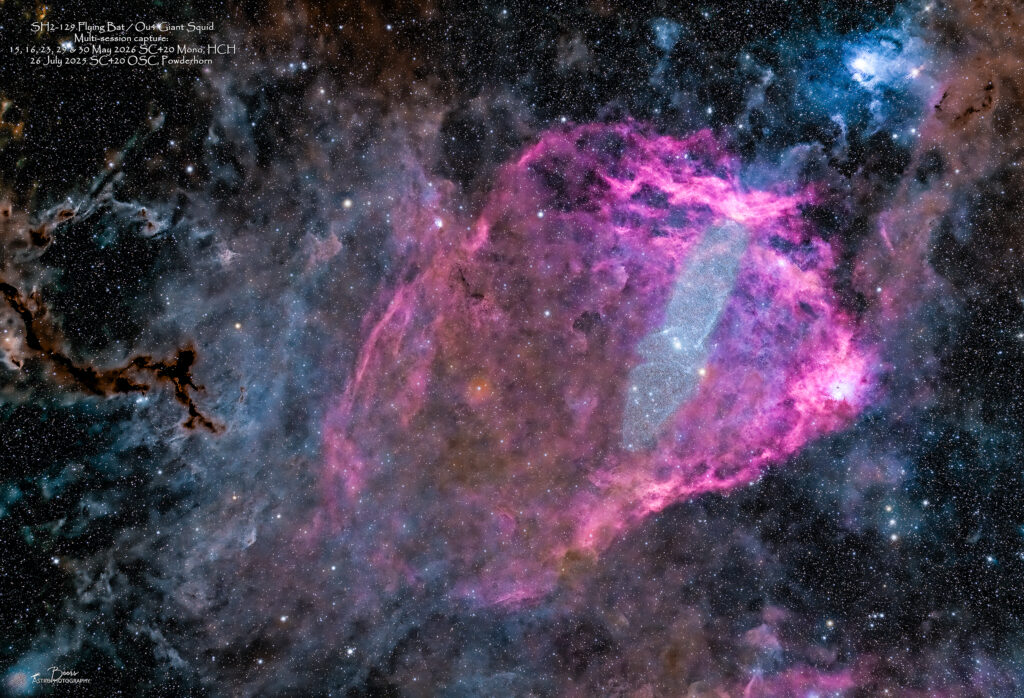
Starting in late April/early May my favorite nebulosity obsession, the SH2-129 Flying Bat with its elusive Ou4 Giant Squid Nebula – starts a period of visibility (four hours or greater per night) until mid-December. Armed with my new mono camera, with most of the bugs worked out (save those that came back to roost from “lessons learned” (and forgotten) or new issues spawned from my switch from SGP version 4.4.1.1441 to v4.5.0.1638 (released 24 Apr 2026)). I was back from Chile (astrophotography trip, 13-24Mar2026) and Australia (work trip, 24Apr-8May2026), so I had the chance to reignited the flames of my OCD and began collecting data on SH2-129/Ou4 beginning during the May 2026 New Moon weekend.
This image, (https://beersastrophotography.com/gallery/sh2-129-flying-bat-ou-4-giant-squid-nebulae/) is definitely a work in progress (likely will continue to be my primary data collection target throughout the summer and fall while it’s visible). It is comprised of a total of 20:21 hours of data, 19:46 hours collected with the mono camera from the front patio on: 15-16 May 2026 (between SW/HW set-up issues on 15 May and a random sequence abort on 16 May – less than a stellar collection period of 4:40 across two nights); 23 May 2026 (successful collect in the short hours of darkness yielded 4:43 hours of data, including 20 x 10 minute subframes of OIII in my quest of capturing the Giant Squid); 29 May 2026 (a whopping 5:53hrs), and 30 May 2026 (an hour plus delay waiting for the bank of clouds right where the target was to clear, yielding 4:30hrs). The mono data were combined with 5:35 hours of data captured in July 2025 at Powderhorn with the same telescope/reducer and the one-shot color (OSC) camera.
Data capture
15 May 2026: A frustrating and not very productive night – waited for the clouds to clear, then spent ~3 hours struggling with disconnects in the new SGPro equipment profiles. First, I struggled with the autofocus routine – not able to figure out why radically moving the focus tube throughout its full range of movement was having little affect on the number of stars and HFR being calculated. After getting to where I thought was a close focus point and running the sequence (EAF #1 gave a focus point, 5092, HFR 1.7, 99% curve fit). When the sequence moved to the PHD2 calibration, the light came on – SGP was using the wrong camera profiles (the AG camera and imaging camera ASCOM drivers were flipped!). At 03:29, restart #3 finally gave me results in the EAF that looked reasonable. When I moved on to the plate solver, it threw a “camera rotation warning” and gave a 0° delta from the 0° camera angle the sequence called for – that seemed bizarre as I’ve never been that precise with the masking tape and eye-ball angle measurement system, but by that time I was too cold and tired to worry about it. I later discovered, the warning and the fact that the plate solver didn’t give a camera angle delta was because I had “mechanical” vs. “sky” selected. I ended up capturing a miniscule amount of data before astronomical twilight ended at about 04:30.
Executed data collection (Mono Data– 15May2026): Gain 100, Offset 50, Temp 0°C. Total data capture time: 12x5min, 5x1min subframes = 65min (1:05hr).
- Lum: 5x1min, 16May26, 03:35 – 03:41MDT
- OIII: 4x5min, 16May26, 03:45 – 04:06MDT
- Ha: 4x5min, 16May26, 04:10 – 04:31MDT
- SII: 4x5min, 16May26, 04:38 – 05:04MDT
16 May 2026: During the day (16May2026), I corrected the equipment profiles for all the errors I’d run into and began playing with the Flat Calibration Wizard – I captured some data, but also sent in several questions to the SGP Forum Help line. The night’s data collection went much more smoothly from a new SW version error perspective. I started the sequence after polar alignment at 22:49MDT. The camera profiles were straightened out so the EAF was actually focusing the imaging camera properly, the plate solver was set to sky so it came up with a 5.47° delta from 0° which I corrected with a small manual camera rotation, PHD2 resumed the autoguider (without a calibration, throwing an error saying that recalibration was required because it was too far from the equator; still need to fix that setting), and started Event 1/Frame 1 (Lum) at 22:55. I sat and watched the Lum frames, filter wheel setting the OIII filter, EAF on the OIII filter, and the capture of the first 5 minute OIII subframe starting at 23:05MDT. At 00:50 (1:45hr later) I woke up and came out to check on the sequence progress. It had captured 1/22 OIII frames – the sequence failed at 23:04! ARGH! Restarted the sequence and it completed a bit of data collection on OIII, SII, and Ha filters before I ended at 04:42MDT.
Executed data collection (Mono Data– 16May2026): Gain 100, Offset 50, Temp 0°C. Total data capture: 42x5min, 5x1min subframes = 215min (3:35hr).
- Lum: 5x1min, 16May26, 22:55 – 23:00MDT
- OIII: 20x5min, 16May26, 23:04 – 23:09MDT, 17May26, 00:56 – 02:35MDT
- Ha: 12x5min, 17May26, 02:39 – 03:41MDT
- SII: 10x5min, 17May26, 03:45 – 04:42MDT
23 May 2026: A clear night after a week of rain, albeit with 62.3% Waxing Gibbous moon (although with a large angle between the target and moon), gave me the chance to gather more data on SH2-129 Flying Bat/OU-4 Giant Squid. During the day, I’d loaded the latest version of SGPro (v4.5.0.1642, eff. 17May2026) with updates that addressed the issue I raised WRT the flats exposure times only handling 2 decimal places. I also had researched focuser backlash, so was ready to change that setting. Finally, I’d researched the Flat Calibration Wizard – played around with that and captured flat and dark (no dark flat) frames. Before I started the sequence, I applied the new equipment profile (with the new backlash value) to the sequence, when I started the sequence I got an error that the file location of astap.exe was not correct. It took me awhile to find that setting (I thought it was in the equipment profile, it’s in the overall options only), so that delayed the start a bit while I fumbled with that. The sequence ran fine throughout the (short) night. Ironically, it lost the guide star during the frame capture that had started just prior to my coming out to shut down the sequence at the end of astronomical twilight/start of nautical twilight (04:30MDT).
Executed data collection (Mono Data– 23May2026): Gain 100, Offset 50, Temp 0°C. Total data capture: 42x5min, 5x1min subframes = 215min (3:35hr).
- Lum: 3x1min, 23May26, 23:25 – 23:28MDT
- OIII: 20x10min, 23May26, 23:32 – 24May26, 02:56MDT
- SII: 12x5min, 24May26, 03:00 – 04:04MDT
- Ha: 4x5min, 24May26, 04:11 – 04:34MDT
29 May 2026: A clear night after a week of rain, albeit with a 97.9% Waxing Gibbous (although with a large angle between the target and moon), gave me the chance to gather more data on SH2-129 Flying Bat/OU-4 Giant Squid. During the day, I’d played around with the Flat Calibration Wizard and captured flat (no dark flat) frames. Before I started the sequence, I applied the new equipment profile (with the new backlash value) to the sequence, when I started the sequence I got an error that the file location of astap.exe was not correct. It took me awhile to find that setting (I thought it was in the equipment profile, it’s in the overall options only), so that delayed the start a bit while I fumbled with that. The sequence ran fine throughout the (short) night. Ironically, it lost the guide star during the frame capture that had started just prior to my coming out to shut down the sequence at the end of astronomical twilight/start of nautical twilight (04:30MDT).
Executed data collection (Mono Data– 29May2026): Gain 100, Offset 50, Temp 0°C. Total data capture: 42x5min, 5x1min subframes = 215min (3:35hr).
- Lum: 3x1min, 29May26, 22:21 – 22:22MDT
- OIII: 20x10min, 29May26, 22:27 – 30May26, 01:51MDT
- SII: 16x5min, 30May26, 01:55 – 03:13MDT
- Ha: 14x5min, 30May26, 03:22 – 04:35MDT
30 May 2026: The night was forecast to be more fully clear all night than the night before, but that turned out not to be the case. I got up at 21:30MDT to get things set up to start imaging when the target rose above the roofline at about 22:00MDT. I was ready to go a few minutes before 22:00 – and then I waited for the clouds to clear, especially the big cloud bank exactly where the target was! The clouds finally cleared at 23:00. I got the sequence started at 23:06. To save the time associated with capturing and refocusing after switching from the Lum filter, I started with the OIII event. The sequence proceeded through: EAF #1 (5012 start, ending at 5071, HFR 1.9, 97% curve fit; validation focus at HFR=1.21), plate solve with a 1.43° delta, autoguide calibration, and second EAF run (5071 start, ending at 5066, HFR 1.9, 96% curve fit (1.12 HFR). Event 2/Frame 1 started its collect at 23:17MDT. At the end of astronomical twilight (04:30) I came out to end the sequence and, as with the night before, the autoguider lost its guide star during that subframe capture (there was an error that the calibration was too far from the meridian), so I ended the sequence and parked the telescope. Although I wasn’t going to capture new flat frames (since I hadn’t changed the camera angle from the previous night’s and had a full set of flats and dark flats to use), I did want to validate my calculation using the USNO look up site on slewing to zenith. It turns out, contrary to what the Google AI answer, for the RA you use the Greenwich Mean Sidereal Time (GMST) rather than the Local Sidereal Time. I will rework the spreadsheet with only that column for future use in capturing flat frames at the end of a session.
Executed data collection (Mono Data– 30May2026): Gain 100, Offset 50, Temp 0°C. Total data capture: 42x5min, 5x1min subframes = 215min (3:35hr).
- OIII: 16x10min, 30May26, 23:17 – 31May26, 02:00MDT
- SII: 16x5min, 31May26, 02:04 – 03:42MDT
- Ha: 6x5min, 31May26, 03:49 – 04:27MDT
Image Data & Processing Summary
A total of 20:21 hours of RAW data was used to create this image. It is a stack of 99% of 192 mono camera light frames captured on 15, 16, 23, 29, & 30 May2026 in APP; creating L, H, S, O channel images. Combined with the OSC camera data captured from Powderhorn on 26 July 2025; separated into R, G, B channels. Ultimately combined using APP’s RGB combine tool using the RGBHOO algorithm.
(Mono Data– 15, 16, 23, 29, 30May2026): Gain 100, Offset 50, Temp 0°C. Total mono data capture: 16x1min, 122x5min, 56x10min subframes = 1186min (19:46hr).
- Lum: 16x1min; 16min
- OIII: 24x5min, 56x10min; 680min, 11:20hrs
- Ha: 40x5min; 200min, 3:20hrs
- SII: 58x5min; 290min, 4:50hrs
(OSC Data – 26Jul2025): Gain 300, Offset 30, Temp 0°C; Total (good) OSC data capture: 67x5min = 335min (5:35hrs). Separated into R, G, B channels for RGB Combine with mono data