
The New Moon period in early October looked like Mother Nature was finally going to be kind and give us clear skies in the Kiowa National Grasslands of New Mexico. But alas, she decided to precede those clear skies with torrential rains and flooding from the remnants of Hurricane Polo in New Mexico (it’s always something with her!). With 4–8 inches of rain forecast for the Grasslands, we had flashbacks of last September’s trip — being chased out after just one night by vicious mosquitoes and having to build a bridge out of very large rocks to get through the huge mud puddle at the cattle guard. So, we cancelled the trip, and I switched my dark-skies plan to a front-patio mono-camera plan.
I decided to give my spring/summer OCD target, the SH2-129 Flying Bat & Ou4 Giant Squid, a break and spend some time on the CTB1 Garlic Nebula, transferring the mono camera from SC (Southern Cross) to BB (Big Bertha). That turned out to be a bit of a re-learning experience that took me a couple of days to figure out! When rotating the mono camera to a 90° camera angle, you need to rotate the bottom of the filter wheel up toward the 1200 position, NOT down toward the 0600 position. Otherwise, you end up with collisions with the tripod legs both before and after the meridian. Who knew a simple camera rotation could be so complicated?!
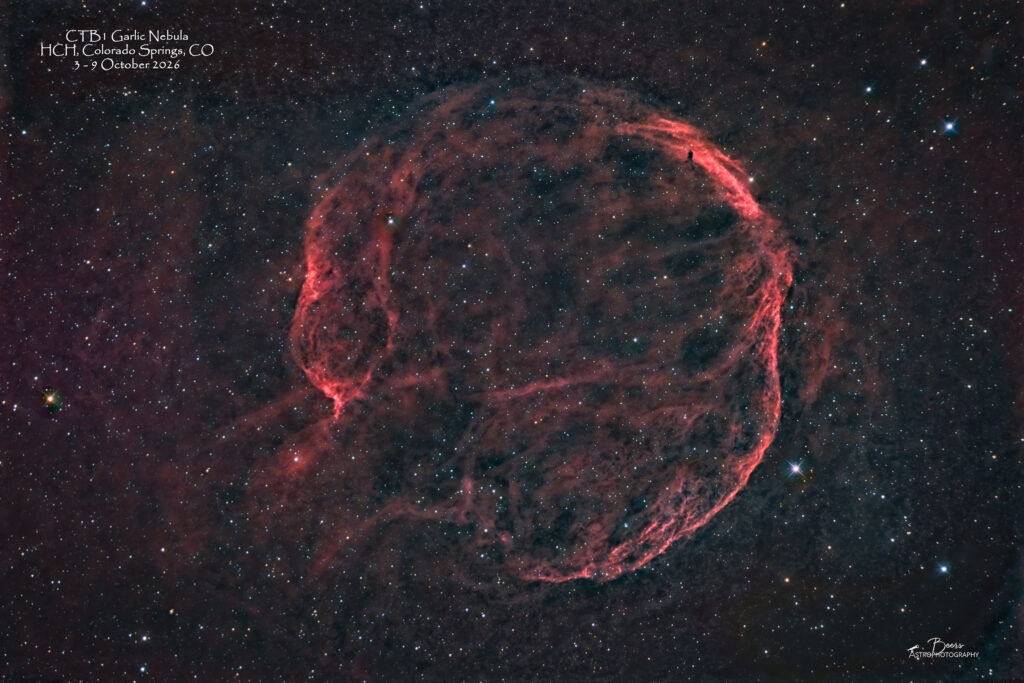
Once I finally figured that out — and decided to increase the OIII subframe time from 5 minutes to 10 minutes — I started collecting a full night’s worth of good data, which resulted in the image below. There’s still work to be done before this image is worthy of printing (my personal litmus test for an image), so this may well become my fall/winter target obsession.
And now, are you thinking about all those recipes that could use a really big piece of garlic? 😁
Capture Notes
Capture Notes Summary: The image above and the latest version of CTB1 Garlic Nebula in the gallery at: https://beersastrophotography.com/gallery/ctb1-garlic-nebula/ is a multi-session image comprised of data collected with Big Bertha, ASI6200MM mono camera from the HCH front patio during the New Moon week in October 2026. I hadn’t used BB-Mono since January and although I was rigorous about documenting the disassembly of the mono camera off of SC and onto BB – I missed one key detail – by rotating the EFW to the 90 degree position with its bottom toward the ground, I set the configuration up for a collision with the tripod legs when it got near the meridian. It took me a couple of nights of crashes to figure that out, but once I did, the collection went pretty smoothly (albeit with some strange guiding behavior that I haven’t figured out).
Below are the gory details of each night’s collection – you can see (even just by the length of each entry) how I learned as the week progressed.
Capture Notes (3Oct2026): This was the first time using Big Bertha since my Jan26 front patio mono imaging extravaganza (mono camera) and early March lunar eclipse (OSC camera) – so there were a few cobwebs to dust off. The start-up went relatively well, although my guess at the focus point for both the autoguide camera (new ZWO ASI120MM set at the same point as the SC ASI120MM, changed from 4.5 to 5.75) and the mono camera (set where it was from imaging the lunar eclipse at 4268, changed to 9268 to get in focus to start sequence). So, there was a pause both the autoguider calibration and the start of the sequence (autofocus routine) to get those two cameras into focus. Once that was done the rest of the sequence went well. E1/F1, 5min OIII started at 20:26MDT
I came out at 00:16 for the 00:09 transit time and the telescope had already flipped and I noticed the base of the EFW was up against the tripod leg and the sequence was in “recovery mode”. I did “recover now” and it went into the plate solve, finding the delta angle of 7.9° (perhaps because of the collision with the leg?) that I rotated to 0.83°. SGP resumed the autoguider, set the Ha filter (the flip was coincident to the end of the OIII target).
As soon as the sequence resumed the autoguider after the EAF, it lost the guide star. I restarted and attempted the plate solve, which was wonky, so I decided to re-accomplish the Calibration Assistant. At 00:52, E2/F1 (Ha 5min) started. I sat to watch the result of the first subframe – it looked pretty star traily. The second was the same. I convinced myself it was my eyes, but then I noticed that the bullseye of the guiding was predominantly to the E of center. I decided at the point, I would change the meridian flip to 20 minutes past the meridian (to avoid the leg collision – but now that I type this there was also an issue with the last OIII subframe that was 20 minutes before the meridian??).
Then went to bed. I didn’t really sleep, instead I perseverated about the cause for the star trails and argued back and forth about “data is data” vs. “don’t waste a good dark skies night collecting data that you will discard”. So, about an hour into laying in bed not sleeping, I decided to get up and see what things looked like – had it maybe “moved away from the meridian enough to settle into good guiding?” Nope – 10 images taken, all looked equally bad. At that point, I decided I needed to redo the polar alignment – boy, did I ever! It was way out of alignment in declination and just a tad out of alignment in RA – that would cause that issue! So, I powered down everything (except I did not reboot the computer), re-accomplished the polar alignment, and then restart the sequence at 01:55.
E2/F11 (Ha, 5min) started at 02:05MDT. I reset the counter on the Ha target to 50, to compensate for the 10 bad subframes I’d collected over the last hour…lesson learned?? The bullseye wasn’t extremely tight, but it was definitely more centered than before. …and I collected frames, mostly “keepers” (except two random phantom star images in the middle of the Ha collection) for the rest of the night.
I woke up (with the alarm) at 06:00 to end the sequence at the end of astronomical twilight. At about 06:16, I decided I was going to use the SGP Calibration Assistant to capture flats for all the data I was going to be collecting this week. I manually slewed the telescope to the “zenith” so I could set the light pad on the top of it. …and went about reminding myself how to use the Calibration Assistant Wizard and the Flats Wizard to create a sequence or a target in the existing sequence to capture the flats and dark flats. About an hour later, I was still struggling with getting it to work correctly, when Paul came out to ask how everything went. I growled “not well” (and a few other cuss words might have been growled in there too). As he turned around to go back inside and leave me to my frustration, I remembered that I might have created the calibration sequences earlier this year – wala – I had! So I captured the flats, dark flats, and a set of 5 minute darks (that I ended up throwing away because of a light streak in all of them from the sun coming through the lens cap and my black pillowcase) while I went inside to shower (a.k.a. thaw out) and get dressed. I spent the morning working through the process of Calibration Assistant and Flats Wizard.
Capture Notes (4Oct2026): The clouds cleared at about 21:30, I set up, polar aligned, ran the PHD2 calibration assistant and started the sequence at 22:00.
Came out for meridian flip (00:05) and found EFW base was against the tripod leg, sequence had failed. I puzzled for a few minutes on how I was going to solve this collision problem, then the picture of the previous installation of the mono camera on BB flashed into my mind. The camera can be at 90° or 270° – so if you flip it by 180° from its collision position…wala! Restarted the sequence. Plate solve angular delta was 1.24° (how’s that for a calibrated eye on the 180° rotation!!). The rest of the night produced good data.
Capture Notes (5Oct2026): The night was clear from the start. Started SGP at 19:38MDT. Ran PHD2 Calibration Assistant – first time the result was poor (HFD ~4.0, SNR ~112); second run result was good (HFD ~4.0, SNR ~2.0). At 19:44, run sequence (forgot to park the scope, so it slewed from the Calibration Assistant zero declination position to the target position without issue).
Came out for meridian flip at 00:09MST (00:01 transit time), the sequence was in the flip pause – I selected “attempt now” – it slewed, plate solved, restarted AG, displayed an “OK” – I selected it. In other words – the meridian flip worked essentially on its own – thank you PHD2 Calibration Assistant and resuming previous calibration results.
Capture Notes (7Oct2026): The three weather forecasts were having a debate about when the clouds were going to clear – WeatherUnderground (20:00), Clear Outside (23:00), and Astropheric (21:00). I was about to go to bed – splitting the difference and getting up at 21:00 – when I looked outside to find clear skies! Came outside at 20:00, GPS synced the mount at 20:05, connect equipment (after polar alignment) at 20:19. PHD2 Calibration Assistant at 20:20. Parked and ran sequence at 20:23. E1/F1, SIIx10min start at 20:33.
Came out at 23:58 for meridian flip (23:53). Attempt now – plate solve 0.89°, 1884 px; 111.8px, resolved on third pass. EAF (OIII) 8884 à 8899, 3.8HFR, 97% (3.54 HFR). Settle AG. Start E2/F2 OIIIx10min. Watched the first subframe collect and the stars looked wonky. At 01:15 aborted, polar aligned, restarted. Plate solve 0.89°. EAF (OIII) 8899 à 8900, 3.4HFR, 99% (3.59), 0.33e (9%). At 01:19, after laying in bed not sleeping wondering about the star shape, I got up and looked the most recent image was traily, looked back at the previous images they were:
| Time | # of stars | HFR | Eccentricity | e percentage |
| 0055 | 144 | 7.50 | 0.51 | 17% |
| 0045 | 123 | 7.95 | 0.56 | 22% |
| 0035 | 93 | 8.17 | 0.54 | 20% |
| 0025 | 152 | 7.40 | 0.56 | 23% |
| 0014 | 202 | 6.27 | 0.36 | 9% |
| 0004 | 181 | 6.54 | 0.37 | 10% |
| After polar align, restart: | ||||
| 01:19 | 167 | 6.85 | 0.33 | 9% |
Set EAF at one hour plus at filter change. Polar aligned. Restarted sequence.
Capture Notes (8Oct2026): Clear from the start of the evening. Started SGP, after polar alignment, connected equipment homed the scope at 19:26. Ran PHD2 Calibration Assistant after the first run, the stars were lost, reran the calibration – good result. Parked scope @ 19:31. Ran sequence @19:32. E1/F1 Ha x 10min start at 19:43MDT. Came out for meridian flip at 23:57 (23:49 transit). Attempt now. Plate solve 4.12°, 7234px, then 53.9px, resolve on third pass. Resume AG, selected OK. EAF#2 (Ha) 8985 to 8962, 3.5HFR, 99%, (3.29HFR), 0.32e, 8%. E1/F24 Hax10min started at 00:03
Capture Notes (9Oct2026): Clear from the start of the evening. Connect equipment in SGP at 19:27. Ran PHD2 Cal Assist – calibration result “acceptable”; re-ran calibration good. Run sequence at 19:34. E1/F1 Hax10min started at 19:43MDT. Came out for meridian flip at 23:54 (23:45transit). Pier delay was at 45 seconds, so I let it run to fruition – the mount started the meridian flip when the timer ran out. Plate solve 4.03°. EAF (Ha) 8931 to 8930, 3.7HFR, 97% (3.60HFR), 0.36e, 10%. E1/F22 (Hax10min) started at 00:01. This is the first time I’ve ever had a successful hands-off meridian flip! But then again – it’s always something (…and I have no idea what this was all about!) I came out at 05:30 – the sequence was in recovery mode…locked up…parked with the iHubo control panel. Then the telescope control was really wonky. When I parked the scope – it pointed to the ground! Homed with the iHubo, disconnected all equipment, restarted. Restarted sequence. EAF #1 8856. Plate solve 4.75°, when it did EAF #2, the focuser wonked out – a sawtooth pattern; cancelled the EAF and it returned to the 8856 focus point that was in good focus with EAF #1. E3/F8 (OIIIx10min) started at 05:41, ended at 06:10.
Captured new calibration frames using the Calibration Frame Wizard to the 05-BB-Mono profile. ADU set at 30,000 +/- 1000. Then ran that sequence to capture new flats and dark flats.
Sequence plans
Multi-session image (3,4,5,7,8,9 Oct 2026) comprised of: 473 subframes; 80x1min (RGB), 240x5min(HSO), 152x10min (HSO) = 2800min (46:40 hrs)
- Red: 30x1min (-2 culled): 28x1min = 28min
- Blue: 30x1min: 30x1min = 30min
- Green: 30x1min (-8 culled): 22x1min = 22min
- Ha: 113x5min (-13 culled), 63x10min: 100x5min + 63x10min = 1130min (18:50 hrs)
- SII: 78x5min (-11 culled), 54x10min (-1 culled): 67x5min + 53x10min = 865min (14:25 hrs)
- OIII: 76x5min (-3 culled), 42x10min (-6 culled): 73x5min + 36x10min = 725min (12:05 hrs)
Sequence plan (Mono Data– 3Oct2026): Gain 100, Offset 50, Temp 0°C. Total imaging data time: 96x5min subframes = 480min, 8:00hrs; 3Oct26, 20:26MDT – 4Oct26, 06:07MDT. (9:41hrs elapsed)
- OIII 40x5min, 3Oct 26, 20:26 – 23:54MDT (208min elapsed, 200min data)
- Gap at meridian flip issues: 3Oct26, 23:54 – 4Oct26, 00:51MDT
- Ha 50x5min, 4Oct26, 00:54 – 05:32MDT (278min elapsed, 250min data)
- Gap to re-polar align after laying in bed wondering about star traily stars, 4Oct26, 01:43 – 02:04MDT (21min)
- SII 6x5min, 4Oct26, 05:36 – 06:07 (31min elapsed, 30min data)
Seti Astro cull: OIII, 2x5min; Ha, 12x5min
Sequence plan (Mono Data– 4Oct2026): Gain 100, Offset 50, Temp 0°C. Sequence ran: 4Oct2026 22:07MDT – 5Oct26, 05:59MDT. Total data capture time: 90x1min; 58x5min subframes = 380min, 6:20hrs
- Red: 30x1min; 4Oct26, 22:07 – 22:43MDT
- Blue: 30x1min; 4Oct26, 22:46 – 23:22MDT
- Green: 30x1im; 4Oct26, 23:24 – 5Oct26, 00:50MDT (50 minute spent on meridian flip)
- SII: 36x5min; 5Oct26, 00:54 – 04:01MDT
- Ha: 22x5min; 5Oct26, 04:05 – 05:59MDT
Seti Astro cull flagged 22 images bad: Grn – 8x1min; Red – 2x1min; SII – 11x5min; Ha – 1x5min
Sequence plan (Mono Data– 5Oct26): Gain 100, Offset 50, Temp 0°C. Sequence ran: 5Oct26, 19:53 – 6Oct26, 06:02MDT. Total data capture time: 112x5min subframes = 560min (9:20hrs)
- SII: 36x5min, 5Oct26, 19:53 – 23:06MDT
- OIII: 36x5min, 5Oct26, 23:10 – 6Oct26, 02:25
- Ha: 41x5min, 6Oct26, 02:29 – 06:02MDT
Seti Astro cull flagged 1 image bad: 1x5min OIII
Sequence plan (Mono Data– 7Oct2026): Gain 100, Offset 50, Temp 0°C. Sequence ran: 7Oct26, 20:33 – 8Oct26, 05:59MDT. Total data capture time: 52x10min; 520min (8:40hrs)
- SII: 18x10min; 7Oct26, 20:33 – 23:41MDT
- OIII: 18x10min; 7Oct26, 23:45 – 8Oct26, 03:15MDT
- Ha: 15x10min; 8Oct26, 03:19 – 05:59MDT
Seti Astro cull flagged 4 images bad: 4x10min OIII
Sequence plan (Mono Data– 8Oct2026): Gain 100, Offset 50, Temp 0°C. Sequence ran: 8Oct26, 19:42 – 9Oct26, 06:04MDT. Total data capture time: 57x10min; 570min (9:30hrs)
- Ha: 24x10min; 8Oct26, 19:42 – 9Oct26, 00:12MDT
- SII: 18x10min; 9Oct26, 00:17 – 03:29MDT
- OIII: 14x10min; 9Oct26, 03:33 – 06:04MDT
Seti Astro cull flagged 2 images: 2x10min OIII
Sequence plan (Mono Data– 9Oct2026): Gain 100, Offset 50, Temp 0°C. Sequence ran: 8Oct26, 19:43 – 9Oct26, 06:10MDT. Total data capture time: 52x10min; 520min (8:40hrs)
- Ha: 24x10min; 9Oct26, 19:43 – 10Oct26, 00:31MDT
- SII: 18x10min; 10Oct26, 00:35 – 03:46MDT
- OIII: 10x10min; 10Oct26, 03:50 – 06:10MDT
Seti Astro cull flagged 1 image: 1x10min SII
Equipment: All equipment controlled by HP Probook (DSO-CTRL1) running Sequence Generator Pro v4.4.1.1441.
- Imaging: (Big Bertha) Orion 8″ f/8 Ritchey-Chretien Astrograph Telescope, (Mono camera & filter wheel with field flattener) ZWO ASI6200MM Pro Monochrome imaging camera; ZWO – EFW 7×2” Filter Wheel with installed filters (1=SII, 2=Ha, 3=OIII, 4=Lum, 5=Red, 6=Grn, 7=Blue): Svbony SV227 2” Narrow-Band – SII, Ha, OIII; Optolong LRGB Filter Set (2”); Teleskop Service Flattener 1.0x for RC Telescopes (TS-RCFLAT2)
- Mount: Rainbow Astro RST-300 (controlled by iHubo ASCOM driver)
- Polar alignment: QHYCCD camera (controlled by Polemaster for polar alignment)
- Autoguiding: Orion 60mm Multi-Use Guide Scope with ZWO ASI12MM Mono Mini Astrophotography Camera (controlled by PHD2)
- Auto Focuser: ZWO EAF Electronic Automatic Focuser – Standard (New 5V Version) (EAF-5V-STD)