
Near the end of the month of my January 2026 mono imaging extravaganza (described in the blog: https://beersastrophotography.com/photography-journals/january-2026-mono-imaging-and-equipment-fix/), I felt I’d gathered enough data on IC434 Horsehead Nebula. I also had the ZWO Dev Team’s new firmware and FPGA software loaded into my mono camera, meant to address my data download issues. With the clear skies (albeit during January’s Blue Moon (second full moon in the same month)), I decided to check out the fix and go back and collect a bit more data on M42 Orion and CTB1 Garlic Nebulae to combine with the data I’d gathered earlier. I successfully collected the data, transferred it to my processing computer, and then promptly forgot about it as I started my trip planning for Chile (13-24Mar2026). That trip was almost immediately followed by a work trip to Australia (24Apr-8May2026). So, the data processing was lost off my to-do list until recently when I was updating my journal with the late May 2026 image processing of SH2-129 Flying Bat / Ou4 Giant Squid. Luckily, the data didn’t go anywhere and was patiently waiting for my returned attention…which happened starting last weekend. This blog describes the late January 2026 data collection and multi-session mono processing of the M42 Orion and CTB1 Garlic Nebulae. I’ve also provided pointers to their gallery pages where you can see the evolution of each objects’ images.

With the clear skies (albeit during January’s Blue Moon (second full moon in the same month)), I decided to check out ZWO’s mono camera data download fix and collect a bit more data on M42 Orion and CTB1 Garlic Nebulae to combine with the data I’d gathered earlier in the month (and M42’s Christmas Eve 2025 data). I successfully collected the data (i.e., the fix fixed the issue!), transferred it to my processing computer, then promptly forgot about it as I started my trip planning for Chile. Late last week, as I was updating my journal with the SH2-129/Ou4 Flying Bat/Giant Squid capture and processing notes, I discovered the to-do list failure. Last weekend, while I was gathering more data on SH2-129/Ou4 and waiting until I ran out of clear nights during the June 2026 New Moon period before I began processing them, I decided to catch up on the M42 Orion and CTB1 Garlic Nebulae processing.
I gathered and restacked all the data for both objects. Then I decided, before I started my APP RGB Combine Tool “hunt and peck” method of combining the individual channels (i.e., “I wonder what moving this dial to this location will make the image look like?”), I would be more systematic. So, using the M42 Orion filter channel data (i.e., each stack of the R-G-B-H-S-O filter data), I ran through each APP combination formula to generate a draft combined image. I created an Appendix for my journal that contains those notes and a screen shot of each formula’s combined image. Using that knowledge as my starting point, definitely shortened the processing time and created the “realistic” color images that I was striving for!
Below is a quick summary of the data collection and processing of the M42 Orion Nebula and CTB1 Garlic Nebula multi-session images. The link to the gallery post for each will show you the history/evolution of those objects’ images. Both, especially the CTB1 Garlic remain a work in progress, likely to be the focus of a winter mono imaging extravaganza from the front patio during clear nights later this year!
Equipment: Both M42 and CTB1 data were captured with BB-Mono, controlled by HP Probook (DSO-CTRL1) running Sequence Generator Pro v4.4.1.1441.
- Imaging (Telescope): (Big Bertha) Orion 8″ f/8 Ritchey-Chretien Astrograph Telescope
- Imaging (Camera): (Mono camera, filter wheel, field flattener)
- ZWO ASI6200MM Pro Monochrome imaging camera;
- ZWO – EFW 7×2” Filter Wheel with installed filters (1=SII, 2=Ha, 3=OIII, 4=Lum, 5=Red, 6=Grn, 7=Blue): Svbony SV227 2” Narrow-Band – SII, Ha, OIII; Optolong LRGB Filter Set (2”);
- Teleskop Service Flattener 1.0x for RC Telescopes (TS-RCFLAT2)
- Mount: Rainbow Astro RST-300 (controlled by iHubo ASCOM driver)
- Polar alignment: QHYCCD camera (controlled by Polemaster for polar alignment)
- Autoguiding: Orion 60mm Multi-Use Guide Scope with Orion StarShoot AutoGuider Pro Mono Astrophotography Camera (controlled by PHD2)
- Auto Focuser: ZWO EAF Electronic Automatic Focuser – Standard (New 5V Version) (EAF-5V-STD)
M42 Orion Nebula
The M42 Orion Nebula gallery (https://beersastrophotography.com/gallery/m42-orion-nebula/) shows the evolution of my imaging of M42 (and NGC1975 Running Man) since my early “career” still-personal favorite image captured in January 2022 in the dark skies of the Kiowa National Grasslands. The processing of the 24Dec2025 mono data alone, using my “hunt and peck” APP RGB Combine Tool method, was interesting but not what I was striving for – a more “realistic” (i.e., what the object looks like when imaged with a one-shot color (OSC) camera). The combination of the 24Dec2025, 29-30Jan2026 gave me a good data set to run my “I’m going to understand what these combination formulas produce” experiment…and a much better understanding that both sped up the processing and allowed me to produce the “realistic” image I was striving for. To summarize – HOO is the most RGB realistic, HSO can get there with some tweaking but tends toward pink/purple (gaudy to start!), SHO is the Hubble palette’s “artificial” green, yellow and aqua look.
Image Data & Processing Summary
- Data capture: 24Dec2025, 29Jan2026, 30Jan2026
- 24Dec2025: 45x30sec, 141x2min = 304.5min (5:04.5 hrs)
- 29Jan2026: 63x2min, 45x1min, 33x3min = 270min (4:30hrs)
- 30Jan2026: 47x3min = 141min (2:21hrs)
- Total data in image: 45x30sec, 45x1min, 204x2min, 80x3min = 715.5 minutes (11:55.5 hrs).
- Shooting location: HCH front patio, Colorado Springs, CO
- Processing: Data collection with SGP sequence; image review with Seti Astro Blink Comparator; stack with Astro Pixel Processor (APP); combine mono images using APP RGB Combine Tool; star removal with Starnet++; image processing with Photoshop/Lightroom
Sequence plan (Mono Data– 24Dec2025): Gain 100, Offset 50, Temp 0°C. Captured 24Dec 20:37 – 25Dec 03:12MST (6:35 min). Total imaging time: 45x30sec, 141x2min; 304.5min; 5:04.5 hours.
- Red 15x30sec; 24Dec 20:37 – 20:47MST
- Green 15x30sec, 24Dec 20:48 – 20:59MST
- Blue 15x30sec, 24Dec 20:59 – 21:10MST
- Ha 55x2min, 24Dec 21:10 – 23:21MST
- SII 45x2min, 24Dec2025 23:35 – 25Dec2025 01:19MST
- OIII 41x2min, 25Dec 01:19 – 03:12MST
Sequence plan (Mono Data– 29Jan2026): Gain 100, Offset 50, Temp 0°C. Sequence ran: 29Jan2026 18:38MST – 30Jan2026 01:03MST (385min, 6:25hrs). Total data capture time: 63x2min, 45x1min, 33x3min = 270min (4:30hrs). 70% efficiency.
- Ha: 63x2min; 29Jan2026, 18:38MST – 21:03MST (145min elapsed, 126min data: 87% efficiency)
- Meridian flip at 21:03MST, decided to change to Ha 1min subframes to capture some detail in the trapezium area (Meridian flip actions: plate solve, AG, EAF: 21:03 – 21:16 (13min))
- Ha: 45x1min, 29Jan2026, 21:16MST – 22:21MST (65min elapsed, 45min data: 69% efficiency)
- SII: 33x3min; 29Jan2026, 22:25MST – 30Jan26, 01:03 (158min elapsed, 99min data: 63%)
- Capture between 23:11 – 23:41 flagged bad in Seti Astro (and 23:31:48 image I marked bad when I woke up to discover that AG camera had failed.
Sequence plan (Mono Data– 30Jan2026): Gain 100, Offset 50, Temp 0°C. Sequence ran: 30Jan2026 18:26MST – 21:27MST (181min, 3:01hrs). Total data capture time: 47x3min = 141min (2:21hrs). 78% efficiency.
- SII: 47x3min; 30Jan2026 18:26MST – 21:27MST (181min elapsed, 141min data, 78%efficiency).
- Capture between 19:28 – 20:37 flagged bad in Seti Astro and 201218, 201527 images marked bad when discovered that AG camera had failed (66min captured 16x3min (48min data), 73% efficiency)
- Meridian flip between 20:57 and 21:08 (11min lost)
- Overall efficiency of good frames, without time for meridian flip: 100min elapsed, 31x3min data; 93% efficiency.
Processing Notes: Rather than the “hunt and peck” method I’d been using to this point in combining the individual mono images into a single color image for further processing, I took the time with these data to run through all the APP RGB Combine algorithms. I wanted to understand what each formula’s result looked like. I captured the results in an Appendix to my journal (hopefully, soon to be turned into an instruction/training database for easier reference) and then proceeded with the processing. Although the 24Dec2025 result was vibrant and unique in its coloration – I was really striving for a more “realistic” color palette – which I was able to achieve here with the RGBHOO APP RGB Combine formula!
My processing workflow: Collect data with SGP sequence; review/culled images in Seti Astro; stacked 100% of 345 subframes in two sessions (Session1=24Dec2025; Session2=29,30Jan2026) with LNC to 1 and 3 iterations; combine Red.FITS, Green.FITS, Blue.FITS using APP Combine Tool formula RGB2 (for star field); combine Red.FITS, Green.FITS, Blue.FITS, Ha.FITS, SII.FITS, OIII.FITS using APP Combine Tool formula RGBHOO; remove stars with Starnet++; import STARLESS and STARS+NEBULA images into Lightroom for processing in LR & Photoshop.
CTB1 Garlic Nebula
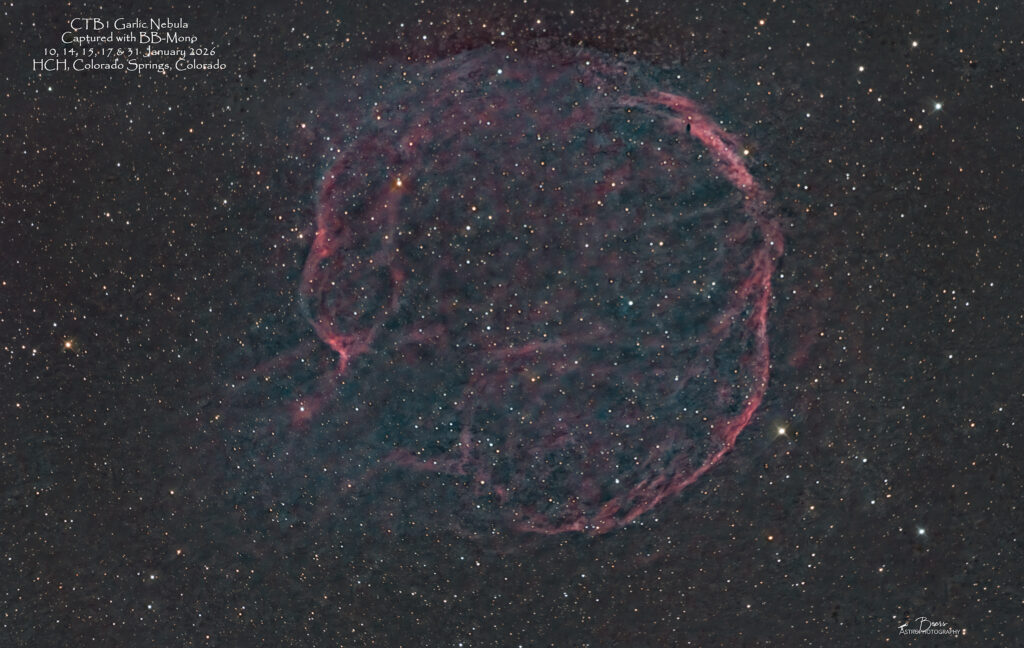
The CTB1 Garlic Nebula gallery (https://beersastrophotography.com/gallery/ctb1-garlic-nebula/) shows the evolution of my imaging of CTB1 Garlic Nebula – absolutely a documentary describing the fits-and-starts along the way to a “yet to be produced” final product! This has definitely been a challenging object for me – the one and only object where my dark skies image in NOT better than the rest! (…and when I add the dark skies data in with the mono data – it ruins that too!). This is definitely a “work in progress” – I need way more data, so this likely going to be my late fall/winter obsession during front patio imaging, like the SH2-129/Ou4 has been my late spring/summer obsession.
Image Data & Processing Summary
- Data capture: 10, 14, 15, 17 & 31 January 2026 (through the majority of which, I was struggling with data download issues – thus the accounting of “efficiency” below).
- 10Jan: 36x1min, 29x5min = 181 min, (3:01hrs);
- 14Jan: 30x1min, 32x5min = 190min (3:10hrs);
- 15Jan: 36x5min subframes = 180min (3:00hrs);
- 17Jan: 43x5min subframes = 215min (3:35hrs);
- 31Jan: 39x5min subframes = 195min (3:15hrs)
- Total data in image = 66x1min, 179x5min = 961minutes (16:01hrs).
- Shooting location: HCH front patio, Colorado Springs, CO
- Processing: Data collection with SGP sequence; image review with Seti Astro Blink Comparator; stack with Astro Pixel Processor (APP); combine mono images using APP RGB Combine Tool (RGB, HOO); Star removal with Starnet++; image processing with Photoshop/Lightroom
Sequence plan (Mono Data– 10Jan2026): Gain 100, Offset 50, Temp 0°C. Plan was: 20x1min RGB, 12x5min HSO. Captured 10Jan2026 18:21MST – 23:14MST (4:53 hrs). Total imaging data time: 36x1min, 29x5min subframes = 181 min; 3:01hrs.
- Red 20x1min, 10Jan2026, 18:21MST – 18:48MST (27min elapsed, 20min data)
- Blue 16x1min, 10Jan2026, 18:51MST – 19:13MST (22min elapsed, 16min data)
- Error occurred here, put sequence in recovery mode (19:13 – 20:14)
- Ha 12x5min, 10Jan2026, 20:14MST – 21:24MST (70min elapsed, 60min data)
- OIII 12x5min, 10Jan2026, 21:30MST – 22:41MST (71min elapsed, 60min data)
- SII 5x5min, 10Jan2026, 22:47MST – 23:14MST (27min elapsed, 25min data)
Sequence plan (Mono Data– 14Jan2026): Gain 100, Offset 50, Temp 0°C. Sequence ran: 14Jan2026 18:41MST – 22:46MST (4:05 hrs). Total data capture time: 30x1min, 32x5min subframes = 190min (3:10hrs)
- Green: 30x1min, 14Jan2026 18:41MST – 19:35MST (with time between 18:44 – 18:57 used for the ASIImg capture (41min elapsed, 30min data: 73% efficiency)
- Ha: 12x5min, 14Jan2026, 19:41MST – 20:46MST (65min elapsed, 60min data: 92% efficiency)
- OIII: 12x5min, 14Jan2026, 20:52MST – 21:56MST (64min elapsed, 60min data: 94% efficiency)
- SII: 8x5min, 14Jan2026, 22:03MST – 22:46MST (43min elapsed, 40min data: 93% efficiency)
Sequence plan (Mono Data– 15Jan2026): Gain 100, Offset 50, Temp 0°C. Sequence ran: 15Jan2026 18:28MST – 21:46MST (3:18 hrs). Total data capture time: 36x5min subframes = 180min (3:00hrs).
- OIII: 20x5min, 15Jan2026, 18:28MST – 20:15MST (1:47hr, 107min elapsed, 100min data: 93%)
- SII: 16x5min, 15Jan2026, 20:21MST – 21:46MST (1:25hr, 85min elapsed, 80min data: 94%)
Sequence plan (Mono Data– 17Jan2026): Gain 100, Offset 50, Temp 0°C. Sequence ran: 17Jan2026 18:21MST – 22:44MST (4:23 hrs). Total data capture time: 43x5min subframes = 215min (3:35hrs).
- OIII: 20x5min, 17Jan2026, 18:21MST – 20:08MST (1:47hr elapsed, 100min data: 93% efficiency)
- SII: 18x5min, 17Jan2026, 20:14MST – 21:50MST (1:36min elapsed, 90min data: 94% efficiency)
- Ha: 5x5min, 17Jan2026, 21:56MST – 22:44MST (48min elapsed, 25min data: 52% efficiency)
- Note: didn’t see the data download error here (but this was back to capturing every other 5minute subframe, with a 5 minute gap in-between)
Sequence plan (Mono Data– 31Jan2026): Gain 100, Offset 50, Temp 0°C. Sequence ran: 31Jan2026 18:26MST – 21:57MST (4:23 hrs). Total data capture time: 39x5min subframes = 195min (3:15hrs).
- SII: 18x5min, 17Jan2026, 20:14MST – 21:50MST (1:36min elapsed, 90min data: 94% efficiency)
- Ha: 5x5min, 17Jan2026, 21:56MST – 22:44MST (48min elapsed, 25min data: 52% efficiency)
Processing Notes: I used my newly gained knowledge of the APP RGB Combine formulas, gleaned from the experiment with the M42 data to “relatively quickly” combine the individual filters’ .FITS stacked images into a combined color image for further processing. I started with RGBHOO (that worked well for M42, but for CTB1 all that could be seen was a mis-colored star field with virtually no nebulosity visible. I then switched to HOO1, still saw a miscolored star field, but a bit more nebulosity (outer edge) was visible – so I went with that formula for the nebulosity. For the star field, I started with RGB1. Result was too much green in the background and teal color in the stars; switched to RGB2 which was a little better, but still a green tint – that I was able to work with in further processing.
My processing workflow: Collect data with SGP sequence; review/culled images in Seti Astro; stacked 100% of 233 subframes (R,G,B,Ha,SII,OIII) in two separate sessions because of the different flat frames captured on 28Jan2026 at 95° camera angle (session 1: 31Jan2026; Session 2: 10, 14, 15, 17 Jan 2026), and set LNC to 1 and 3 iterations; combine Red.FITS, Green.FITS, Blue.FITS using APP Combine Tool formula RGB2 (for star field); combine Ha.FITS, SII.FITS, OIII.FITS using APP Combine Tool formula HOO1; remove stars with Starnet++; import STARLESS and STARS+NEBULA images into Lightroom for processing in LR & Photoshop.