
Switching obsessions – Bats & Squids for Garlic
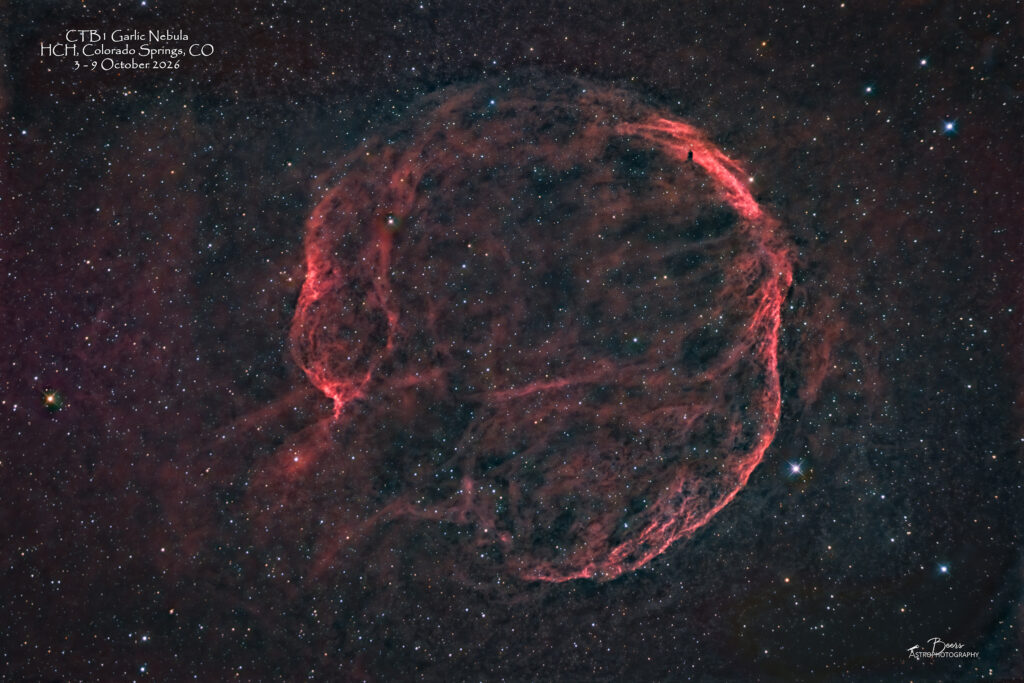
The New Moon period in early October looked like Mother Nature was finally going to be kind and give us clear skies in the Kiowa National Grasslands of New Mexico. But alas, she decided to precede those clear skies with torrential rains and flooding from the remnants of Hurricane Polo in New Mexico (it’s always something with her!). With 4–8 inches of rain forecast for the Grasslands, we had flashbacks of last September’s trip — being chased out after just one night by vicious mosquitoes and having to build a bridge out of very large rocks to get through the huge mud puddle at the cattle guard. So, we cancelled the trip, and I switched my dark-skies plan to a front-patio mono-camera plan.
I decided to give my spring/summer OCD target, the SH2-129 Flying Bat & Ou4 Giant Squid, a break and spend some time on the CTB1 Garlic Nebula, transferring the mono camera from SC (Southern Cross) to BB (Big Bertha). That turned out to be a bit of a re-learning experience that took me a couple of days to figure out! When rotating the mono camera to a 90° camera angle, you need to rotate the bottom of the filter wheel up toward the 1200 position, NOT down toward the 0600 position. Otherwise, you end up with collisions with the tripod legs both before and after the meridian. Who knew a simple camera rotation could be so complicated?!
Once I finally figured that out — and decided to increase the OIII subframe time from 5 minutes to 10 minutes — I started collecting a full night’s worth of good data, which resulted in the image below. There’s still work to be done before this image is worthy of printing (my personal litmus test for an image), so this may well become my fall/winter target obsession.
And now, are you thinking about all those recipes that could use a really big piece of garlic? 😁
One final (?) look at the Flying Bat & Giant Squid
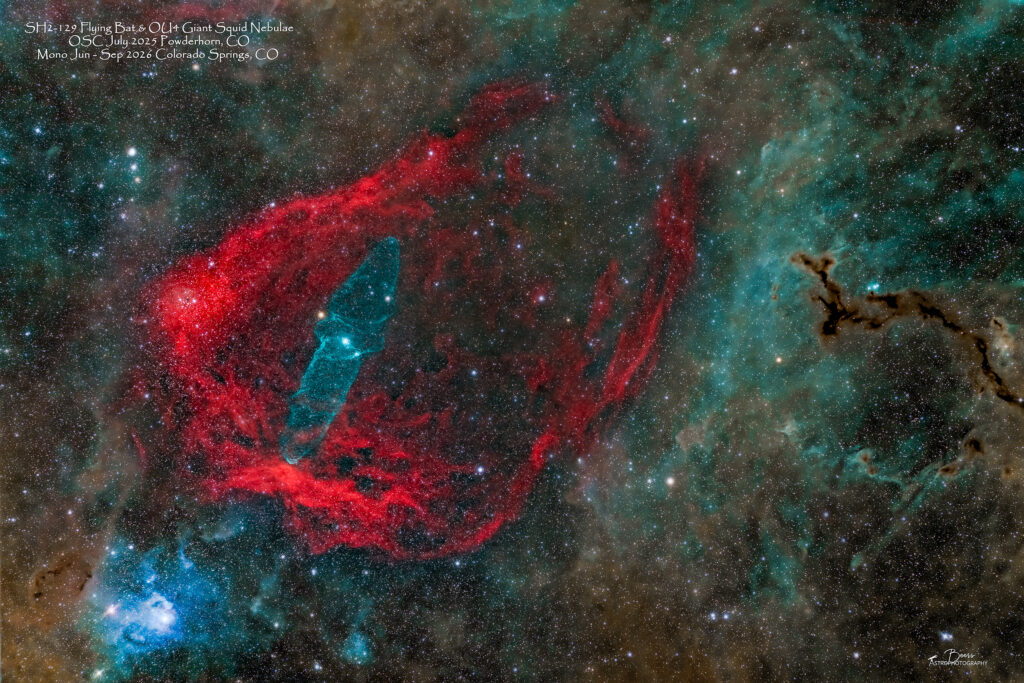
The summer project of collecting data on my “OCD” target continues…or maybe concludes?? At this point, it seems less a matter of collecting more data and more a matter of refining my mono processing skills. But when Thursday night (10 Sep—the New Moon) was forecast to be completely clear in Colorado Springs (albeit a bit windy to start the night), I couldn’t resist one more “data fix” on SH2-129. This time, I focused primarily on Ha, with a little OIII thrown in at the end of the night for good measure, giving me some fresh data for the processing experiments I mentioned after working through the 4 September data.
Until I can spend some dedicated time under truly dark skies, this may be my “final” version of the SH2-129 Flying Bat & Ou4 Giant Squid Nebulae. Although, as with “never say never,” you never really say “final” when it comes to astrophotography processing! 😉For now, though, it’s time to move on to some of those Fall and Winter nebulae!
Summer data collection project – September data boost
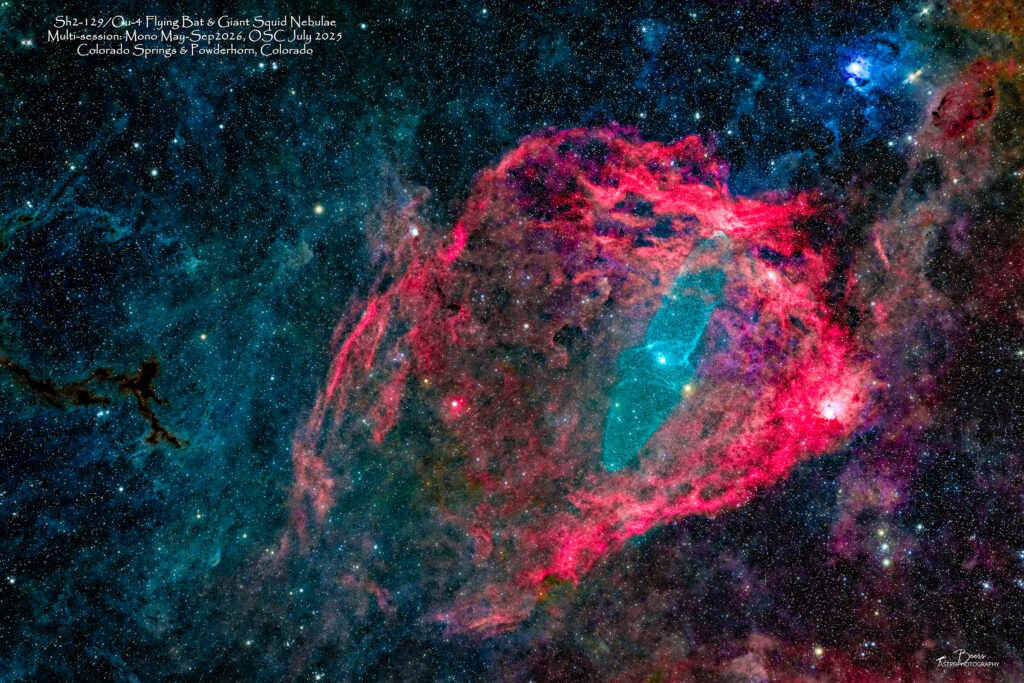
The summer project of collecting data on my “OCD” target—SH2-129 Flying Bat / Ou4 Giant Squid—continues! Once again, Mother Nature apparently got wind of our New Moon dark-skies trip plans and decided to fill the week leading up to the New Moon, and the weekend itself, with storms and clouds. On Friday night, 4 September, our renovation project’s stucco crew had finished their work and, thankfully, removed the scaffolding from in front of the front patio’s sliding glass door. The forecast was calling for a mostly clear night, so I decided to take advantage of both the newly re-accessible patio and the clear skies to get the telescope out and capture more 15-minute OIII subframes of the Flying Bat and Giant Squid. This image adds another approximately seven hours of OIII 15-minute subframes to the data included in the July edition (mono data from May, June, and July, plus OSC data from July 2025). I’d still love to get some dark-skies data into the mix—but for now, we’ll keep those plans under wraps! 😉
Partial Lunar Eclipse – August Sturgeon Moon
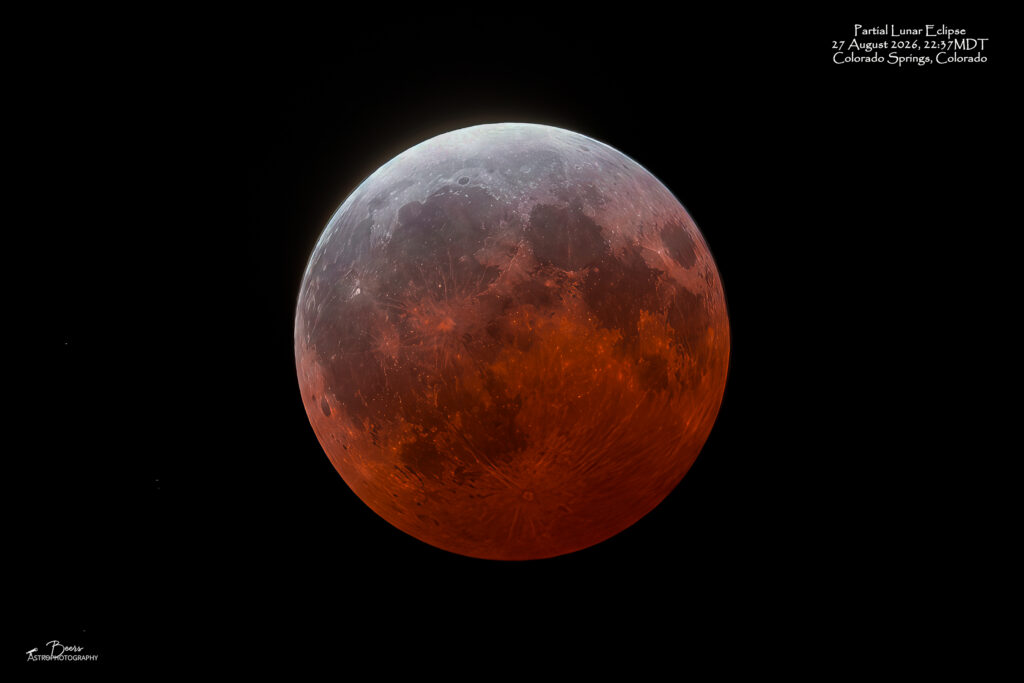
In last month’s blog and newsletter, I promised a break from the Flying Bat/Giant Squid with some Milky Way shots during the August New Moon. Big mistake! Publicizing those plans gave Mother Nature just enough lead time to whip up a massive storm system across the Midwest. With thick clouds stretching from Colorado to Iowa, both our flying trip in the Cardinal and our Milky Way shoot over the Bridges of Madison County were scrubbed.
However, because I paid zero attention to the partial lunar eclipse until the last second, I snuck one past her during August’s Full Moon. That oversight gave me just enough of a gap in the clouds to capture the eclipsed Sturgeon Moon from the front patio.
Summer data collection project – July installment
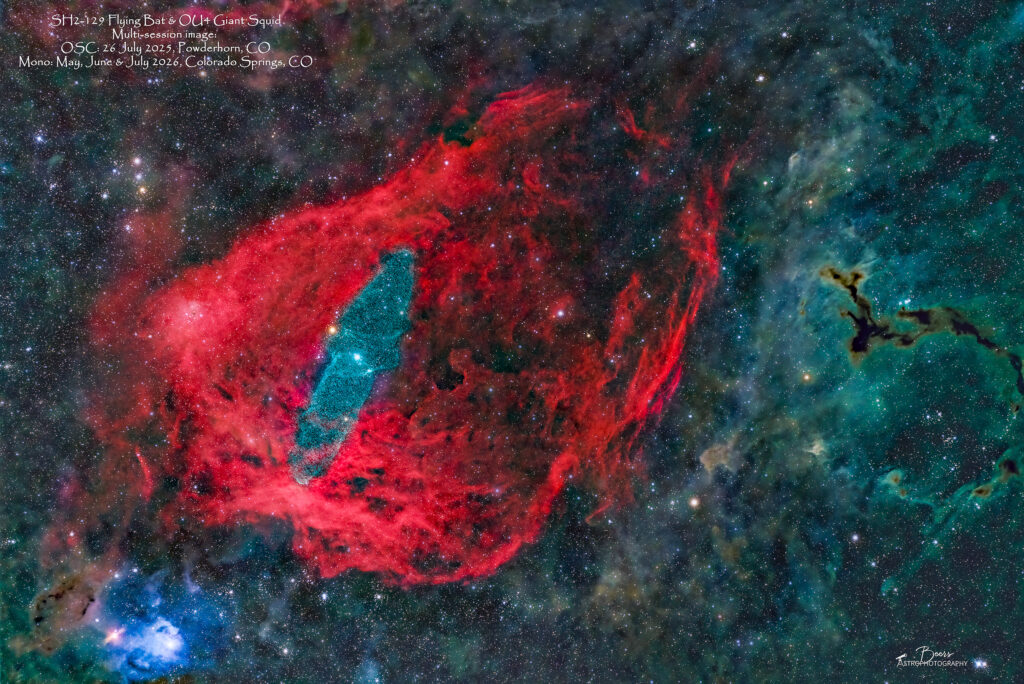
The summer project collecting data on my “OCD” target – SH2-129 Flying Bat / Ou4 Giant Squid continued through the clear sky nights on the front patio preceding the New Moon (11-14July2026) and my departure for EAA on 16 July 2026. July’s data collection mostly focused on collecting 15-minute subframes of OIII data.. This image, getting better but still a work in progress, is comprised of Ha and OIII data collected with the mono camera from the front patio on: 29 & 30 May 2026; 10, 11, 12, 16, 18, & 20 June 2026; and 11-14 July 2026. The mono data were again combined with OSC data captured in July 2025 at Powderhorn with the same telescope/reducer.
Summer data collection project – June installment
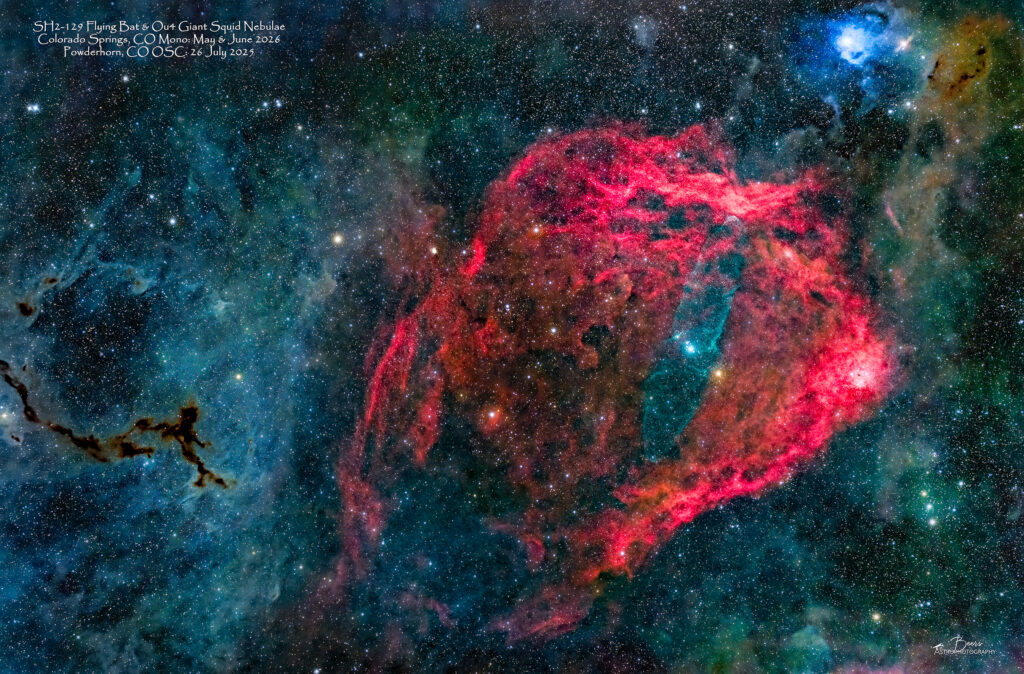
The summer project collecting data on my “OCD” target – SH2-129 Flying Bat / Ou4 Giant Squid continued through the clear sky nights on the front patio throughout June 2026. This image, getting better, but still a work in progress, is comprised of data collected with the mono camera from the front patio on: 10, 11, 12, 15, 16, 17, 18, and 20 June 2026; added to the mono data in last month’s “summer project kick-off image” collected 15, 16, 23, 29, and 30 May 2026. The mono data are again combined with data captured in July 2025 at Powderhorn with the same telescope/reducer and the one-shot color camera.
What? Unprocessed data – can’t have that!

Near the end of the month of my January 2026 mono imaging extravaganza (described in the blog: https://beersastrophotography.com/photography-journals/january-2026-mono-imaging-and-equipment-fix/), I felt like I’d gathered enough data on IC434 Horsehead Nebula. I also had the ZWO Dev Team’s new firmware and FPGA software loaded into my mono camera, meant to address my data download issues. With the clear skies (albeit during January’s Blue Moon (second full moon in the same month)), I decided to check out the fix and go back and collect a bit more data on M42 Orion and CTB1 Garlic Nebulae to combine with the data I’d gathered earlier. I successfully collected the data, transferred it to my processing computer and then promptly forgot about it as I started my trip planning for Chile (astrophotography trip, 13-24Mar2026). That trip was almost immediately followed by a work trip to Australia (work trip, 24Apr-8May2026). So, the data processing was lost off my to-do list until recently when I was updating my journal with the late May 2026 image processing of SH2-129 Flying Bat / Ou4 Giant Squid. Luckily, the data didn’t go anywhere and was patiently waiting for my returned attention…which happened starting last weekend (while I was gathering more data on SH2-129/Ou4 and waiting until I ran out of clear nights during the June 2026 New Moon period before I began processing a new version of the Flying Bat & Giant Squid!). This blog describes the late January 2026 data collection and multi-session mono processing of the M42 Orion and CTB1 Garlic Nebulae and provides pointers to their gallery pages where you can see the evolution of each objects’ images.
It’s Back… Flying Bat & Giant Squid visible again!
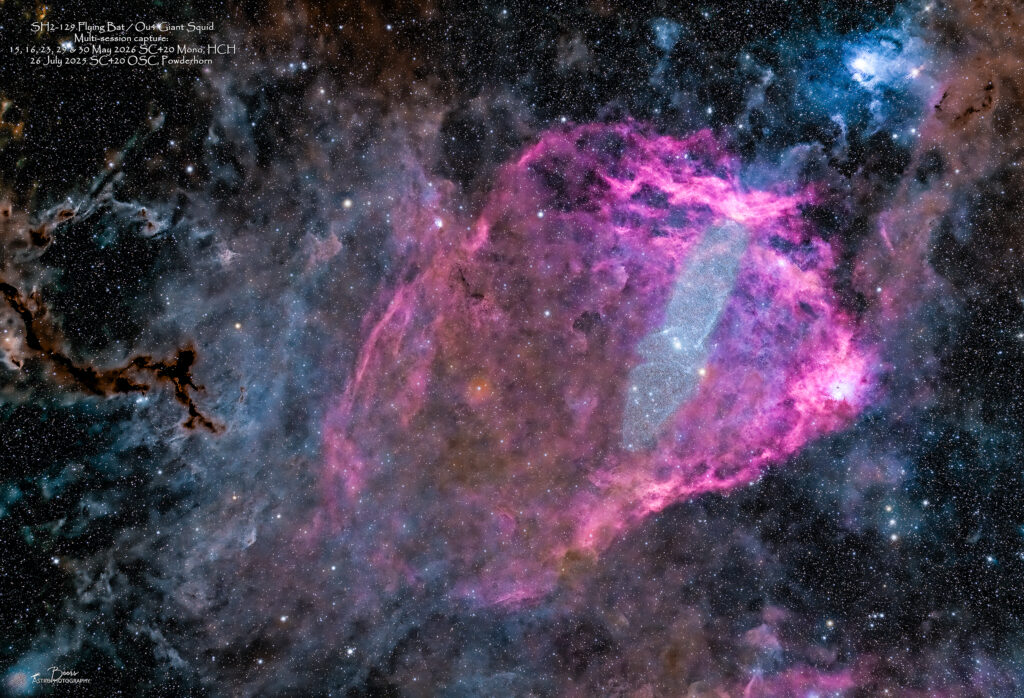
Back from Chile (astrophotography trip, 13-24Mar2026) and back from Australia (work trip, 24Apr-8May2026), the May 2026 New Moon weekend, partially clear at home, allowed me to dust off the mono imaging camera and take the new version of Sequence Generator Pro (SGP v4.5.0.1638 (released 24 Apr 2026)) for a test drive. This started a month’s long visit back to my “OCD” target – SH2-129 Flying Bat / Ou4 Giant Squid. This image, definitely a work in progress (likely all throughout the summer and early fall while it’s visible) is comprised of data collected with the mono camera from the front patio on: 15, 16, 23, 29, and 30 May 2026. The mono data are combined with data captured with the same telescope/reducer and my one-shot color camera in July 2025 at Powderhorn, Colorado.
Sequence Generator Pro CSASTRO presentation
Our Colorado Springs Astronomical Society (CSASTRO) club has a monthly Imaging Group meeting. The organizer and host, Brian Clary, started an image capture series last month with his presentation on N.I.N.A. At the end of that meeting, he asked if anyone could give a similar presentation on Sequence Generator Pro. Since that’s the software that I use, I volunteered to give May’s presentation. The meeting was on Tuesday, 12 May 2026, at Brian’s house in Black Forest and on-line through GoMeeting. Brian shared the link to the GoMeeting recording with us, so I thought I’d share it with you…for any of you who are (really bored) or interested in learning a bit about how the capture process works.
Frankenmosaic of the Vela Supernova Remnant
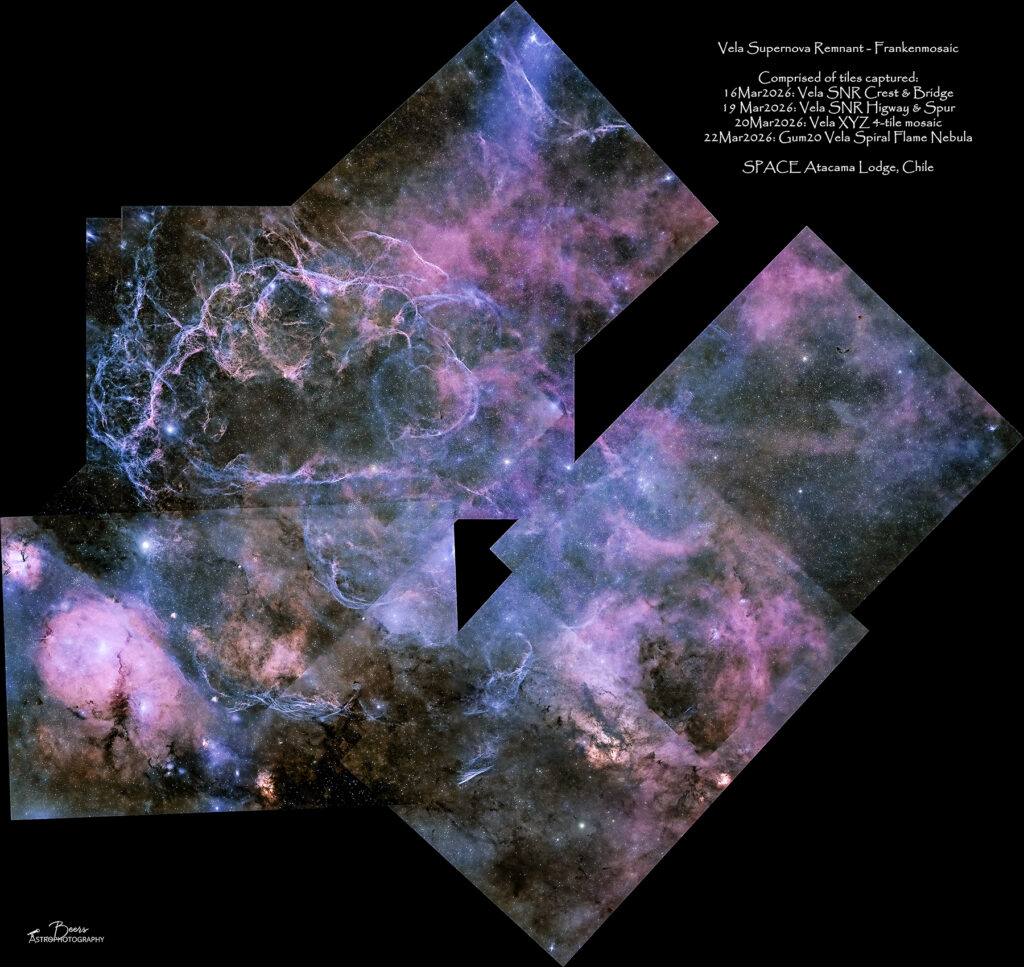
I mentioned when I posted the Chile trip images, I had an issue while capturing the Vela SNR 4-tile mosaic (the camera angle was 90° off-plan) that precluded those 4 tiles from mosaicking together (there was no overlap between tiles#1-2 and #3-4). Once I got the rest of the trip’s processing and posting done, I planned to revisit the data to see what could be done with it. I ended up mosaicking those 4 tiles with the tiles created from the data the other three nights’ data from the Vela SNR region. It’s a Frankenmosaic for sure, but as I’ve done before (and since you’ve signed up for the ride on this journey!), I’m sharing the good, bad, and UGLY with you!