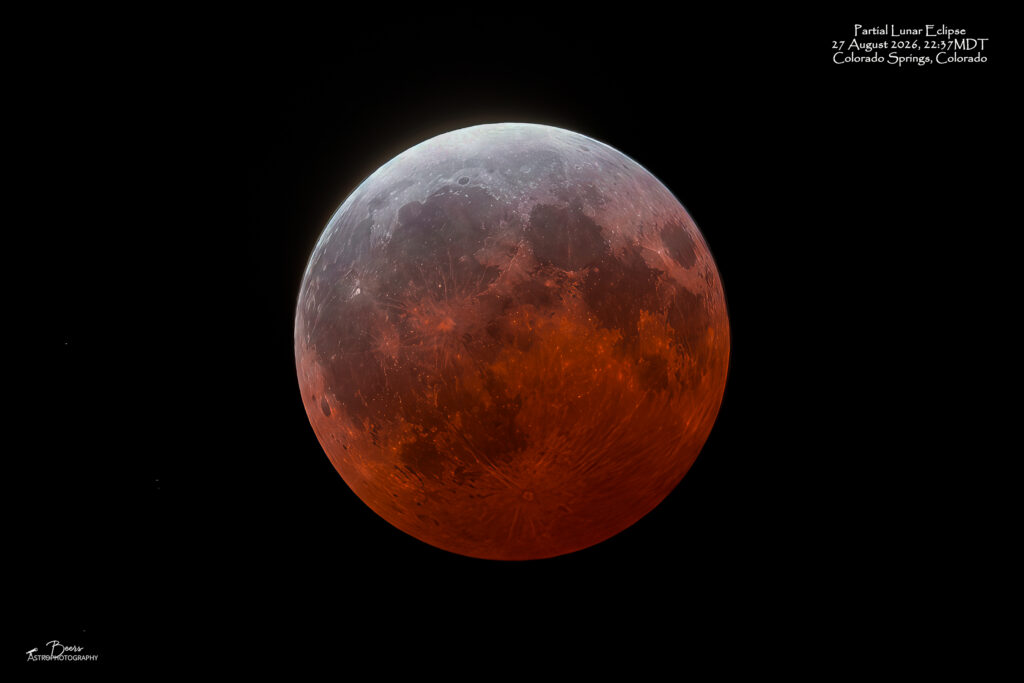
Partial Lunar Eclipse, captured from Colorado Springs, Colorado on 27 August 2026, 22:39MDT
Fun facts
The Full Moon of August is traditionally called the “Sturgeon Moon.” The Full Moon names used by The Old Farmer’s Almanac have different origins, including Native American, Colonial American, and European sources. Traditionally, each Full Moon name was applied to the entire lunar month in which it occurred, not solely to the Full Moon. The name Sturgeon Moon comes from the giant lake sturgeon of the Great Lakes and Lake Champlain; this native freshwater fish was readily caught during this part of summer and an important food staple for Native Americans who lived in the region. At one time, the lake sturgeon were quite abundant in late summer, though they are rarer today.
{ From: https://www.almanac.com/content/full-moon-august }
A partial lunar eclipse occurred at the Sturgeon Moon’s ascending node of orbit on Friday, August 28, 2026 (UTC) with an umbral magnitude of 0.9319. This lunar eclipse was the last of an almost tetrad, with the others being on March 14, 2025 (total), September 8, 2025 (total), and March 3, 2026 (total). {I had to look it up, so I’ll save you the trouble…In astronomy, a tetrad is a set of four total lunar eclipses within two consecutive years}
A lunar eclipse occurs when the Moon moves into the Earth’s shadow, causing the Moon to be darkened. A partial lunar eclipse occurs when one part of the Moon is in the Earth’s umbra, while the other part is in the Earth’s penumbra. Unlike a solar eclipse, which can only be viewed from a relatively small area of the world, a lunar eclipse may be viewed from anywhere on the night side of Earth. Occurring about 5.8 days after apogee (08:20 UTC, August 22) and about 9.7 days before perigee (20:26 UTC, September 6), the Moon’s apparent diameter was less than average.
{From: https://en.wikipedia.org/wiki/August_2026_lunar_eclipse }
Equipment
- Camera: Canon EOS 5DSR
- Lens: Tamron SP 150-600mm F/5-6.3 telephoto lens
- Hand-conroller: Pixel TW-283 E3 Wireless Shutter Release Cable Wired Remote Control
Capture & processing notes
I captured the March 2026 Total Lunar Eclipse using my telescope and dedicated astronomy camera. If you want to relive that debacle, feel free to check out my Total Lunar Eclipse notes. I wrapped up that post asking, “So many lessons learned—but will I actually remember them during the next eclipse?”
Spoiler alert: my track record for event knowledge management is pretty poor, so I completely forgot about that “seemed like a great idea at the time” night. In fact, if it weren’t for a heads-up from Ann Chavtur earlier in the day and a last-minute reminder from Victoria right as I was heading to bed, I would have missed it entirely. Spurred into action, I grabbed my gear to see if Mother Nature would grant us a clear view through the recent cloud cover.
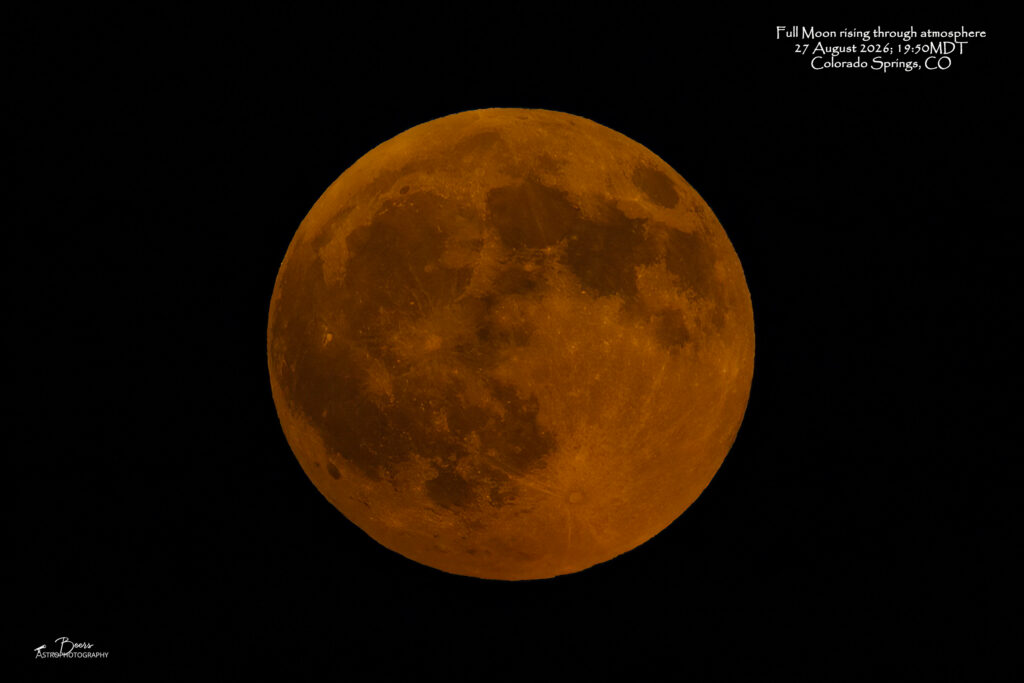
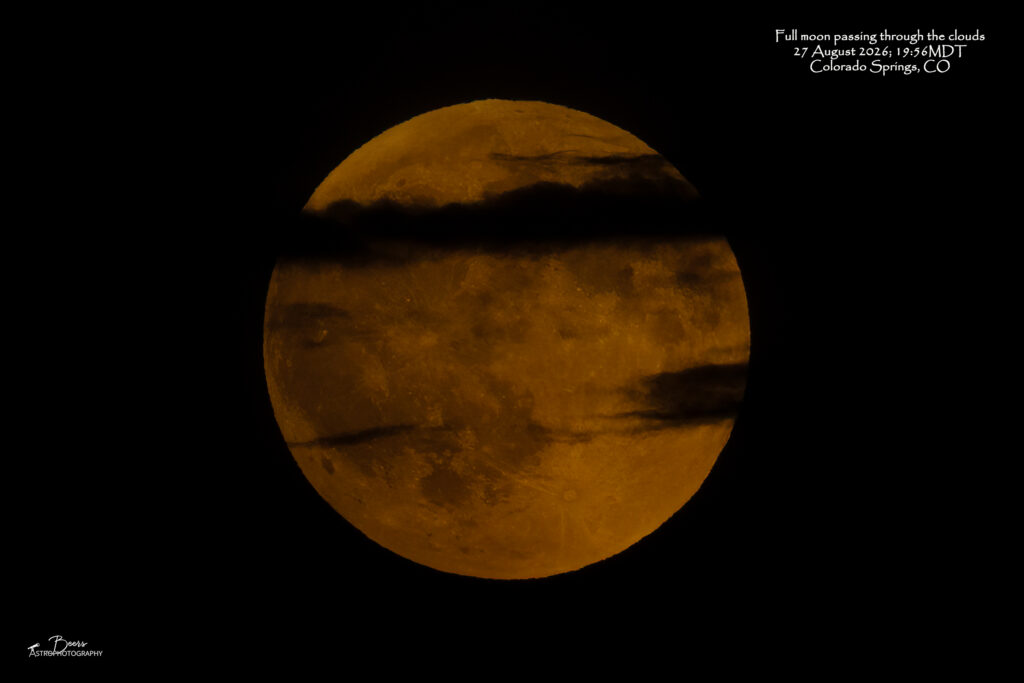
After setting up the camera, tripod, and hand controller, I stepped outside around moonrise (~19:50 MDT) to dial in the focus. The rising full moon already had a striking, eclipse-like orange hue as it passed through the lower atmosphere. It drifted through a few light cloud layers before vanishing into a dense cloud bank. To protect the gear from potential rain, I brought the camera inside and set an alarm for 22:00 MDT—just ahead of maximum eclipse at 22:13 MDT. My plan was to skip the full sequence and take just a “few” quick frames, but that “few” quickly ballooned into 234 shots captured between 22:05 and 22:40 MDT!
Consulting the Lunar Eclipse Exposure Guide alongside PhotoPills (which listed a magnitude of 0.93), I calculated my starting exposure settings: ISO 400, f/11, and a shutter speed between 1/15 and 1/30 second.
Eclipse timing/Sequence plans: Here are the start times for each phase of the eclipse. For a partial eclipse, PhotoPills (the app I use for eclipse and Milky Way planning) bins the time spent inside Earth’s umbra together rather than breaking it down into distinct U2, Max, and U3 windows. As a result, this was less of a rigid sequence plan and more of a real-time adjustment of my exposure settings as the eclipse progressed.
- P1: 19:25MDT
- Start occurred before the moon rose above the horizon. 21 images of the Full Moon rising through the atmosphere and into the clouds were captured during the P1 phase using: ISO400, f/11, 1/400sec.
- U1: 20:34MDT
- Set my alarm for 22:00MDT and began imaging/dialing in the settings at 22:06MDT (technically while the moon was still in U1, Earth’s Penumbra), but there wasn’t much of a visible difference between the tail end of U1 and the U2-Max-U3
- U2 – Max – U3: 22:13MDT
- 22:06 – 22:08MDT: 12 images to dial in settings, ranging between ISO 400-1600 and t= 1/30 – 1/4 seconds
- 22:08 – 22:19MDT: 101 images at 5 second intervals (controlled by remote hand controller) at: f/11, ISO1600, t=1/4 second
- 22:19 – 22:40MDT: 100 images captured using a “manual” bracketing switching back and forth between short (1/15 – 1/60 second) exposure to capture the non-eclipsed (bright) portion of the moon and long (1/4 – 0.5 second) exposure to capture the eclipsed (darkened) portion of the moon
- The two images used to create the “HDR” image at the top of this gallery were captured:
- 22:39:15MDT, ISO1600, f/11, 1/60sec (non-eclipsed portion of the moon)
- 22:39:27MDT, ISO1600, f/11, 0.5sec (ecliped portion of the moon
- U4: 23:53MDT
- P4: 01:02 MDT
Processing:
To create the HDR image: Brought both images into Photoshop as layers. Masked the non-eclipsed image, aligned and blended. Made final image exposure, vibrance, saturation, and sharpening adjustments in Lightroom.
Summary
Capture: 27 August 2026; 22:06 – 22:40MDT
Shooting location: Colorado Springs, Colorado
Processing: Captured with Canon EOS 5DSR; two individual images blended to create an “HDR” image with Photoshop/Lightroom
August 2026 Partial Lunar Eclipse images
There isn’t much “action” in a partial lunar eclipse, so out of the roughly 230 images I captured, I only processed three to share here: two pre-eclipse shots of the Full Moon during P1, and one composite “HDR” image.
The two pre-eclipse images feature the moon rising through the lower atmosphere—where atmospheric refraction gave it a deep orange hue that looks strikingly like a total eclipse—and transiting through a thin cloud layer. The final HDR image was created by blending two separate exposures to properly capture both the brightly lit and shadowed portions of the moon.