
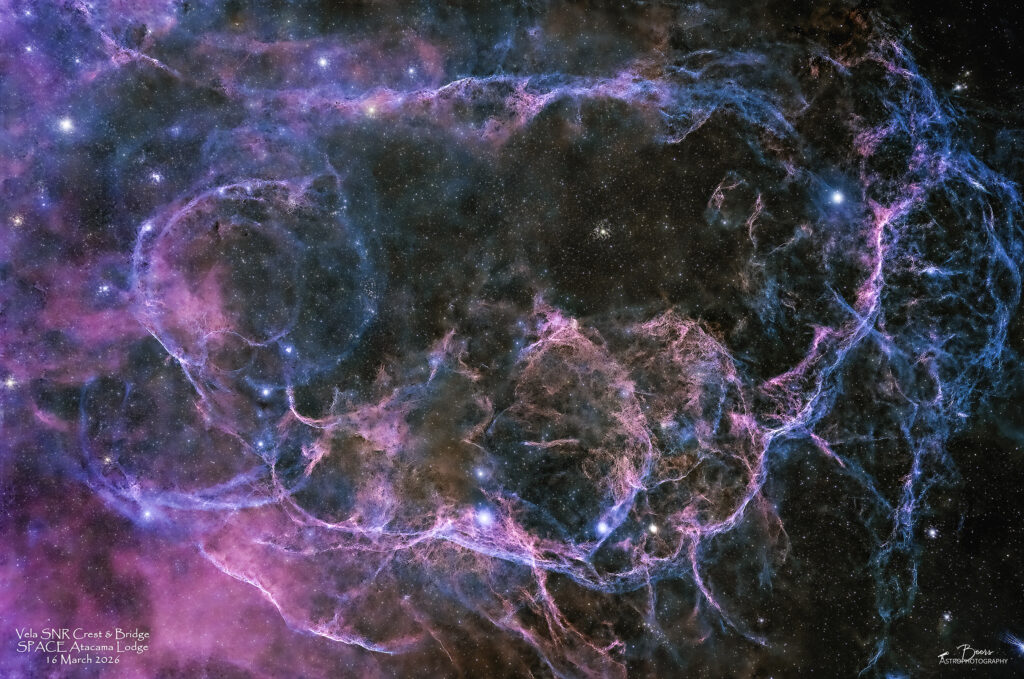
Fun facts
The Vela supernova remnant is a supernova remnant in the southern constellation Vela. Its source Type II supernova exploded approximately 11,000 years ago (and was about 900 light-years away). The association of the Vela supernova remnant with the Vela pulsar, made by astronomers at the University of Sydney in 1968, was direct observational evidence that supernovae form neutron stars.
The Vela supernova remnant is one of the closest known to us. The Geminga pulsar is closer (and also resulted from a supernova), and in 1998 another near-Earth supernova remnant was discovered, RX J0852.0-4622, which from our point of view appears to be contained in the southeastern part of the Vela remnant. This remnant was not seen earlier because when viewed in most wavelengths, it is lost in the Vela remnant.
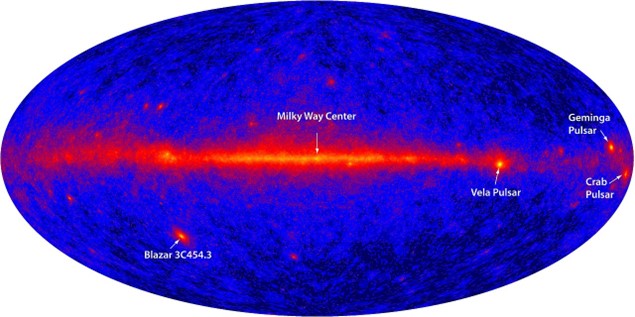
Distance: ~936 light years
Apparent Magnitude: 12
Apparent Dimensions: 8 degrees (approximately
Constellation: Vela
Designations: Vela XYZ, Gum 16, SNR G263.9-03.3, 1E 0840.0-4430, RE J083854-430902
{ From: https://en.wikipedia.org/wiki/Vela_Supernova_Remnant }
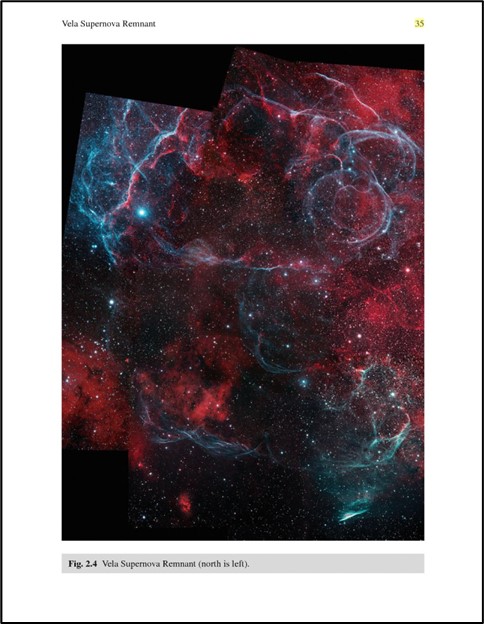
The book, Imaging the Southern Sky by Stephen Chadwick & Ian Cooper (an EXCELLENT reference that I used to plan all my targets for this trip) describes the Vela Supernova Remnant on pp 34-54, including an overall image and reference chart shown below.
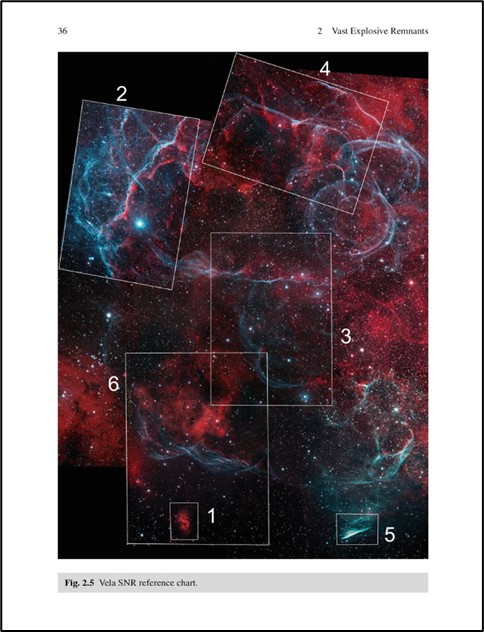
- Gum20
- Crest and the Bridge
- Twin Crescents and the Bypass
- Highway and the Spur
- Pencil Nebula
- Spiral Flame Nebula
Reference Chart #2: Crest and the Bridge: Chadwick & Cooper Vela SNR reference chart p. 36 – this image captures the eastern half including #2 Crest and Bridge, #4 Highway and the Spur, and half of #3 Twin Crescents and the Bypass
The Crest comes from the region around the fourth magnitude star e Velorum. Apart from the Pencil Nebula, this is the brightest section of the Vela SNR. In images with north at the top the highway appears to have reached a crest before turning north and then west to trail away in a plume-like spur. Back along the highway we find a bright bifurcated section reminiscent of the symbol for a bridge in civil engineering drawings with a short spur line running underneath the bridge.
{From: Imaging the Southern Sky; Stephen Chadwick and Ian Cooper; pp. 39-41}
Capture & Processing Notes
This image was captured on the second imaging night of my 2026 Atacama Desert trip and I was determined NOT to repeat the last two years’ polar alignment experience. (Spend 2 hours the first night, then do not immediately recognize the Sigma Octantis template pattern stars and start moving the mount around – wildly – in search of them. Ending up spending 6 hours on the second night to achieve polar alignment). I most certainly did not! On night #1, with the help of NINA 3-point polar alignment, I was assured that the pole star and its neighbors were seconds away from aligned and sure to be in the Polemaster field of view. I stared at the Polemaster screen until I found them – the start-up process on night #1 took me 43 minutes. On night #2, again, I was determined to NOT touch anything until I spotted the Sigma Octantis template stars. Since it was in approximately the same place and rotation aspect as night #1 – it took me 5 minutes to complete the polar alignment!! I put away the Polemaster and got the sequence going – 23 minutes from start to completion of first 5-minute subframe!! Wooohooo!
Sequence Plan: Gain 158, Offset 30, Temp 0°C; 59x5min, 295min (4:55hrs); Collected 16Mar2026, 20:48 Chilean Daytime Time (CDT) – 17Mar2026, 02:15CDT.
Processing summary: Captured with SGP. Stacked in APP. Star removal with Starnet++. Processed in LR/PS
Equipment
All equipment controlled by HP Probook (DSO CTRL 1) Windows 11 laptop running Sequence Generator Pro v4.4.0.1441.
- Imaging (ASI2400-SC420): ZWO ASI2400MC imaging camera; (Southern Cross) Askar FRA600 108mm; f/5.6 Quintuplet Petzval Flat-Field Astrograph with Askar 0.7x reducer for FRA600
- Mount: Rainbow Astro RST-135E (controlled by iHubo ASCOM driver)
- Polar alignment: QHYCCD camera (controlled by Polemaster for polar alignment)
- Autoguiding: Orion 60mm Multi-Use Guide Scope with ZWO ASI120MM mini mono camera (controlled by PHD2)
- Autofocuser: ZWO EAF Electronic Automatic Focuser (EAF-5V-STD)
Summary
Captured: 16 March 2026, 20:48 Chilean Daytime Time (CDT) – 17Mar2026, 02:15CDT. 59x5min, 295min (4:55hrs).
Shooting location: SPACE Atacama Lodge, San Pedro de Atacama, Chile
Equipment: ZWO ASI2400MC imaging camera; (Southern Cross-420mm) Askar FRA600 108mm; f/5.6 Quintuplet Petzval Flat-Field Astrograph with Askar 0.7x reducer for FRA600; Rainbow Astro 135E mount
Processing summary: Captured in SGP, stacked in APP (Adaptive Airy), star removal with Starnet++, processing with LR/PS
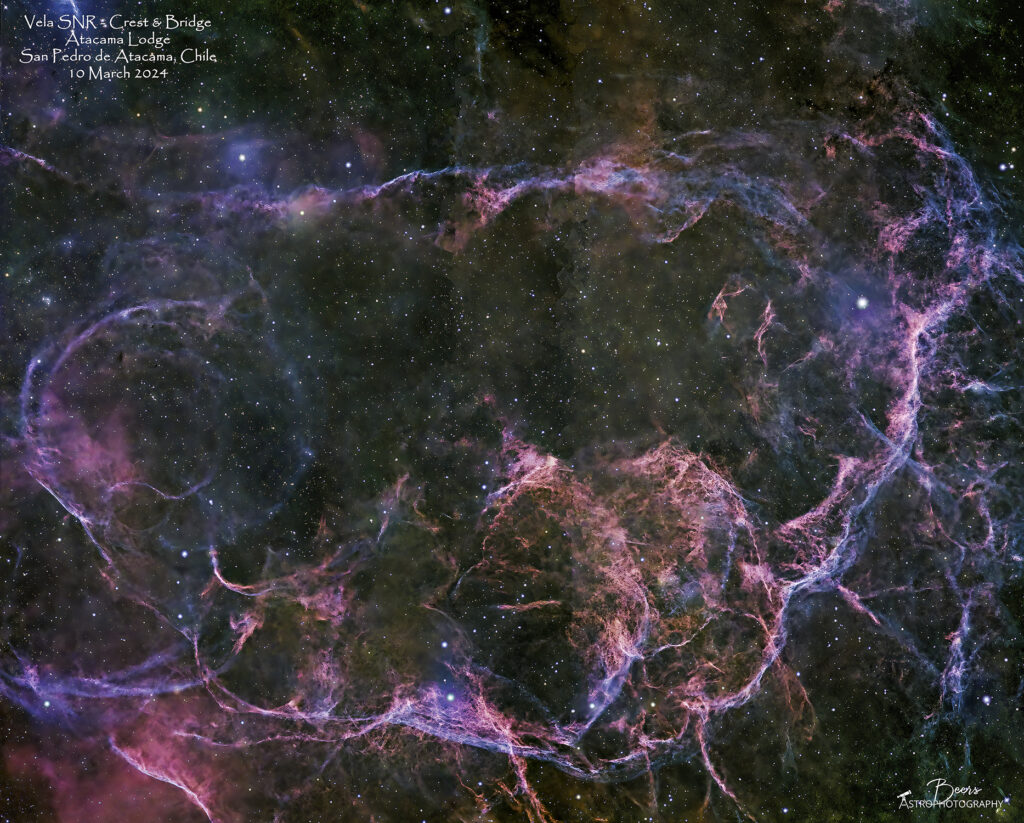
Previously captured images of Vela SNR Crest & Bridge
Capture & Processing Notes
On night #5 of the 2024 Atacama Desert trip, I imaged a two-tile image of the Vela SNR Crest & Bridge from sunset until it set at 0400. Then switched to (what I’m calling) the Carina group (Keyhole, Banana, Whirling Dervish, Gabriel Mistral) from 0400 until sunrise at 0645.
The only issue I encountered was during the meridian flip. For the first time, the time of the meridian in SGP was exactly at the time of the meridian flip as opposed to 20 minutes past, that I’m accustomed to and had been showing since I turned off the auto meridian flip earlier in the trip when I was having issues with it. As a result, I got up and outside (and Danita joined me!) at exactly the meridian flip time. When I attempted the flip, the telescope returned to the west side of the pier. I terminated the sequence, rebooted everything and waited until about 8 minutes after the meridian, then the flip worked fine.
I got up to check the switch between the two tiles – that as usual, went smoothly. Although in processing, they were slightly misaligned requiring a cropping of some of the edges. There was also a noticeable seam between the two tiles – definitely cause for recapture (and perhaps processing and posting the individual tiles, when time allows).
Sequence Plan:
- Sequence plan: Two-tile mosaic.
- Tile#1: Captured 38x5min, Total time = 190min, 3:10 hrs. Captured 10Mar2024, 2101CDT – 11Mar2024, 0044CDT
- Tile#2: Captured 36x5min, Total time = 180min, 3:00 hrs. Captured 11Mar2024, 0045CDT – 11Mar2024, 0401CDT
- Captured: Night of 10 March 2024 (10Mar2024, 2101CDT – 11Mar2024, 0401CDT);
- Shooting location: Atacama Lodge, San Pedro de Atacama, Chile
Processing summary: Captured with SGP. Stacked in APP. Star removal with Starnet++. Processed in LR/PS
Equipment
All equipment controlled by HP Probook (DSO CTRL 1) Windows 10 laptop running Sequence Generator Pro v4.3.0.1305.
- Polar alignment: QHYCCD camera (controlled by Polemaster for polar alignment)
- Imaging: (Southern Cross) Askar FRA600 on Rainbow Astro RC-135E, ZWO ASI2400MC#1 camera
- Autofocuser: ZWO EAF ( Electronic Automatic Focuser)
- Mount: Rainbow Astro RST-135E (controlled by iHubo ASCOM driver)
- Autoguiding: Orion 60mm Multi-Use Guide Scope with Orion StarShoot AutoGuider Pro Mono Astrophotography Camera (controlled by PHD2)
Summary
Captured: 10 March 2024 (10Mar2024, 2101CDT – 11Mar2024, 0401CDT). Two tile mosaic: Tile #1=38x5min, Total time = 190min, 3:10 hrs; Tile#2=36x5min, Total time = 180min, 3:00 hrs.
Shooting location: SPACE Atacama Lodge, San Pedro de Atacama, Chile
Equipment: ZWO ASI2400MC imaging camera; (Southern Cross) Askar FRA600 108mm; f/5.6 Quintuplet Petzval Flat-Field Astrograph; Rainbow Astro 135E mount
Processing summary: Captured in SGP, stacked in APP (Adaptive Airy), star removal with Starnet++, processing with LR/PS