
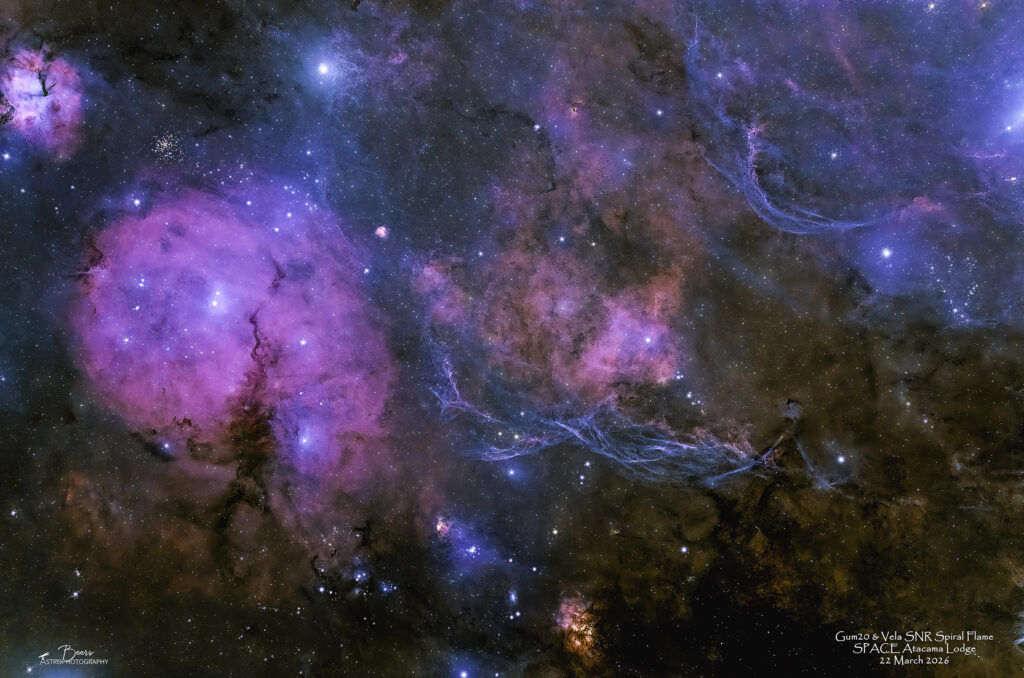
Fun facts
The Vela supernova remnant is a supernova remnant in the southern constellation Vela. Its source Type II supernova exploded approximately 11,000 years ago (and was about 900 light-years away). The association of the Vela supernova remnant with the Vela pulsar, made by astronomers at the University of Sydney in 1968, was direct observational evidence that supernovae form neutron stars.
The Vela supernova remnant is one of the closest known to us. The Geminga pulsar is closer (and also resulted from a supernova), and in 1998 another near-Earth supernova remnant was discovered, RX J0852.0-4622, which from our point of view appears to be contained in the southeastern part of the Vela remnant. This remnant was not seen earlier because when viewed in most wavelengths, it is lost in the Vela remnant.
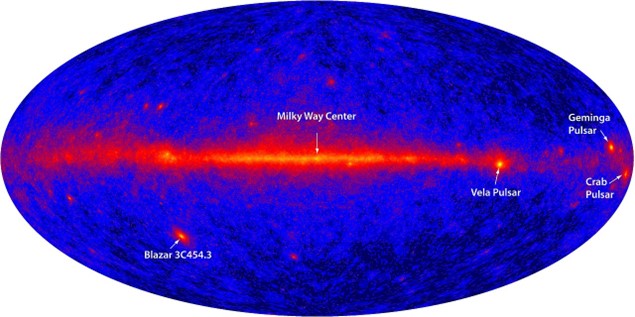
Distance: ~936 light years
Apparent Magnitude: 12
Apparent Dimensions: 8 degrees (approximately
Constellation: Vela
Designations: Vela XYZ, Gum 16, SNR G263.9-03.3, 1E 0840.0-4430, RE J083854-430902
{ From: https://en.wikipedia.org/wiki/Vela_Supernova_Remnant }
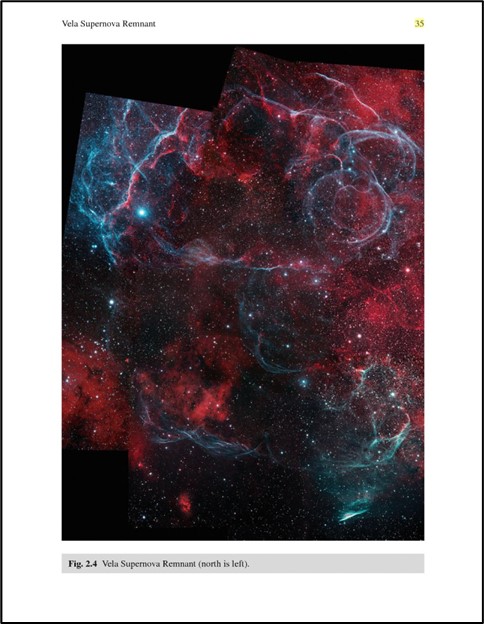
The book, Imaging the Southern Sky by Stephen Chadwick & Ian Cooper (an EXCELLENT reference that I used to plan all my targets for this trip) describes the Vela Supernova Remnant on pp 34-54, including an overall image and reference chart shown below.
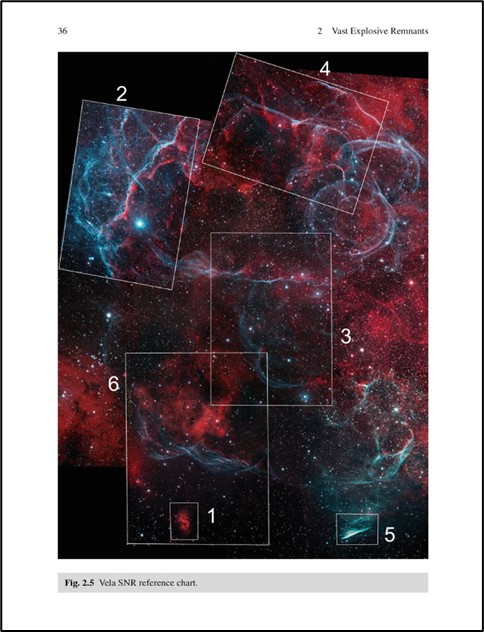
- Gum20
- Crest and the Bridge
- Twin Crescents and the Bypass
- Highway and the Spur
- Pencil Nebula
- Spiral Flame Nebula
Vela SNR Reference Chart #1: Gum 20
Gum20: RCW 36 (also designated Gum 20) is an emission nebula containing an open cluster in the constellation Vela. This H II region is part of a larger-scale star-forming complex known as the Vela Molecular Ridge (VMR), a collection of molecular clouds in the Milky Way that contain multiple sites of ongoing star-formation activity. The VMR is made up of several distinct clouds, and RCW 36 is embedded in the VMR Cloud C.
RCW 36 is one of the sites of massive-star formation closest to the Solar System, whose distance of approximately 700 parsecs (2300 light-years). The most massive stars in the star cluster are two stars with late-O or early-B spectral types, but the cluster also contains hundreds of lower-mass stars. This region is also home to objects with Herbig–Haro jets, HH 1042 and HH 1043. It is about 1.1 million years old.
Star formation in RCW 36: Like most star-forming regions, the interstellar medium around RCW 36 contains both the gas from which stars form and some newly formed young stars. Here, young stellar clusters form in giant molecular clouds. Molecular clouds are the coldest, densest form of interstellar gas and are composed mostly of molecular hydrogen (H2), but also include more complex molecules, cosmic dust, and atomic helium. Stars form when the mass gas in part of a cloud becomes too great, causing it to collapse due to the Jeans instability. Most stars do not form alone, but in groups containing hundreds or thousands of other stars. RCW 36 is an example of this type of “clustered” star formation.
Molecular cloud and H II region: The Vela Molecular Ridge can be subdivided into several smaller clouds, each of which in turn can be subdivided into cloud “clumps”. The molecular cloud clump from which the RCW 36 stars are forming is Clump 6 in the VMR C cloud.
Early maps of the region were produced by radio telescopes that traced emission from several types of molecules found in the clouds, including CO, OH, and H2CO. More detailed CO maps were produced in the 1990s by a team of Japanese astronomers using the NANTEN millimeter-wavelength telescope. Using emission from C18O, they estimated the total mass of Cloud C to be 44,000 M☉. The cloud maps suggest that Cloud C is the youngest component of the VMR because of an ultra-compact H II region associated with RCW 36 and several sites of embedded protostars, while H II regions in other VMR clouds are more evolved. Observations from the Herschel Space Telescope show that the material within the cloud is organized into filaments and RCW 36 sits near the south end of a 10-parsec long filament.
Star formation in RCW 36 is currently ongoing. In the dense gas at the western edge of RCW 36, where the far-infrared emission is greatest, are found protostellar cores, the Herbig Haro objects, and an ultra-compact H II region. However, more deeply embedded star-formation is obscured by dust, so radiation can only escape from the cloud surface and not from the embedded objects themselves.
The H II region is an area around the cluster in which hydrogen atoms in the interstellar medium have been ionized by ultraviolet light from O- and B-type stars. The H II region in RCW 36 has an hourglass morphology, similar to the shape of H II regions around other young stellar clusters like W40 or Sh2-106.
Location: Right ascension 8h 59m 00.9s / Declination −43° 44′ 10″
Distance: 2300 light years (700 pc)
Apparent dimensions: 5 arcmin
Constellation: Vela
Designations: RCW 36, Gum 20, BBW 217
{From: https://en.wikipedia.org/wiki/RCW_36}
Vela SNR Reference Chart #6: Spiral Flame Nebula
Gum20 is a curious star forming nebula with brilliant young stars deeply embedded amongst the dark and light nebulosity. A larger field of view will capture Gum 20 along with the Spiral Flame Nebula. The Spiral Flame is a helixial, delicate, twisting series of filaments.
Location: #6 Spiral Flame Nebula: RA: 8h 54m 21.0s / Dec: -43° 50’ 43”
Distance: 650 light years
Apparent dimensions: (Field size of Chadwick&Cooper images)
Spiral Flame Nebula: 2.5° x 2°
Gum20: 35’ x 26’
Constellation: Vela
{From: Imaging the Southern Sky; Stephen Chadwick and Ian Cooper; pp. 32-33, 52-54}
Capture & Processing Notes
I’d originally planned to spend most of my last night imaging a re-planned Vela SNR 4-tile mosaic. Actually the “replan” was most likely a “reproduction” of my original 90° SGP plan created at home to capture the amazing image by Gorann in Telescopius, before I got creative and with the 50° plan (whose capture was a complete fail on the night of 20Mar2026). Throughout the day, it had been somewhat overcast – when I went to pay my Lodge bill, Ale commented that the clouds had been a surprise to her and not in the forecast, but it would be alright for imaging. I went out at 19:30 to rotate the camera to the night’s 90° angle and capture calibration and dark frames before the data collection started. When I came back out at 20:20 to end that and begin the night’s data collection, there were still quite a few high cirrus clouds. I checked the WeatherUnderground forecast, which earlier in the day said the clouds would clear at 21:00, it was now saying 23:00! Yikes! I went back inside to finish up a few things on the computer, including responding to SGP’s Ken’s comment on my issue with the 50° plan’s failure (“there are just too many combinations, too hard to fix, but if you provide x,y,z we can try and develop a patch”). After holding my tongue in the response, I had to step away! I went outside and discovered that the clouds had cleared!!!
I’d already decided, when I couldn’t get started right away, that it was going to be a bridge too far to try and capture the 4-tile mosaic, which was going to set at 04:00. So, while I was inside waiting for the clouds to clear, I looked up other 90° targets still on my list. I decided on Plan B…starting out with Gum20 Vela Spiral Flame, which I believe is the “lower” portion (in the Chadwick & Cooper Fig 2.5) of the Vela SNR that I haven’t already captured during this trip. Then I would switch to NGC3372 Carina Southern Pillars and IC2944 Running Chicken a little earlier than I’d planned.
At 20:55, with the polar alignment complete (no movement of the mount required), I began the Gum20 sequence. The sequence proceeded as usual: EAF#1 (5938 to 6148); plate solve (2.80° (from 90°) and 1172.6px, resolved on the second pass); start autoguider (no calibration, 5.17 HFD, 126.1 SNR); EAF#2 (6148 to 6128); settled the autoguider and started collecting E1/F1 at 21:02CDT.
At 22:24 I went out to accomplish the meridian flip, the sequence was on frame#16…I let it finish collecting that subframe, then ended the sequence. Parked the mount in the correct Southern Hemisphere position, disconnected the equipment electronically in SGP, shut down PHD2, disconnected/reconnected the ASI120MM cable (there does seem to be a bit of play in that connection, I’ll ask Bruce about his advice on a new cable that is more secure), and restarted the sequence at 22:30. The sequence proceeded as usual: plate solve (3.01° (from 90°) and 650.6px, resolved on the second pass); start autoguider (no calibration, 5.21 HFD, 104.8 SNR); EAF (6046 to 6042); settled the autoguider and started collecting E1/F17 at 22:34CDT.
At 01:58, I came out to switch targets (to NGC3372 Carina Southern Pillars). Gum20 Vela Spiral Flame was collecting subframe #54.
Post stacking wonderment: This did capture the bottom portion of the full Vela SNR image pictured in the Chadwick & Cooper book (Fig 2.5, p.36) – wondering if I can throw all the tiles from my failed mosaic and the individual captures of portions of the image at APP to see if it can create the full picture??
Sequence plan: Gain 158, Offset 30, Temp 0°C; 54x5min, 270min (4:30hrs); Collected 22Mar2026, 21:02 – 23Mar2026, 02:00CDT
Processing summary: Captured with SGP. Stacked in APP. Star removal with Starnet++. Processed in LR/PS
Equipment
All equipment controlled by HP Probook (DSO CTRL 1) Windows 10 laptop running Sequence Generator Pro v4.4.0.1441.
- Polar alignment: QHYCCD camera (controlled by Polemaster for polar alignment)
- Imaging: (Southern Cross) Askar FRA600 on Rainbow Astro RC-135E, ZWO ASI2400MC#1 camera
- Autofocuser: ZWO EAF ( Electronic Automatic Focuser)
- Mount: Rainbow Astro RST-135E (controlled by iHubo ASCOM driver)
- Autoguiding: Orion 60mm Multi-Use Guide Scope with Orion StarShoot AutoGuider Pro Mono Astrophotography Camera (controlled by PHD2)
Summary
Captured: 22Mar2026, 21:02 CDT – 23Mar2026, 02:00 CDT. 54x5min, 270min (4:30hrs).
Shooting location: San Pedro de Atacama Celestial Explorations (SPACE) Atacama Lodge, Chile
Equipment: ZWO ASI2400MC imaging camera; (Southern Cross-420mm) Askar FRA600 108mm; f/5.6 Quintuplet Petzval Flat-Field Astrograph with Askar 0.7x reducer for FRA600 on Rainbow Astro RST-135E
Processing summary: Captured in SGP, stacked in APP (Adaptive Airy), star removal with Starnet++, processing with LR/PS
Previously captured images of Vela SNR Spiral Flame Nebula
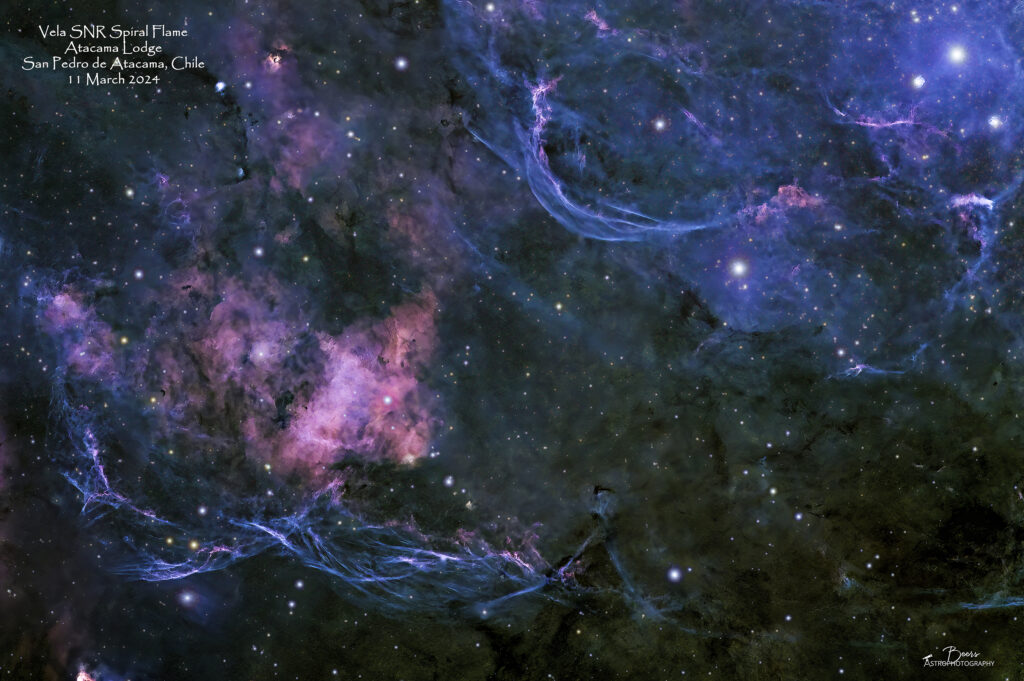
Capture & Processing Notes
On night #6, the final imaging night of the Atacama Desert trip, I ran out of targets! I never would have imagined or dared to hope for 6 completely clear nights in a row! So, I went into the Imaging the Southern Sky book and found another segment of the Vela SNR – in the vicinity of the Spiral Flame Nebula and built a sequence to image it to start the night. I’d planned to image Vela SNR until it set at about 0400, then switch to Gum 22-23 for the rest of the night. While the Vela SNR was beginning (PHD2 calibration), it dawned on me that I had intended to image the IC4592 Blue Horsehead Nebula, since it is always so low on the horizon from the Northern Hemisphere. While the PHD calibration was on-going, I pulled up Stellarium to see what the visibility was from the Atacama Lodge. I was delighted to find that it rose at about 0130 crossed the meridian at 0630 (just about the time I’ve been terminating my sequences at the end of astronomical twilight) and was very high in the sky! So, that became my night’s second target.
All the imaging went extremely well, with no glitches whatsoever. Like Danita mentioned – “you’ve had 6 days in a row of practice, rather than sporadic imaging sessions with time in-between to forget what you learned from one to the next.”
Sequence Plan: Gain 158, Temp: 0°C, 53x5minute subframes. Total time = 265minutes, 4:25 hours. Captured night of 11 March 2024 (11Mar2024, 2105CDT – 12Mar2024, 0151CDT).
Processing summary: Captured with SGP. Stacked in APP. Star removal with Starnet++. Processed in LR/PS
Equipment
All equipment controlled by HP Probook (DSO CTRL 1) Windows 10 laptop running Sequence Generator Pro v4.3.0.1305.
- Polar alignment: QHYCCD camera (controlled by Polemaster for polar alignment)
- Imaging: (Southern Cross) Askar FRA600 on Rainbow Astro RC-135E, ZWO ASI2400MC#1 camera
- Autofocuser: ZWO EAF ( Electronic Automatic Focuser)
- Mount: Rainbow Astro RST-135E (controlled by iHubo ASCOM driver)
- Autoguiding: Orion 60mm Multi-Use Guide Scope with Orion StarShoot AutoGuider Pro Mono Astrophotography Camera (controlled by PHD2)
Summary
Captured: Night of 11 March 2024 (11Mar2024, 2105CDT – 12Mar2024, 0151CDT). 53x5min, 265min (4:25hrs)
Shooting location: San Pedro de Atacama Celestial Explorations (SPACE) Atacama Lodge, Chile
Equipment: ZWO ASI2400MC imaging camera; (Southern Cross) Askar FRA600 108mm; f/5.6 Quintuplet Petzval Flat-Field Astrograph on Rainbow Astro RST-135E
Processing summary: Captured in SGP, stacked in APP (Adaptive Airy), star removal with Starnet++, processing with LR/PS