The mono imaging that I started in December 2025 continued into January 2026 – including more processing learning, equipment troubleshooting, and new lessons learned about the limits of mono image capture during a full moon! Through all this, I’ve reinforced my initial impression of the down-side of mono imaging…while I continue to see the potential for processing creativity. I am nowhere near the point of capitalizing upon that positive…but I’ve never shied from a challenge, especially when it comes to this hobby!
The story up until this point of my mono data capture and processing struggles…
My mid-November (15Nov2025) blog described my first foray into mono imaging and processing with the QHYCCD Mono Mini and the switch to the ZWO ASI6200MM mono camera and ZWO 7×2″ filter wheel from early June through mid November 2025. Check out: https://beersastrophotography.com/photography-journals/the-plunge-into-mono-imaging-second-times-a-charm/ for a full accounting of that saga and “first light” images of the OU-4 Giant Squid (the blue section of the SH2-129 Flying Bat)…
My early January (2Jan2026) blog described “second light” data collection with my new ZWO ASI6200MM mono camera and ZWO 7×2” Electronic Filter Wheel (on the Southern Cross). I followed up that blog with one (7Jan2026) that discussed my “Twelve Days of Christmas” with the images captured and the issues experienced during the data collection during the clear nights we had between the 21st and 30th of December. (https://beersastrophotography.com/photography-journals/the-rest-of-the-story-and-images-of-my-12-days-of-christmas-mono-imaging-extravaganza/)
I spent much of the month of January 2026 continuing to image (and battle with technical issues) with the mono camera from the Half Circle House front patio. It wasn’t until now (mid-March sitting in the Houston airport’s Polaris Club on my way to Chile!) that I’ve had a chance to put together the blog that describes those January nights..
I did continue imaging and fighting equipment issues in February – but packing and prepping for the Chile trip took precedence – those data remain partially or completely unprocessed – likely for the foreseeable future. So, here you’ll hear January’s story.
Your off-ramp…
As with other blogs, I’ll offer an off-ramp for those of you who really are just interested in seeing the images. (I can’t say that I blame you!).
But I will ask a favor…as I mentioned before, I’m not certain I’m completely sold on this whole mono imaging idea. Not only does it increase the data collection time 3x, 4x, or 7x (depending upon how many filters an image demands) but the processing complexity, at least at this point with my nascent skills, feels a bit overwhelming. It’s especially overwhelming (and discouraging) when you enter into the process with a color camera’s image in mind and a desire to replicate it using your mono data. (Much like my experience of going shopping with an idea of the blouse or dress I plan to purchase – and just not finding it!!)
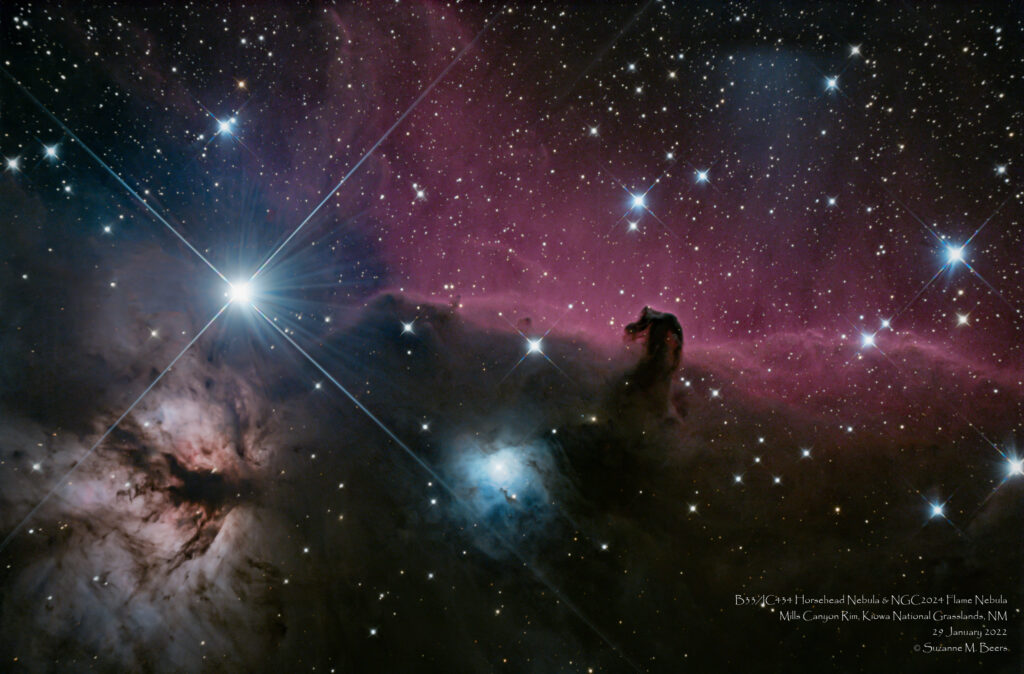
So – you tell me – in each of the galleries is the mono image that I’ve processed in an “RGB palette” (i.e., to look like the color camera’s image or what it “really” looks like if we could see it with our naked eye) and a corresponding image of the same object captured in dark skies with my OSC camera.
Do you think the juice is worth the squeeze?
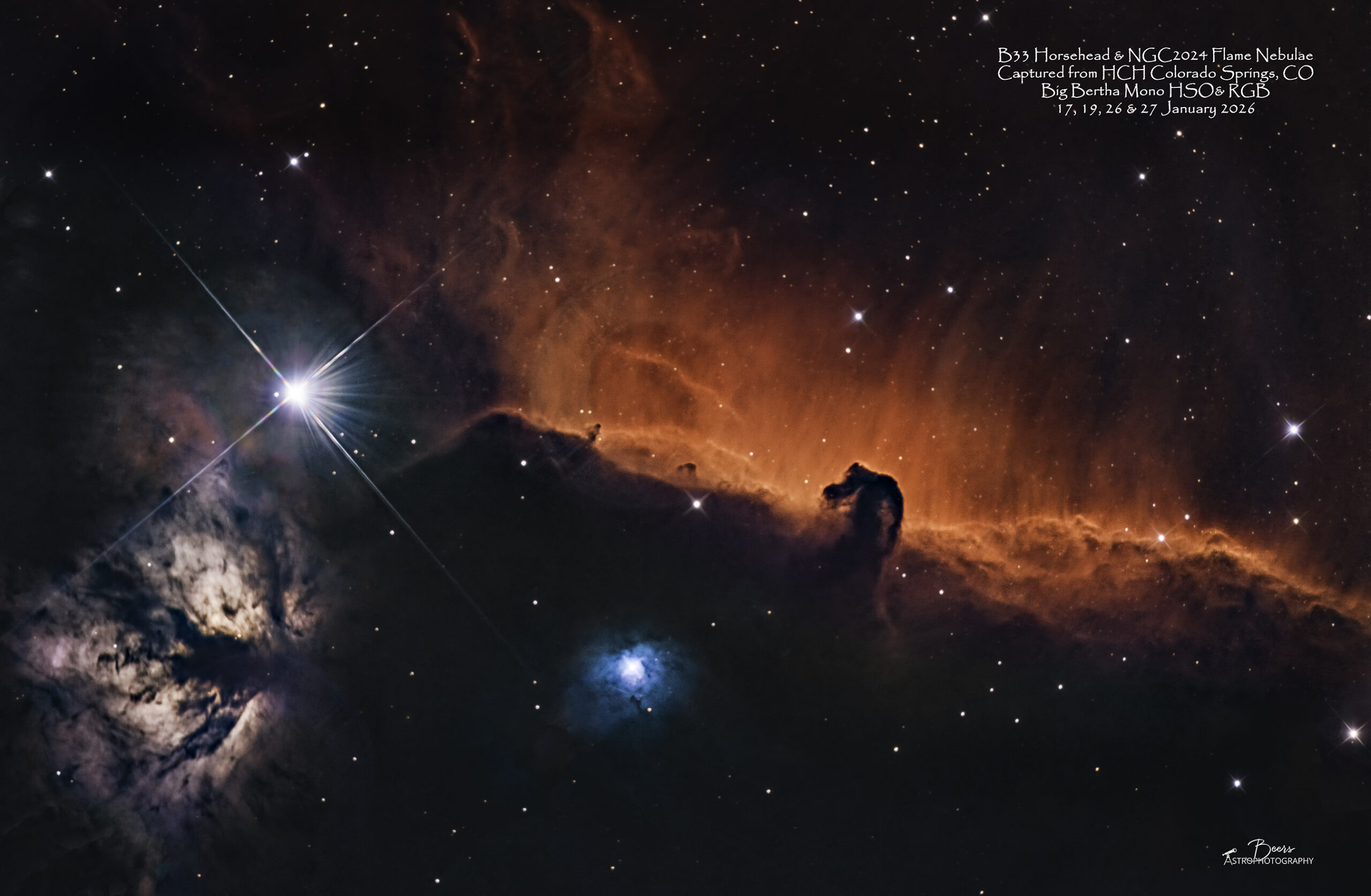
B33/IC434 Horsehead and NGC2024 Flame Nebulae at: https://beersastrophotography.com/gallery/b33-ic434-horsehead-ngc2024-flame-nebulae/
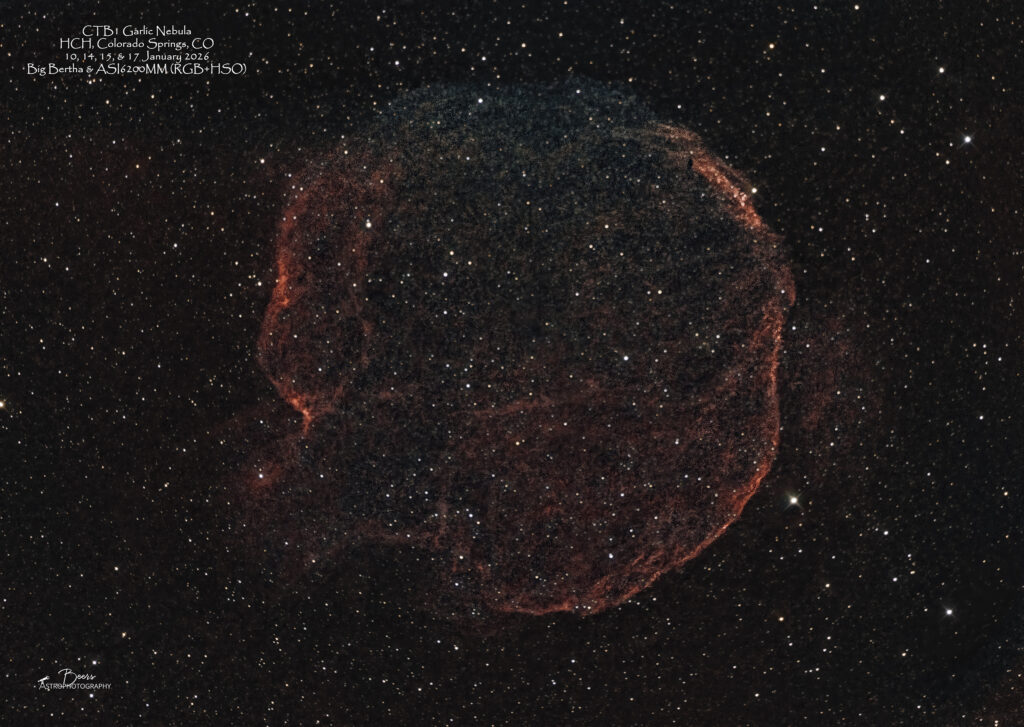
CTB1 Garlic Nebula at: https://beersastrophotography.com/gallery/ctb1-garlic-nebula/
The January images, processing, and equipment struggles …
The week leading up to January’s New Moon, starting on Saturday 10 January 2026 we were forecast to have mostly clear nights, so I drew up a quick January target list and spent Saturday morning (while I steeled myself to go out into the 10° weather and shovel the approximately one foot of wet, heavy snow) loading the SGP targets onto DSO CTRL2 for another Big Bertha mono imaging extravaganza.
On Saturday, 10 January I imaged CTB1 Garlic Nebula from dark until it set at 23:15MST, with “something terrible went wrong” having me lose an hour of data collection early in the sequence. I started the CTB1 sequence right after astronomical twilight, with BB on the front patio connected to the laptop inside the bedroom’s sunroom via the Baye-Aire. I connected all the cables before dark, then once it was dark enough completed the polar alignment (with the laptop outside connected to the Polemaster). Then took the laptop inside and started the sequence at 18:10MST. I came in to do email, website update, and 2026 journal clean-up. When I went to bed at approximately 20:00MST, I discovered that SGP was in recovery mode – “something terrible has gone wrong” and PHD2 was also displaying an error that “could not connect to the camera after 16ms” As a result, I’d lost almost an hour of collection time, so decided to forego the Green filter (had data on Red, Blue when the failure occurred) to opt for gathering HSO data with the remaining time before CTB1 set (into the house parapet at 30°) at 23:15MST.
I was still having download delays. It was nothing like what was happening before the camera driver update (one subframe capture of good data and one subframe capture of garbage that SGP didn’t recognize as valid data). But I was still only averaging about 75% of the imaging time being used for data capture, while the other 25% is spent on download delays. Also, there’s a randomness and variability to the data download times that makes it impossible to accurately plan a night’s imaging sequence. It’s very frustrating, because not only is it slow, but it’s random – it seems worse for the shorter exposures, but even that isn’t consistently true! So there’s NO WAY to predict how much of a sequence you’ll get through during a night.
The next day (11Jan2026) I reached out to Nico Carver, ZWO, and Tolga Astro for advice. Nico replied with several suggestions including power supplied to the camera and the ASCOM drivers being possible culprits. ZWO – very encouragingly – took the issue very seriously. I entered into week’s long email conversations with Jose, a ZWO Technical Support Technician. He had me download ASIStudio and capture images directly with their software controling the camera, for their engineers to evaluate. Then, finally in late January – while they had (suspiciously) been releasing updates to their native camera drivers on a two-week interval – Jose passed me off to their development team. In late January, Mei remoted into my laptop and downloaded/installed camera firmware, ASCOM driver, and native camera driver! Mei’s fix seemed to address the problem, so I was able to image during the clear nights at the end of January (albeit with the moon increasing in intensity with each passing night!)
As a spoiler alert – which will probably not be documented on these pages – I continued to have other issues throughout February. Those turned out to be caused by the ASCOM Platform 7.1.2 update and a failure of the receiver end of the Baye-aire remote transmitter/receiver. In mid-February, as the clock was counting down (rapidly) toward my Atacama Desert imaging trip’s departure data, I cried UNCLE! I fell back to my last stable version of the ASCOM Platform (v6.5) and ran an imaging session with the Southern Cross equipment (including the OSC camera vs. the mono camera) and took the Baye-aire out of the equation – everything worked very well. At that point, I also turned my attention to getting ready for the Chile trip – target planning, locking down the configuration and loading SW onto the control laptops, validating my packing lists, packing/re-packing equipment, etc. So – those data have not been (and likely will not be) processed…
Okay, alright – show me the images!!
As I mentioned (now multiple times!) I’m still not sold on this mono imaging idea (from a time invested vs. finished product perspective), but I am beginning to see the potential for a great deal of artistic creativity. Once I figure out the intricacies of the processing, I’ll be able to create all sorts of variations…one data set could suck me in for days with the “what if I did this” game!
Below are the links to the gallery posts and the primary image of each…
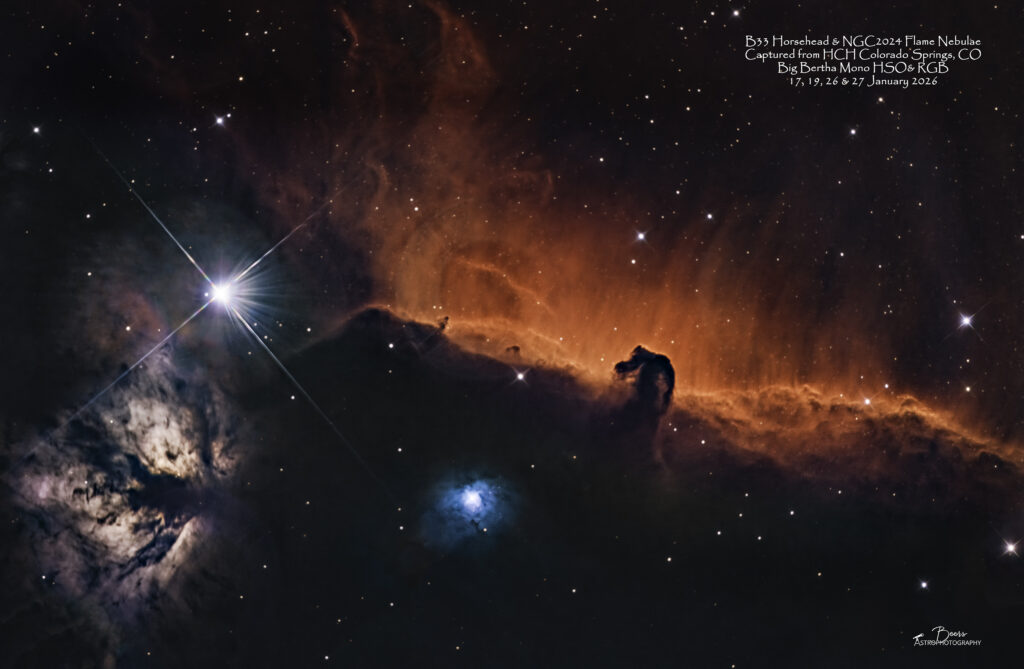
B33/IC434 Horsehead & NGC2024 Flame Nebula
Horsehead and Flame gallery post is: https://beersastrophotography.com/gallery/b33-ic434-horsehead-ngc2024-flame-nebulae/. In that gallery you’ll see the “original” Horsehead – captured from the dark skies of the Kiowa National Grasslands in January 2022. That image won second place Williamina Fleming Imaging Award in 2023. As I was processing the mono data, I was trying to replicate the colors and features of the Canon EOS Ra image – I didn’t get there! Not sure if that is because of lack of data or lack of processing skills…time will tell!
CTB1 Garlic Nebula
CTB1 Garlic Nebula gallery is: https://beersastrophotography.com/gallery/ctb1-garlic-nebula/. This image is definitely an improvement from previous (mess of an) images I’ve posted under my “full disclosure” rules of engagement. It’s still not ideal. I did gather more data on CTB1 on 31 January and had intended to process and include that combined data here, but I ran out of time in the week leading up to the Chile departure (i.e., I was stacking it on Wednesday night – and the stacking algorithm failed, so it missed its chance!)
M44 Beehive Cluster
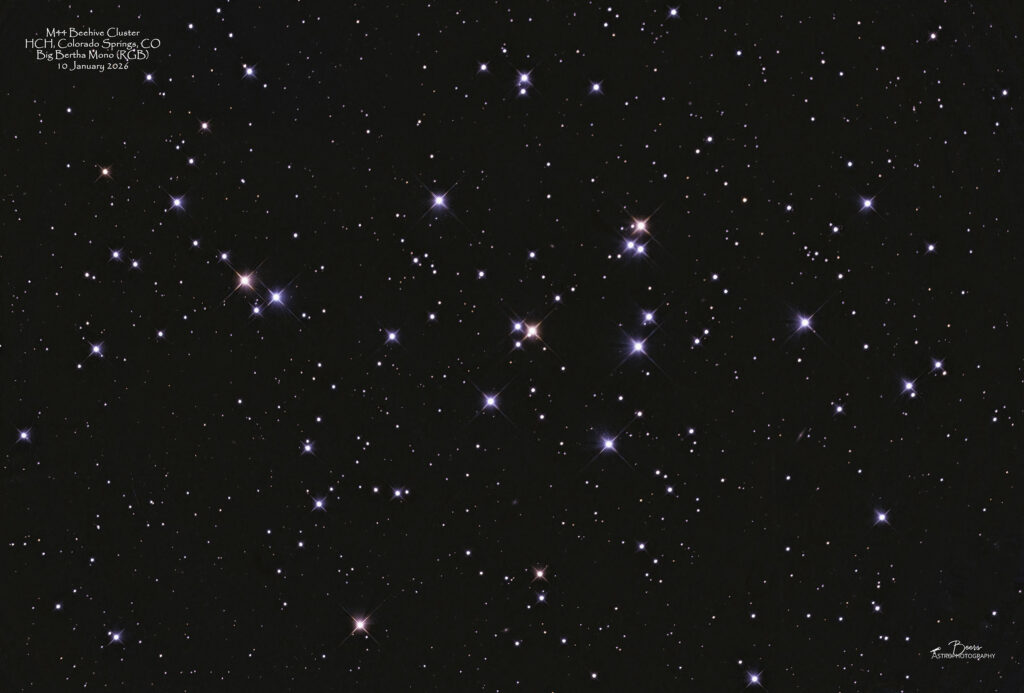
Finally, the M44 Beehive Cluster gallery is: https://beersastrophotography.com/gallery/m44-beehive-cluster/. I captured a couple of star clusters in the hours after the “main” nebula targets set during the January clear nights. M44 seemed like the only one worth posting at this point, with its extra added bonus of its association with our bee-keeping hobby AND an interesting article in the April 2026 Sky and Telescope magazine about beehives.