
The summer project collecting data on my “OCD” target – SH2-129 Flying Bat / Ou4 Giant Squid continued through the clear sky nights on the front patio throughout June 2026. This image, getting better, but still a work in progress, is comprised of data collected with the mono camera from the front patio on: 10, 11, 12, 15, 16, 17, 18, and 20 June 2026; added to the mono data in last month’s “summer project kick-off image” collected 15, 16, 23, 29, and 30 May 2026. The mono data are again combined with data captured in July 2025 at Powderhorn with the same telescope/reducer and the one-shot color camera.
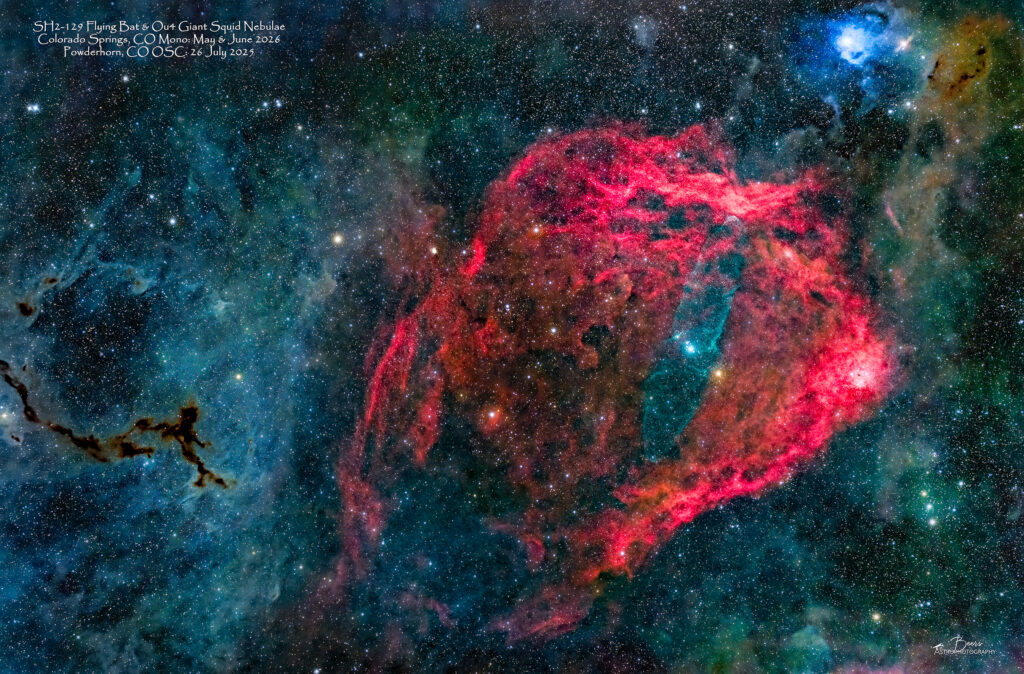
SH2-129 Flying Bat & Ou4 Giant Squid Nebulae
The SH2-129 Flying Bat & Ou4 Giant Squid Nebulae gallery (https://beersastrophotography.com/gallery/sh2-129-flying-bat-ou-4-giant-squid-nebulae/) shows the evolution of my imaging of this elusive pair. I have been intrigued by them, especially the faint Ou4 Giant Squid (the blue portion of the image that looks like a flying bat!) since I first saw Nico Carver’s version of it at: https://www.nebulaphotos.com/sharpless/sh2-129/ in 2023.
Last fall, I got a full size (after the summer’s disastrous experience with the QHYCCD MonoMini) and got to the business of learning entirely new capture and processing workflows. In early May, I noted that my OCD target was beginning a “reasonable” amount of visibility and decided it was time to start my summer project – focusing on (pun intended) the SH2-129/Ou4 and collecting mono data in the Red, Green, Blue, Hydrogen Alpha, Sulphur II, and Oxygen III wavelengths (especially OIII where the Ou4 signal resides) with my new mono camera and 7-place filter wheel.
The image I produced with May’s ~20 hours of data (with a lot of fits and starts) with the one-shot color (OSC) camera is in the gallery as the first “other images” example. I hope you’ll agree that the additional ~40 hours of data I gathered throughout June (and my time spent understanding the results from integrating the the individual channels using the various algorithms in the APP RGB Combine Tool) moved the image in the right direction. It’s still not a “finished product” – I would love to have some mono dark skies data to throw into the mix and further experimentation with the RGB Combine algorithms (especially HaRGB for the Flying Bat nebulous region) are definitely in order. But, given the additional data collected over the course of 8 imaging nights in June, I figured this image was worth a Blog post and an accompanying Newsletter.
Capture Summary – June 2026 with SC420Mono from HCH Front Patio
I continued the data collection on SH2-129/Ou4 I started in May, during the clear nights surrounding June 2026’s New Moon (10-12Jun) and during the following week while the moon was still setting late and in its first quarter (15-20Jun).
Throughout the month, I managed to drive out/resolve a few lingering data collection errors/issues:
- I discovered that the pointer to the ANSVR plate solver was pointing to the directory where the database was stored, rather than where the .exe. file was located. When I changed that pointer to the right location, it did away with the error message I was getting at each start-up (that I’d been ignoring, but being irritated by!).
- To address the lingering PHD2 warning “calibration too far from the meridian, recalibration needed”, I reached out to PHD2 Forum. Brian and Kent both told me I should run the Calibration Assistant (CA) at the beginning of the night’s activities then select “restore calibration” in the PHD2 settings to both save time during nightly imaging and get a better calibration result. I doubted that I could reach the required Dec=0° from my front patio shooting location – but found that it’s much higher in the southern sky than I anticipated! Finally, on the last night of my June imaging extravaganza – 20 June – I had the courage to try the PHD2 CA – I found it to be easy, quick, and it worked like a charm! PHD2 CA is now the step in my nightly start-up workflow immediately following the polar alignment, before I kick off the SGP sequence.
- In using SGP’s Flat Calibration Assistant throughout the month, I finally figured out its nuances – the flat frame exposure value for each filter is saved in the equipment profile, then when you add a target using that profile and select “flat” as the frame time, it auto populates that exposure length. The second issue I was experiencing with the calibration frame collection was camera disconnects. I submitted a Help Ticket to the SGP Forum, Ken replied with a number of possible issues (cables, USB hub, laptop I/O, etc.). At the end of his message he stated, “you might try putting a 5 second pre-capture delay” into the target. That worked like a charm in capturing a full set of calibration frames that stacked and combined easily without errors in APP (the set I’d captured in late May would not stack).
The details of each night’s collection during June 2026 are near the bottom of the Blog (for those diehards who want to read every detail!)
The details of each night’s collection during May 2026 are in the Blog post: https://beersastrophotography.com/photography-journals/its-back-flying-bat-giant-squid-visible-again/
The details of the data collection from Powderhorn, Colorado (dark skies image with one-shot color camera (OSC)) in July 2025 are in the Blog post: https://beersastrophotography.com/photography-journals/one-night-beast-recon-trip-to-tolvar-flats/
Image Data & Processing Summary
A total of 59:55 hours of RAW mono data were used to create this image (with 24:40 hours of OIII to create the Giant Squid)! I stacked 95% of 691 light frames (656/691) using the mono data captured on 15, 16, 23, 29, and 30 May 2026 and on 10, 11, 12, 15, 16, 17, 18, and 20 Jun 2026. The APP stacking algorithm created individual R, G, B, H, S, O channel images (I didn’t use the luminance data). Then, I stacked the one-shot color (OSC) data collected on 26 July 2025 from Powderhorn, Colorado. Once stacked, I separated the OSC data channels into R, G, B channels. I registered (aligned) all the individual channel images, so they would properly lay on top of each other during the operation to combine the individual filters’ images into a single color image for further processing (in Photoshop and LIghtroom). When I combined the data into single color images using the APP RGB Combine Tool, I used both the mono and OSC R, G, B channels in the algorithms that called for them.
Total Mono Data (May & Jun 2026): 3595min (59:55 hours)
- Lum: 16x1min = 16min
- OIII: 24x5min; 136x10min = 1480min, 24:40hrs
- Ha: 143x5min = 715min, 11:55hrs
- SII: 122x5min = 610min, 10:10hrs
- Red: 90x3min = 270min, 4:30hrs
- Green: 90x3min = 270min, 4:30hrs
- Blue: 78x3min = 234min, 3:54hrs
May Mono Data– 15, 16, 23, 29, 30May2026: Gain 100, Offset 50, Temp 0°C. Total mono data capture: 16x1min, 122x5min, 56x10min subframes = 1186min (19:46hr).
- Lum: 16x1min; 16min
- OIII: 24x5min, 56x10min; 680min, 11:20hrs
- Ha: 40x5min; 200min, 3:20hrs
- SII: 58x5min; 290min, 4:50hrs
June Mono Data– 10, 11, 12, 15, 16, 17, 18, 20Jun2026: Gain 100, Offset 50, Temp 0°C. Total mono data capture: 258x3min, 167x5min, 80x10min subframes = 2,409min (40:09hr).
- OIII: 80x10min = 800min, 11:20hrs
- Ha: 103x5min; 515min, 8:35hrs
- SII: 64x5min; 320min, 5:20hrs
- Red: 90x3min; 270min, 4:30hrs
- Green: 90x3min; 270min, 4:30hrs
- Blue: 78x3min; 234min, 3:54hrs
July 2025 OSC Data – 26Jul2025: Gain 300, Offset 30, Temp 0°C; Total (good) OSC data capture: 67x5min = 335min (5:35hrs). Separated into R, G, B channels for RGB Combine with mono data
Equipment
All equipment controlled by HP Probook (DSO-CTRL1) running Sequence Generator Pro v4.5.0.1642.
- Imaging Train:
- Telescope: (Southern Cross with 0.7x reducer (SC420)) Askar FRA600 108mm f/5.6 Quintuplet Petzval Flat-Field Astrograph with Askar f3.9 Full Frame Reducer for Askar FRA600
- Camera: (OSC camera) ZWO ASI2400MC Pro One Shot Color imaging camera
- Camera: (Mono camera) ZWO ASI6200MM Pro Monochrome imaging camera;
- Filter Wheel: ZWO – EFW 7×2” Filter Wheel with installed filters (1=SII, 2=Ha, 3=OIII, 4=Lum, 5=Red, 6=Grn, 7=Blue): Svbony SV227 2” Narrow-Band – SII, Ha, OIII; Optolong LRGB Filter Set (2”)
- Polar alignment: QHYCCD camera (controlled by Polemaster for polar alignment)
- Mount: Rainbow Astro RC-135E (controlled by iHubo ASCOM driver)
- Autoguiding: Orion 60mm Multi-Use Guide Scope with ZWO ASI120MM mini mono camera (controlled by PHD2)
- Auto Focuser: ZWO EAF Electronic Automatic Focuser – Standard (New 5V Version) (EAF-5V-STD)
Summary
- Total data in image:
- Mono data captured May & June 2026: 3595min (59:55 hours)
- Lum: 16x1min = 16min
- OIII: 24x5min; 136x10min = 1480min, 24:40hrs
- Ha: 143x5min = 715min, 11:55hrs
- SII: 122x5min = 610min, 10:10hrs
- Red: 90x3min = 270min, 4:30hrs
- Green: 90x3min = 270min, 4:30hrs
- Blue: 78x3min = 234min, 3:54hrs
- OSC data capture: 67x5min = 335min (5:35hrs). Separated into R, G, B channels for RGB Combine with mono data
- Mono data captured May & June 2026: 3595min (59:55 hours)
- Shooting location:
- Mono data captured from HCH front patio, Colorado Springs, CO (15, 16, 23, 29, 30May2026 and 10, 11, 12, 15, 16, 17, 18, 20Jun2026);
- OSC data captured from Powderhorn, Colorado (26Jul2025)
- Processing: Data collection with SGP sequence; image review with Seti Astro Blink Comparator; stack with Astro Pixel Processor (APP); combine mono images using APP RGB Combine Tool; star removal with Starnet++; image processing with Photoshop/Lightroom
Executed Sequence Plans (getting into the details…)
Note: This is a dive into the weeds with a daily accounting of by-filter data collected throughout May and June 2026 from the HCH front patio with SC420Mono (Southern Cross telescope, with 0.7x reducer making it a 420mm focal length; Mono camera with 7 slot filter wheel).
Sequence plan (Mono Data– 15May2026): Gain 100, Offset 50, Temp 0°C. Sequence ran: 16May2026, 03:36 – 05:04MDT (1:28hr). Marked the last frame (captured 04:58 – 05:04) BAD – too light by that time of the morning. 3 filter changes at ~5min per EAF run at filter change. Total data capture time: 12x5min, 5x1min subframes = 65min (1:05hr).
- Lum: 5x1min, 16May26, 03:35 – 03:41MDT
- OIII: 4x5min, 16May26, 03:45 – 04:06MDT
- Ha: 4x5min, 16May26, 04:10 – 04:31MDT
- SII: 4x5min, 16May26, 04:38 – 05:04MDT
Sequence plan (Mono Data– 16May2026): Gain 100, Offset 50, Temp 0°C. Sequence ran: 16May2026, 22:55MDT – 17May2026, 04:42MDT (5:47hr). Lost guide star after first OIII frame capture, didn’t discover until came out to check almost 2 hours later, lost 23:09 – 00:56MDT. So, data capture time was 22:55 – 23:09, 00:56 – 04:42 (4:00hrs). Total data capture: 42x5min, 5x1min subframes = 215min (3:35hr).
- Lum: 5x1min, 16May26, 22:55 – 23:00MDT
- OIII: 20x5min, 16May26, 23:04 – 23:09MDT, 17May26, 00:56 – 02:35MDT
- Ha: 12x5min, 17May26, 02:39 – 03:41MDT
- SII: 10x5min, 17May26, 03:45 – 04:42MDT
Sequence plan (Mono Data– 23May2026): Gain 100, Offset 50, Temp 0°C. Sequence ran: 23May2026, 23:25MDT – 24May2026, 04:34MDT (5:09hr). Lost guide star when I came down to shutdown the sequence at astronomical twilight…so ended the sequence rather than waiting for that last frame to capture. Total data capture: 42x5min, 5x1min subframes = 215min (3:35hr).
- Lum: 3x1min, 23May26, 23:25 – 23:28MDT
- OIII: 20x10min, 23May26, 23:32 – 24May26, 02:56MDT
- SII: 12x5min, 24May26, 03:00 – 04:04MDT
- Ha: 4x5min, 24May26, 04:11 – 04:34MDT
Sequence plan (Mono Data– 29May2026): Gain 100, Offset 50, Temp 0°C. Sequence ran: 29May2026, 22:21MDT – 24May2026, 04:35MDT (6:14hr). Lost guide star when I came down to shutdown the sequence at astronomical twilight…so ended the sequence rather than waiting for that last frame to capture. Total data capture: 3x1min, 20x10min, 30x5min subframes = 353min (5:53hr).
- Lum: 3x1min, 29May26, 22:21 – 22:22MDT
- OIII: 20x10min, 29May26, 22:27 – 30May26, 01:51MDT
- SII: 16x5min, 30May26, 01:55 – 03:13MDT
- Ha: 14x5min, 30May26, 03:22 – 04:35MDT
Sequence plan (Mono Data– 30May2026): Gain 100, Offset 50, Temp 0°C. Sequence ran: 30May2026, 23:17MDT – May2026, 04:27MDT (6:14hr). Set up at the same time as the previous night, but had to wait for almost an hour for the clouds (that were favoring the location of this target!) to clear before starting the sequence. Lost guide star when I came down to shutdown the sequence at astronomical twilight…so ended the sequence rather than waiting for that last frame to capture. Total data capture: 16x10min, 22x5min subframes = 270min (4:30hr).
- OIII: 16x10min, 30May26, 23:17 – 31May26, 02:00MDT
- SII: 16x5min, 31May26, 02:04 – 03:42MDT
- Ha: 6x5min, 31May26, 03:49 – 04:27MDT
Sequence plan (Mono Data– 10Jun2026): Gain 100, Offset 50, Temp 0°C. Sequence ran: 10Jun2026, 22:06MDT – 11Jun2026, 04:22MDT (6:16hr). Total data capture: 20x10min, 26x5min subframes = 330min (5:30hr).
- OIII: 20x10min, 22:06 – 01:30
- SII: 20x5min, 11Jun2026 01:34 – 03:34MDT
- Ha: 6x5min, 03:42 – 04:22MDT
Sequence plan (Mono Data– 11Jun2026): Gain 100, Offset 50, Temp 0°C. Sequence ran: 11Jun2026 21:54 – 13Jun2026, 04:20 (6:26hr). Total data capture: 20x10min, 30x5min subframes = 350min (5:50hr).
- OIII: 20x10min, 21:54 – 01:18MDT
- Ha: 20x5min, 01:22 – 03:06MDT
- SII: 10x5min, 03:17 – 04:26MDT
Sequence plan (Mono Data– 12Jun2026): Gain 100, Offset 50, Temp 0°C. Sequence ran: 12Jun2026 22:37 – 12Jun2026, 04:26 (5:49hr). Total data capture: 4x10min, 17x5min, 60x3min subframes = 305min (5:05hr).
- Red: 20x3min, 22:37 – 11:41MDT
- Grn: 20x3min, 23:44 – 00:48MDT
- Blue: 20x3min, 00:51 – 01:55MDT
- Ha: 9x5min, 01:59 – 02:46MDT
- SII: 8x5min, 02:55 – 03:31MDT
- OIII: 4x10min, 03:35 – 04:20MDT
Sequence plan (Mono Data– 15Jun2026): Gain 100, Offset 50, Temp 0°C. Sequence ran: 16Jun2026 00:12 – 04:24 (4:12hr). Total data capture: 78x3min subframes = 234min (3:54hr).
- Red: 30x3min, 00:12 – 01:45MDT
- Grn: 30x3min, 01:51 – 03:24MDT
- Blue: 18x3min, 03:30 – 04:24MDT
Sequence plan (Mono Data– 16Jun2026): Gain 100, Offset 50, Temp 0°C. Sequence ran: 16Jun2026 21:55 – 17Jun2026, 04:31 (6:36hr). Total data capture: 18x10min, 35x5min subframes = 355min (5:55hr).
- OIII: 18x10min, 21:55 – 00:59MDT
- Ha: 24x5min, 01:03 – 03:15MDT
- SII: 11x5min, 03:25 – 04:31MDT
Sequence plan (Mono Data– 17Jun2026): Gain 100, Offset 50, Temp 0°C. Sequence ran: 17Jun2026, 21:49 – 23:49 (2:00hr). Night ended early due to clouds moving in. Total data capture: 36x3min subframes = 108min (1:48hr).
- Red: 36x3min, 21:49 – 23:49MDT
Sequence plan (Mono Data– 18Jun2026): Gain 100, Offset 50, Temp 0°C. Sequence ran: 18Jun2026 21:47 – 19Jun2026, 04:23 (6:10hr). Total data capture: 20x5min, 84x3min subframes = 352min (5:52hr).
- Red: 4x3min, 21:47 – 21:59MDT
- Grn: 40x3min, 22:02 – 00:10MDT
- Blue: 40x3min, 00:13 – 02:18MDT
- Ha: 20x5min, 02:26 – 04:23MDT
Sequence plan (Mono Data– 20Jun2026): Gain 100, Offset 50, Temp 0°C. Sequence ran: 20Jun2026 21:43 – 21Jun2026, 04:28 (6:45hr). Total data capture: 18x10min, 39x5min subframes = 375min (6:15hr).
- OIII: 18x10min, 21:43 – 23:50MDT
- Ha: 24x5min, 00:56 – 02:56MDT
- SII: 15x5min, 03:05 – 04:28MDT
Daily Capture Notes – May & June 2026 (…really diving into the details!)
Note: This is even a deeper dive into the weeds with a daily description of the data collection activities. If you are still reading – you have earned the “HARD CORE” medal! Thank you VERY much for having this much interest in the details of my hobby!!
Capture Notes (May 2026 summary)
Back from Chile (astrophotography trip, 13-24Mar2026) and back from Australia (work trip, 24Apr-8May2026), the May 2026 New Moon weekend was partially clear at home to allow me to dust off the mono imaging camera and take the new version of Sequence Generator Pro (SGP v4.5.0.1638 (released 24 Apr 2026)) for a test drive.
This started a month’s long visit back to my “OCD” target – SH2-129 Flying Bat / Ou4 Giant Squid. This image, definitely a work in progress (likely all throughout the summer and early fall while it’s visible) is comprised of data collected with the mono camera from the front patio on: 15-16 May 2026 (between SW/HW set-up issues on 15 May and a random sequence abort on 16 May – less than a stellar collection period of 4:40 across two nights); 23 May 2026 (successful collect in the short hours of darkness yielded 4:43 hours of data, including 20 x 10 minute subframes of OIII in my quest of capturing the Giant Squid); 29 May 2026 (a whopping 5:53hrs), and 30 May 2026 (an hour plus delay waiting for the bank of clouds right where the target was to clear, yielding 4:30hrs). The mono data are combined with data captured in July 2025 at Powderhorn with the same telescope/reducer and the one-shot color camera.
Capture Notes (15May2026): A frustrating and not very productive night – waited for the clouds to clear, then spent ~3 hours struggling with disconnects in the new SGPro equipment profiles. First, I struggled with the autofocus routine – not able to figure out why radically moving the focus tube throughout its full range of movement was having little affect on the number of stars and HFR being calculated. After getting to where I thought was a close focus point and running the sequence (EAF #1 gave a focus point, 5092, HFR 1.7, 99% curve fit). When the sequence moved to the PHD2 calibration, the light came on – SGP was using the wrong camera profiles (the AG camera and imaging camera ASCOM drivers were flipped!). At 03:29, restart #3 finally gave me results in the EAF that looked reasonable. When I moved on to the plate solver, it threw a “camera rotation warning” and gave a 0° delta from the 0° camera angle the sequence called for – that seemed bizarre as I’ve never been that precise with the masking tape and eye-ball angle measurement system, but by that time I was too cold and tired to worry about it. I later discovered, the warning and the fact that the plate solver didn’t give a camera angle delta was because I had “mechanical” vs. “sky” selected. I ended up capturing a miniscule amount of data before astronomical twilight ended at about 04:30.
During the day (16May2026), I corrected the equipment profiles for all the errors I’d run into and began playing with the Flat Calibration Wizard – I captured some data, but also sent in a number of questions in a Help Desk ticket to SGP Forum.
Capture Notes (16May2026): The night’s data collection went much more smoothly from a new SW version error perspective. I started the sequence after polar alignment at 22:49MDT. The camera profiles were straightened out so the EAF was actually focusing the imaging camera properly, the plate solver was set to sky so it came up with a 5.47° delta from 0° which I corrected with a small manual camera rotation, PHD2 resumed the autoguider (without a calibration, throwing an error saying that recalibration was required because it was too far from the equator; still need to fix that setting), and started Event 1/Frame 1 (Lum) at 22:55.
I sat and watched the Lum frames, filter wheel setting the OIII filter, EAF on the OIII filter, and the capture of the first 5 minute OIII subframe starting at 23:05MDT. At 00:50 (1:45hr later) I woke up and came out to check on the sequence progress. It had captured 1/22 OIII frames – the sequence failed at 23:04! ARGH! Restarted the sequence and it completed a bit of data collection on OIII, SII, and Ha filters before I ended at 04:42MDT.
Capture Notes (23May2026): A clear night after a week of rain, albeit with 62.3% Waxing Gibbous moon (although with a large angle between the target and moon), gave me the chance to gather more data on SH2-129 Flying Bat/OU-4 Giant Squid.
During the day, I’d loaded the latest version of SGPro (v4.5.0.1642, eff. 17May2026) with updates that addressed the issue I raised WRT the flats exposure times only handling 2 decimal places. I also had researched focuser backlash, so was ready to change that setting. Finally, I’d researched the Flat Calibration Wizard – played around with that and captured flat and dark (no dark flat) frames.
Before I started the sequence, I applied the new equipment profile (with the new backlash value) to the sequence, when I started the sequence I got an error that the file location of astap.exe was not correct. It took me awhile to find that setting (I thought it was in the equipment profile, it’s in the overall options only), so that delayed the start a bit while I fumbled with that.
When I started the sequence, again, PHD2 did not do a calibration and gave me the error that it was “too far from the meridian and needed to be recalibrated.” I ignored it (and the guiding at the beginning of the sequence was very rough, but seemed to have settled when I came out to check on progress about an hour later). I need to figure out how to set up the AG, so that it does an initial calibration at the beginning of the night, but not every time a sequence starts – or do that setting manually, if it’s not possible within SGP.
The sequence ran fine throughout the (short) night. Ironically, it lost the guide star during the frame capture that had started just prior to my coming out to shut down the sequence at the end of astronomical twilight/start of nautical twilight (04:30MDT).
Capture Notes (29May2026): A clear night after a week of rain, albeit with a 97.9% Waxing Gibbous (although with a large angle between the target and moon), gave me the chance to gather more data on SH2-129 Flying Bat/OU-4 Giant Squid.
During the day, I’d played around with the Flat Calibration Wizard and captured flat (no dark flat) frames. Before I started the sequence, I applied the new equipment profile (with the new backlash value) to the sequence, when I started the sequence I got an error that the file location of astap.exe was not correct. It took me awhile to find that setting (I thought it was in the equipment profile, it’s in the overall options only), so that delayed the start a bit while I fumbled with that.
When I started the sequence, again, PHD2 did not do a calibration and gave me the error that it was “too far from the meridian and needed to be recalibrated.” I ignored it (and the guiding at the beginning of the sequence was very rough, but seemed to have settled when I came out to check on progress about an hour later). I need to figure out how to set up the AG, so that it does an initial calibration at the beginning of the night, but not every time a sequence starts – or do that setting manually, if it’s not possible within SGP.
The sequence ran fine throughout the (short) night. Ironically, it lost the guide star during the frame capture that had started just prior to my coming out to shut down the sequence at the end of astronomical twilight/start of nautical twilight (04:30MDT).
Capture Notes (30May2026): The night was forecast to be more fully clear all night than the night before, but that turned out not to be the case. I got up at 21:30MDT to get things set up to start imaging when the target rose above the roofline at about 22:00MDT. I was ready to go a few minutes before 22:00 – and then I waited for the clouds to clear, especially the big cloud bank exactly where the target was! The clouds finally cleared at 23:00. I got the sequence started at 23:06. To save the time associated with capturing and refocusing after switching from the Lum filter, I started with the OIII event. The sequence proceeded through: EAF #1 (5012 start, ending at 5071, HFR 1.9, 97% curve fit; validation focus at HFR=1.21), plate solve with a 1.43° delta, autoguide calibration, and second EAF run (5071 start, ending at 5066, HFR 1.9, 96% curve fit (1.12 HFR). Event 2/Frame 1 started its collect at 23:17MDT.
At the end of astronomical twilight (04:30) I came out to end the sequence and, as with the night before, the autoguider lost its guide star during that subframe capture (there was an error that the calibration was too far from the meridian), so I ended the sequence and parked the telescope.
Although I wasn’t going to capture new flat frames (since I hadn’t changed the camera angle from the previous night’s and had a full set of flats and dark flats to use), I did want to validate my calculation using the USNO look up site on slewing to zenith. It turns out, contrary to what the Google AI answer, for the RA you use the Greenwich Mean Sidereal Time (GMST) rather than the Local Sidereal Time. I will rework the spreadsheet with only that column for future use in capturing flat frames at the end of a session.
Capture Notes (June 2026 summary)
Continued the data collection on SH2-129/Ou4 during the clear nights surrounding the New Moon (10-12Jun) and during the following week. Did drive out a few lingering errors: 1) discovered that the pointer to the ANSVR plate solver was pointing to the directory where the database was stored, rather than the .exe. Changed that in the overall setting “external connections” tab and got rid of that issue. 2) The lingering PHD2 error of “calibration too far from the meridian, recalibration needed.” Reached out to PHD2 forum and had a bit of a back and forth wit Brian and Kent – both telling me I should run the Calibration Assistant at the beginning of the sequence then select “restore calibration” in the PHD2 settings to both save time during nightly imaging and get a better calibration result. I doubted that I could reach the required Dec=0° from my front patio shooting location – but found that it’s much higher in the southern sky than I anticipated. Finally, on the last night of my June imaging – 20 June, I added that to my workflow after the polar alignment. It was easy, quick, and worked like a charm! 3) In using SGP’s Flat Calibration Assistant, I finally figured out all the nuances – the flat frame exposure value for each filter is saved in the equipment profile, then when you add a target using that profile and select “flat” it autopopulates that exposure length. Second issue is was experiencing with the calibration frame collection was the camera disconnects. Ken from SGP replied to my help ticket with a number of possible issues (cables, USB hub, etc.) then at the end of his message stated, “you might try putting a 5 second pre-capture delay” into the target – that worked like a charm in capturing a full set of calibration frames for SC420-Mono at 0° camera angle that stacked and combined easily without errors in APP.
Capture Notes (10Jun2026): Woke up at 21:20MDT to begin set-up, finished polar alignment (PA) and connected cables at 21:45MDT. Turned on the computer and it was asking for a reboot for the Windows update (ARGH) – I figured I better do it, so it didn’t decide to do it in the middle of the sequence. Started the sequence at 21:50MDT. During plate solve, still getting the ANSVR settings error – selected continue and vowed to figure out what directory it was pointing t, 597.o that was incorrect. Everything else with the start-up went well – sequence started at 22:06MDT collecting OIII subframes.
Capture Notes (11Jun2026): Woke up at 21:15MDT to begin set-up, finished polar alignment (PA) and connected cables at 21:42MDT. Started the sequence at 21:43MDT. Ran through standard startup sequence with no issues (still doing PHD2 AG calibration at the targe): EAF#1 OIII (5103-5086); plate solve 1.50°, 597px then resolved on second attempt; AG resume/recal; EAF#2 OIII (5086 – 5084). Sequence started at 21:55MDT collecting OIII subframes. Ended the sequence prior to the meridian flip (04:44) at the start of astro twilight 04:21MDT.
Capture Notes (12Jun2026): Had to wait for clouds to clear, so didn’t start sequence until almost 22:30. The night was planned to collect RGB data, so started with Red. Started the sequence at 22:26MDT. Ran through standard startup sequence (still doing PHD2 AG calibration at the targe): EAF#1 Red (5037) and was about in focus at the third step, so the curve was very Nike swoosh looking; EAF claimed it couldn’t find focus and returned to 5307 (?) and resolved a rough focus at 5276, HFR 1.0, 98% match, 1.45px HFR); plate solve 1.47°, 668.7px then resolved on second attempt; AG resume/recal; EAF#2 Red (5276 – 5268). Sequence started at 22:37MDT collecting Red subframes. At the end of the night (04:51), I ran the Flats Calibration Assistant and got R=0.0201, G=0.0166, B=0.0100. Then tired to run the calibration frame capture and kept getting a camera disconnect and errors saving.
I submitted a help ticket to SGP Forum on the calibration issue and after a long list of proposed issues: bad cables, malfunctioning configuration, etc.; at the end of the message Ken said the exposure lengths are pretty short and “rapid fire” so I might consider putting a 5-second delay start in between the flat (and dark flat) frames. I did that when I finally captured a new full set of calibration frames on 20 Jun 2026 and it worked like a charm!
Capture Notes (15Jun2026): Had to wait for clouds to clear, first came out at 23:04 and was able to do the polar alignment, connect all the cables, and get started on the sequence. It failed EAF #1 for a huge bank of clouds! Went inside and came back out at about midnight to start the sequence. Ran through standard startup sequence with no issues (still doing PHD2 AG calibration at the targe): EAF#1 Red (5044-5156); plate solve 1.46°, 302px then resolved on second attempt; AG resume/recal; EAF#2 Red (5156-5158). Sequence started at 00:09MDT collecting Red subframes. Ended the sequence prior to the meridian flip at approximately the start of astro twilight 04:24MDT.
Capture Notes (16Jun2026): First fully clear night, so got the sequence started at 21:44 Ran through standard startup sequence with no issues (still doing PHD2 AG calibration at the targe): EAF#1 OIII (5048-5232); plate solve 1.48°, 484px then resolved on second attempt; AG resume/recal; EAF#2 OIII (5232-5225). Sequence started at 21:56MDT collecting OIII subframes. At 04:25MDT came out to end the sequence, missed the pause, so it collected another subframe, ending at 04:31. PHD2 was displaying a “calibration is too far from equator recalibration is needed.”
Reached out to the PHD2 forum to understand what that meant. Brian and Kent both criticized me for wasting time on so many calibrations and for calibrating at the target rather than near/at 0° declination. I went back and forth with them a couple of times asking question about what they meant – they insisted I should use the Calibration Assistant at the beginning of each night as a part of the pre-sequence activities, then select “use previous calibration” – I tried that a few nights later, after I’d had a chance to study the documentation and it worked like a charm!! That will be my new workflow going forward: polar align; PHD2 Calibration Assistant; disconnect equipment and shut down PHD2; connect equipment; start SGP sequence
Capture Notes (17Jun2026): Got the RGB collection sequence started at 21:41. Ran through standard startup sequence with no issues (still doing PHD2 AG calibration at the target): EAF#1 Red (5221-5317); plate solve 1.46°, 255px then resolved on second attempt; AG resume/recal; EAF#2 Red (5317-5320). Sequence started at 21:49MDT collecting Red subframes. Clouds (and the threat of rain that wasn’t in the forecast!) ended the night at 00:00MDT.
Capture Notes (18Jun2026): Got the RGB-Ha collection sequence started at 21:38. Ran through standard startup sequence (still doing PHD2 AG calibration at the target): EAF#1 Red (5320-5248); plate solve 1.49°, 443px then resolved on second attempt; AG resume/recal gave me the same “too far from the meridian” warning message; I forced a recalibration within PHD2 (not using the Calibration Assistant yet); EAF#2 Red ran while the recalibration was going on (5320-5252). Sequence started at 21:47MDT collecting Red subframes. I woke up and checked the sequence and manage to see the focus point for the other filters. Green focus: 5174; Blue focus: 5122. Ended the sequence at 04:23MDT, again with the PHD2 calibration warning/error about being too far from the meridian.
Capture Notes (20Jun2026): Tonight I finally listed to what the PHD2 experts had been telling me and after the PA, used the PHD2 Calibration Assistant before the sequence start. I also turned on the auto meridian flip, unchecked wait for meridian and set it to flip +10minutes after the meridian. The transit was 04:09 – so I set an alarm for 04:15 to come out and watch it – when I came out, it was already on the post-meridian side of the pier and collecting a sequence frame – so apparently the “don’t wait” check mark does the calculation of subframe length and if it is going to go past +10 minutes, it does it then!
At 21:25MDT I rant the PHD2 CA – slew, calibrate (at 0° Dec – which is much higher above the southern horizon than I expected); calibration result was good; gave me an message “calibration is active using new calibration; I cancelled, parked, and disconnected. At 21:31 I opened SGP. Ran through standard startup sequence; EAF#1 OIII (5075-5181); plate solve 1.28°, 275px then resolved on second attempt; AG resumed almost immediately; EAF#2 OIII (5181-5192). Sequence started at 21:42MDT collecting OIII subframes. Sequence ended at 04:29MDT