
The summer project collecting data on my “OCD” target – SH2-129 Flying Bat / Ou4 Giant Squid continued through the clear sky nights on the front patio preceding the New Moon (11-14July2026) and my departure for EAA on 16 July 2026. July’s data collection mostly focused on collecting 15-minute subframes of OIII data.. This image, getting better but still a work in progress, is comprised of Ha and OIII data collected with the mono camera from the front patio on: 29 & 30 May 2026; 10, 11, 12, 16, 18, & 20 June 2026; and 11-14 July 2026. The mono data were again combined with OSC data captured in July 2025 at Powderhorn with the same telescope/reducer.
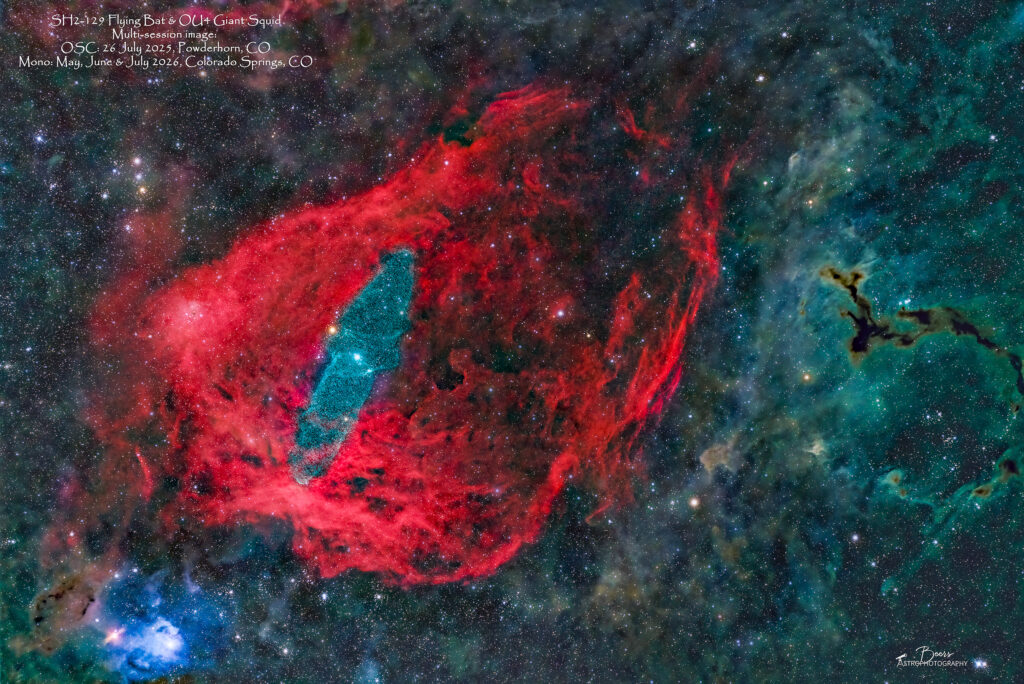
SH2-129 Flying Bat & Ou4 Giant Squid Nebulae
The SH2-129 Flying Bat & Ou4 Giant Squid Nebulae gallery (https://beersastrophotography.com/gallery/sh2-129-flying-bat-ou-4-giant-squid-nebulae/) shows the evolution of my imaging of this elusive pair. I have been intrigued by them, especially the faint Ou4 Giant Squid (the blue portion of the image that looks like a flying bat!) since I first saw Nico Carver’s version of it at: https://www.nebulaphotos.com/sharpless/sh2-129/ in 2023.
During the clear skies around the New Moon in July, I concentrated on collecting 15-minute OIII subframes – to see if that captured more of the Ou4 Giant Squid’s faint OIII signal than my previously collected 10-minute exposures. So, this month’s image is comprised of those 15-minute OIII subframes (77x15min collected on 11, 12, and 14Jul); all the Ha data I’d captured in May, June, and on the night of 13Jul26; and the RGB data I’d captured with the one shot color (OSC) camera in on 26 July 2025 at Powderhorn, Colorado.
I used slightly different APP RGB Combine algorithms this month – RGB1 for the dust background and the star field; HaRGB1 for the deeper red in the SH2-129 Flying Bat; and HOO1 for the Ou4 Giant Squid’s elusive OIII signal. I blended the three combined images together using clipping masks in Photoshop and LIghtroom to bring out the portion of each image that I created it to highlight (i.e., the background, Flying Bat, Giant Squid)
…the July data were captured and stacked into an image that is rotated 180° from all the previous months’ (May, May+Jun) data. When the registration aligned the individual channels, it decided to use the latest data as the reference. I have no idea why! Thus this image is rotated 180° from this years’ version, but is the same as the November 2025 version of the image. I’m not sure that there’s a “right” way – so I’ll let the algorithm decide, and I’ll leave it alone!
It’s still not a “finished product” – I would love to have some mono dark skies data to throw into the mix – especially with the R,G,B filters (I tried adding the RGB mono data to the RGB combination and all it contributed was light pollution and a muting of the colors in the image). Also, I will likely experiment with using all the data I’ve collected over the last three months (i.e., both the 15-min and 10-min OIII, and SII data). But, again, as with last month – I felt the need to share the latest in this “summer project.”
Capture Summary – July 2026 with SC420Mono from HCH Front Patio
Capture Notes (July 2026 summary): During the clear nights preceding the New Moon (11-14July2026) and my departure for EAA on 16 July 2026, I continued data collection on SH2-129/Ou4. July’s data collection mostly focused on collecting 15-minute subframes of OIII data.
I continued the practices that I’d learned last month (PHD2 Calibration Assistant prior to starting sequence, auto meridian flip), all four nights were mostly successful, with slightly different glitches around the meridian flip each night, mostly when AG failed to re-acquire after the flip or lost its guide star near/at the meridian (at precisely the moment I touched the laptop, when I came out to witness the meridian flip).
The process that I’ve settled into leading up to the capture of the first subframe:
- Connect all cables and electrical power connections
- Polar align with Polemaster, disconnect and stow
- Connect all equipment in SGP
- Run PHD2 Calibration Assistant:
- Slew, Calibrate, Cancel
- Stop guiding (do NOT close PHD2!)
- Park scope
- Run SGP sequence
- Slews to target, EAF #1
- Plate solves
- Resumes autoguider
- EAF#2
- Waits for AG to settle, Captures frame#1
Capture Notes (11Jul2026): On 11 July, the first night of data collection in the series, I’d forgotten the correct process for PHD2 Calibration Assistant operation. After I parked the mount, I closed PHD2. When I started the SGP sequence, and it got to the point after the plate solve where it would resume the autoguider – it wouldn’t connect. I quickly opened PHD2 and the sequence began collecting its first subframe without going through EAF#2. When I came out at 02:30MDT to witness the meridian flip, the AG resume in the auto meridian flip failed. I ended up parking and restarting the sequence the “old fashioned way” (i.e., manually). The sequence went through the full EAF#1, plate solve, resume AG (this time it worked correctly), EAF#2, and restart data collection.
Capture Notes (12Jul2026): On 12 July, I was still not rock-solid on the PHD2 Calibration Assistant steps. Once it finished the calibration, returning a good result, I homed the scope – failing to stop guiding first). I stopped the guiding, and ran the sequence – none the worse for the wear. The sequence went through all its proper steps and began the sequence as expected at 21:40MDT. I came out to witness the meridian flip at 02:43 and had the “next frame is longer than time to meridian” message. I selected “attempt now.” It worked perfectly – flipped, plate solved, restarted AG, EAF, settled AG, restarted sequence at 02:51.
Capture Notes (13Jul2026): Third night was a charm WRT the start up sequence – I completed the PHD2 Calibration Assistant steps correctly and the start-up was flawless – from a connecting the cabling at 21:27 to first frame capture at 21:40! But…when I came out at 02:36 to witness the meridian flip and opened the laptop, I found that it had just lost the guide star and was in its auto recovery mode. I selected “attempt now” and the auto recovery worked. It gave me the “flip now or wait for the meridian” I selected “attempt flip” which worked flawlessly.
Capture Notes (14Jul2026): The sequence start-up went smoothly. Started the PHD2 Calibration Assistant at 21:24MT and was collecting the first subframe at 21:37. I came out at 02:40 to witness the meridian flip (transit at 02:35). Again, as soon as I touched the laptop, it lost the guide star, I selected “abort” and it entered recovery mode (losing the 15 minute subframe it was about to complete. SGP conducted the meridian flip, no EAF, and went right into collecting the next subframe.
The details of each night’s collection during June 2026 are in the Blog post: https://beersastrophotography.com/photography-journals/summer-data-collection-project-june-installment/
The details of each night’s collection during May 2026 are in the Blog post: https://beersastrophotography.com/photography-journals/its-back-flying-bat-giant-squid-visible-again/
The details of the data collection from Powderhorn, Colorado (dark skies image with one-shot color camera (OSC)) in July 2025 are in the Blog post: https://beersastrophotography.com/photography-journals/one-night-beast-recon-trip-to-tolvar-flats/
Image Data & Processing Summary
Total Data Collected:
July 2025 OSC Data – 26Jul2025: Gain 300, Offset 30, Temp 0°C; Total (good) OSC data capture: 67x5min = 335min (5:35hrs). Separated into R, G, B channels for RGB Combine with mono data
Total Mono Data Collected (May, Jun & Jul2026): 5112min (85:12 hours)
- Lum: 16x1min; 16min
- OIII: 24x5min, 140x10min, 77x15min; 2675min, 44:35hrs
- Ha: 193x5min; 965min, 16:05hrs
- SII: 122x5min; 610min, 10:10hrs
- Red: 90x3min; 270min, 4:30hrs
- Green: 105x3min; 315min, 5:15hrs
- Blue: 87x3min; 261min, 4:21hrs
May Mono Data– 15, 16, 23, 29, 30May2026: Gain 100, Offset 50, Temp 0°C. Total mono data capture: 16x1min, 122x5min, 56x10min subframes = 1186min (19:46hr).
- Lum: 16x1min; 16min
- OIII: 24x5min, 56x10min; 680min, 11:20hrs
- Ha: 40x5min; 200min, 3:20hrs
- SII: 58x5min; 290min, 4:50hrs
June Mono Data– 10, 11, 12, 15, 16, 17, 18, 20Jun2026: Gain 100, Offset 50, Temp 0°C. Total mono data capture: 258x3min, 167x5min, 80x10min subframes = 2,409min (40:09hr).
- OIII: 80x10min = 800min, 11:20hrs
- Ha: 103x5min; 515min, 8:35hrs
- SII: 64x5min; 320min, 5:20hrs
- Red: 90x3min; 270min, 4:30hrs
- Green: 90x3min; 270min, 4:30hrs
- Blue: 78x3min; 234min, 3:54hrs
July Mono Data – 11-14 Jul2026: Gain 100, Offset 50, Temp 0°C. Total mono data capture: 258x3min, 167x5min, 80x10min subframes = 2,409min (40:09hr).
- OIII: 77x15min = 1155min, 19:15hrs
- Ha: 50x5min; 250min, 4:10hrs
- Grn: 15x3min = 45min
- Blue: 3x3min = 9min
Total Data Used in July image:
Total data included in RGB Combine algorithms to produce image (OIII July 15min; Ha May,Jun,Jul (without 15-16May); OSC RGB data for R-G-B combine): 2350min (39:10hrs)
July 2025 OSC Data – 26Jul2025: Gain 300, Offset 30, Temp 0°C; Total (good) OSC data capture: 67x5min = 335min (5:35hrs). Separated into R, G, B channels for RGB Combine with mono data
Total mono data used in image (May, Jun & Jul2026): 2015min (33:35 hours)
- OIII: 77x15min; 1155min, 19:15hrs
- Ha: 172x5min; 860min, 14:20hrs
Processing Summary (APP Stack, Register, Combine):
Stack: In APP, I stacked 100% (77/77) of the July OIII 15-minute subframes to create a new OIII.FITS. Stacked 100% of 172 Ha 5-minute subframes (172/172) captured on 29 & 30 May2026 and 10, 11, 12, 16, 18, & 20 Jun2026; and 13Jul2026 in APP, using multi-filter, 1st degree LNC, 3 iterations to create a new Ha.FITS.
Register: In APP, I registered (aligned) the new OIII.FITS and Ha.FITS with the previous months’ SII.FITS, RGB Mono.FITS, and RGB OSC separated channel.FITS; creating (R, G, B) Mono & OSC; H, S, O channel images registered with each other.
Combine: In APP, I used the RGB Combine tool to create three separate images, highlighting distinct aspects of the image, that I would ultimately blend together in LR/PS to create the final image. The APP RGB Combine algorithms were:
- RGB1: Combining the RGB OSC channels to create the dust background and the star field (I attempted to also combine the RGB mono channels, but all they contributed was light pollution)
- HaRGB1: Combining the RGB OSC channels with the mono Ha channel to create a richer red Flying Bat (with the Ha signal contributing red to the image).
- HOO1: Combined the Ha and OIII channels to create the OIII-dominant Giant Squid
Blend Combined Images: Finally, I blended the three RGB Combined images together in Lightroom and Photoshop with a series of clipped layer masks to create the final image.
Equipment
All equipment controlled by HP Probook (DSO-CTRL1) running Sequence Generator Pro v4.5.0.1642.
- Imaging Train:
- Telescope: (Southern Cross with 0.7x reducer (SC420)) Askar FRA600 108mm f/5.6 Quintuplet Petzval Flat-Field Astrograph with Askar f3.9 Full Frame Reducer for Askar FRA600
- Camera: (OSC camera) ZWO ASI2400MC Pro One Shot Color imaging camera
- Camera: (Mono camera) ZWO ASI6200MM Pro Monochrome imaging camera;
- Filter Wheel: ZWO – EFW 7×2” Filter Wheel with installed filters (1=SII, 2=Ha, 3=OIII, 4=Lum, 5=Red, 6=Grn, 7=Blue): Svbony SV227 2” Narrow-Band – SII, Ha, OIII; Optolong LRGB Filter Set (2”)
- Polar alignment: QHYCCD camera (controlled by Polemaster for polar alignment)
- Mount: Rainbow Astro RC-135E (controlled by iHubo ASCOM driver)
- Autoguiding: Orion 60mm Multi-Use Guide Scope with ZWO ASI120MM mini mono camera (controlled by PHD2)
- Auto Focuser: ZWO EAF Electronic Automatic Focuser – Standard (New 5V Version) (EAF-5V-STD)
Summary
- Total data in image:
- Mono data captured May, June & July 2026: 2015min (33:35 hours)
- OIII: 77x15min; 1155min, 19:15hrs
- Ha: 172x5min; 860min, 14:20hrs
- OSC data capture: 67x5min = 335min (5:35hrs). Separated into R, G, B channels for RGB Combine with mono data
- Mono data captured May, June & July 2026: 2015min (33:35 hours)
- Shooting location:
- Mono data captured from HCH front patio, Colorado Springs, CO (29 & 30May2026; 10, 11, 12, 16, 18, & 20Jun2026; 11-14 July 2026);
- OSC data captured from Powderhorn, Colorado (26Jul2025)
- Processing: Data collection with SGP sequence; stack and register with Astro Pixel Processor (APP); combine mono images using APP RGB Combine Tool; star removal with Starnet++; image processing with Photoshop/Lightroom