
The summer project of collecting data on my “OCD” target continues…or maybe concludes?? At this point, it seems less a matter of collecting more data and more a matter of refining my mono processing skills. But when Thursday night (10 Sep—the New Moon) was forecast to be completely clear in Colorado Springs (albeit a bit windy to start the night), I couldn’t resist one more “data fix” on SH2-129. This time, I focused primarily on Ha, with a little OIII thrown in at the end of the night for good measure, giving me some fresh data for the processing experiments I mentioned after working through the 4 September data.
Until I can spend some dedicated time under truly dark skies, this may be my “final” version of the SH2-129 Flying Bat & Ou4 Giant Squid Nebulae. Although, as with “never say never,” you never really say “final” when it comes to astrophotography processing! 😉 For now, though, it’s time to move on to some of those Fall and Winter nebulae!
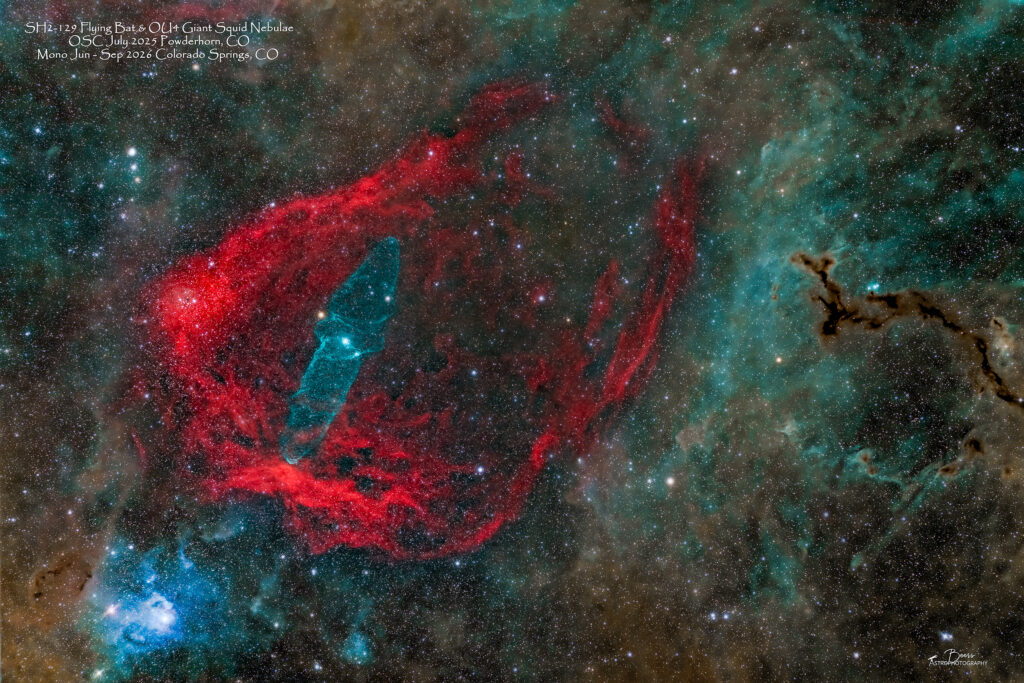
SH2-129 Flying Bat & Ou4 Giant Squid Nebulae
The SH2-129 Flying Bat & Ou4 Giant Squid Nebulae gallery (https://beersastrophotography.com/gallery/sh2-129-flying-bat-ou-4-giant-squid-nebulae/) shows the evolution of my imaging of this elusive pair. I have been intrigued by them, especially the faint Ou4 Giant Squid (the blue portion of the image that looks like a flying bat!) since I first saw Nico Carver’s version of it at: https://www.nebulaphotos.com/sharpless/sh2-129/ in 2023.
This “final” image of my spring and summer data collection extravaganza (obsession?) comprises 47:25 hours of total data, including 5:35 hours of OSC RGB data captured at Powderhorn in July 2025 and 41:50 hours of mono data captured from the HCH front patio.
The mono data consists of 212 × 5-minute Ha subframes (1,060 minutes / 17:40 hours) captured in June, July, and September 2026 (10, 11, 12, 16, 18, and 20 Jun; 13 Jul; and 10 Sep), along with 110 × 15-minute OIII subframes (1,650 minutes / 27:30 hours) captured in July and September 2026 (11, 12, and 14 Jul; 4 and 10 Sep).
Processing began with APP stacking of the Ha and OIII data, along with separation of the OSC RGB data into individual R, G, and B channels. Using APP’s RGB Combine tool, I created four separate channel-combination images: RGB for the star field and background, HaRGB for the Flying Bat, and HOO for both the Flying Bat and Giant Squid. I processed each combination separately and then blended them using a series of clipping-mask layers, allowing me to bring out the unique characteristics of each combination. Finally, I recombined the star field with the resulting starless blended image.
Until I can get some dedicated time under truly dark skies, this may be my “final” version of the SH2-129 Flying Bat & Ou4 Giant Squid Nebulae. Although, just as you never say never, you never really say final in astrophotography processing! 😄
For now, though, it’s time to move on other Fall and Winter nebulae!
Capture, Data & Processing Summary
Capture Notes (10 Sep 2026)
The bad weather forecast for our dark-skies trip to Creede, CO—and, unfortunately, across much of Colorado and the surrounding states within driving distance—had us cancel our camping plans. YES! You are remembering correctly: it has been an entire year since our last trip out in the Beast!
True to form, once Mother Nature had ensured the cancellation, Thursday night—the night of the New Moon—turned out to be completely clear in Colorado Springs. So, naturally, I decided to get one more “data fix” on SH2-129. This session focused primarily on Ha, with a little OIII thrown in at the end of the night for good measure, giving me some fresh data for the processing experiments I mentioned after working through the 4 September data.
I started the process promptly at astronomical twilight (~20:30 MDT) and had a smooth start-up:
- 20:34MDT: PHD2 Calibration assistant. Slew, calibrate (HFR = 2.86)
- 20:36MDT: Calibration result good. Cancel, stop guiding (do NOT shut down PHD2),
- 20:37: Park scope
- 20:38: Run sequence.
- Slew to target, set Ha filterEAF#1 (5127 –> 5179); 5179, 1.8HFR, 97% (1.28)Plate solve. Attempt 1: 1.45° and 603.8px delta. Resolved on second attemptEAF#2 (5179 –> 5175); 5175, 1.9HFR, 97% (1.24)
- AG settle
- 20:47: Event1/Frame1 start (Ha, 300seconds)
I came out at 21:57 on my way to bed, however, and discovered that SGP was in recovery mode—ARGH! Three 5-minute Ha subframes had been captured before the AG camera disconnected; the error reported in PHD2 was an ASCOM driver error. I tried encouraging the auto-recovery to “try now,” but since the underlying problem was the physical cable disconnect, it unsurprisingly got nowhere. So, I manually ended the sequence, parked the scope, disconnected the equipment electronically, disconnected and reconnected the AG camera cable physically, then reconnected everything and restarted the sequence. Surprisingly, SGP performed an abbreviated start-up: one EAF run, settled the AG, and resumed the sequence. Back in business!
I thought I had set my alarm to get up and watch the meridian flip at 22:47 MDT. Apparently, I had not. I woke up around 23:30 MDT and stared at the clock for a moment, trying to remember when the flip was supposed to happen. I checked my phone and confirmed that, indeed, there was no alarm set. 😳 I got up and looked outside to see that the telescope was on the proper post-transit side of the pier—YEAH! I then went out to verify that the sequence was still running and found it happily collecting frame #20 of the Ha sequence. Woohoo!
The PHD2 Calibration Assistant run at the beginning of the night, combined with turning off automatic calibration throughout the SGP sequence, appears to have solved the issue I’ve had with never being able to depend on an automatic meridian flip. …and a very good thing, too. Sleeping through the meridian flip when the mount wasn’t set to flip automatically could have had a disastrous effect on my equipment!
I slept in a little past my normal weekday wake-up time (04:00) to let the sequence continue until the start of astronomical twilight—the end of the imaging night—at 05:15 MDT. Even with the hour lost to the AG camera disconnect, I ended up with 60 × 5-minute Ha subframes and 7 × 15-minute OIII subframes. I added the new Ha data to the June and July data and the OIII data to the July and September data to create this “final” (for now!) version of the Flying Bat and Giant Squid.
The details of the 4 September data collection and processing are in the Blog post: https://beersastrophotography.com/photography-journals/summer-data-collection-project-september-data-boost/
The details of each night’s collection during July 2026 are in the Blog post: https://beersastrophotography.com/photography-journals/summer-data-collection-project-july-installment/
The details of each night’s collection during June 2026 are in the Blog post: https://beersastrophotography.com/photography-journals/summer-data-collection-project-june-installment/
The details of each night’s collection during May 2026 are in the Blog post: https://beersastrophotography.com/photography-journals/its-back-flying-bat-giant-squid-visible-again/
The details of the data collection from Powderhorn, Colorado (dark skies image with one-shot color camera (OSC)) in July 2025 are in the Blog post: https://beersastrophotography.com/photography-journals/one-night-beast-recon-trip-to-tolvar-flats/
Image Data
Total Data Collected
July 2025 OSC Data – 26Jul2025: 67x5min = 335min (5:35hrs).
Total Mono Data Collected (May, Jun, Jul, & Sep2026): 5907min (98:27 hours)
- Lum: 16x1min = 16min
- OIII: 24x5min, 140x10min, 110x15min = 3170min, 52:50hrs
- Ha: 253x5min = 1265min, 21:05hrs
- SII: 122x5min = 610min, 10:10hrs
- Red: 90x3min = 270min, 4:30hrs
- Green: 105x3min = 315min, 5:15hrs
- Blue: 87x3min = 261min, 4:21hrs
Monthly Summaries of Data Collected
May Mono Data– 15, 16, 23, 29, 30May2026: Gain 100, Offset 50, Temp 0°C. Total mono data capture: 16x1min, 122x5min, 56x10min subframes = 1186min (19:46hr).
- Lum: 16x1min; 16min
- OIII: 24x5min, 56x10min; 680min, 11:20hrs
- Ha: 40x5min; 200min, 3:20hrs
- SII: 58x5min; 290min, 4:50hrs
June Mono Data– 10, 11, 12, 15, 16, 17, 18, 20 June 2026: Gain 100, Offset 50, Temp 0°C. Total mono data capture: 258x3min, 167x5min, 80x10min subframes = 2,409min (40:09hr).
- OIII: 80x10min = 800min, 11:20hrs
- Ha: 103x5min; 515min, 8:35hrs
- SII: 64x5min; 320min, 5:20hrs
- Red: 90x3min; 270min, 4:30hrs
- Green: 90x3min; 270min, 4:30hrs
- Blue: 78x3min; 234min, 3:54hrs
July Mono Data – 11-14 July 2026: Gain 100, Offset 50, Temp 0°C. Total mono data capture: 258x3min, 167x5min, 80x10min subframes = 2,409min (40:09hr).
- OIII: 77x15min = 1155min, 19:15hrs
- Ha: 50x5min; 250min, 4:10hrs
- Grn: 15x3min = 45min
- Blue: 3x3min = 9min
September Mono Data – 4, 10 September 2026: Gain 100, Offset 50, Temp 0°C. Total mono data capture: 33x15min, 60x5min subframes = 795min (13:15hr).
- OIII: 33x15min = 495min, 8:15hrs
- Ha: 60x5min = 300min, 5:00hrs
Data from the data collection extravaganza in this image (Jun-10Sep 2026 Mono Ha, OIII; July 2025 OSC)
This latest version of the image includes the 15 minute OIII subframes captured in July and on 4 & 10 Sep (110x15min subframes) and the 5 minute subframes captured in June, July, and on 10 Sep (212x5min subframes) to the RGB data collected with the OSC camera in Powderhorn, CO on 26 July 2025.
Total data used to produce image (OIII: July&Sep 15-minute subframes only; Ha: Jun,Jul,Sep 5-minute subframes; OSC RGB 5-minute subframes): 3045min, 50:45hrs
July 2025 OSC Data – 26Jul2025: 67x5min = 335min, 5:35hrs
- Separated into R, G, B channels for RGB Combine with mono data
Total Ha & OIII mono data used in image (Jun, Jul, Sep2026): 2710min (45:10 hours)
- OIII: 110x15min = 1650min (27:30hrs)
- Ha: 212x5min = 1060min (17:40hrs)
Processing Summary (APP Stack, Register, Combine)
Stack
Learning from the stacking experience in generating the 4 Sep 2026 image, I stacked all of the 15 minute OIII data to create an OIII image for the RGB Combine step: the September and July 15-minute subframes (110x15min = 1650min (27:30hrs). Stacked all the June, July, and September collected Ha data to create an Ha image for the RGB Combine step.
- OIII Stack: 4 & 10Sep, 11, 12, & 14 Jul 2026; 110 × 15 min. Applied 1st-degree LNC, 3 iterations, and Drizzle with a droplet size of 2.25. Saved as .FITS and light-pollution-corrected .FITS.
- Ha Stack: 10Sep26, 13Jul26, and 10, 11, 12, 16, 18, 20Jun2026; 212 x 5 min. Applied 1st-degree LNC, 3 iterations, and Drizzle with a droplet size of 1.25. Saved as .FITS and light-pollution-corrected .FITS.
Register
IIn APP, I registered and normalized the Ha, OIII (both with/without lpc) and separated R, G, B channels from the OSC image.
From training checklist – these are the registration steps:
- Restart APP and in the Load tab (Tab1) load in the FITS files as lights
- Click on Analyze stars (Tab3) and click on the Analyze Stars button
- When Analyze stars is complete, Click on Register (Tab4) and click Start Registration
- When Registration is complete, click on Normalization (Tab5), click on Normalize lights
- When complete, click on Save Normalized Frames (will save one FITS file per light frame
Combine & Blend
For this processing run, and because of the “issues” I had dialing in the correct red for the Flying Bat in the 4 Sep 2026 version, I decided to go back to creating separate combined images for each major element: RGB for the background, HaRGB for the Flying Bat (red), and HOO for the Giant Squid. In APP, I used the RGB Combine tool to create these separate images and then blended them together in Lightroom and Photoshop to create the final image.
The APP RGB Combine algorithms were:
- RGB1: Combined the separated R, G, and B channels from the OSC image to create the background and star field.
- HaRGB1: Combined the separated R, G, and B channels from the OSC image with the mono Ha channel to create the red Flying Bat and background.
- HOO1: Combined the Ha and OIII channels to create the OIII-dominant Giant Squid.
- HOO1-RedFB: When APP generated the initial combination, I actually liked the red in the Flying Bat even better than the red I had created with HaRGB, so I saved this version as HOO1-RedFB.
- HOO1-BlueGS: I then recombined the Ha and OIII channels in the RGB Combine tool, this time focusing on maximizing the blue in the Giant Squid, and saved that version as HOO1-BlueGS.
Finally, I melded the two RGB Combined images together in Lightroom and Photoshop, using a series of clipped layer masks to selectively blend the different elements and create the final image.
Equipment
All equipment controlled by HP Probook (DSO-CTRL1) running Sequence Generator Pro v4.5.0.1642.
- Imaging Train:
- Telescope: (Southern Cross with 0.7x reducer (SC420)) Askar FRA600 108mm f/5.6 Quintuplet Petzval Flat-Field Astrograph with Askar f3.9 Full Frame Reducer for Askar FRA600
- Camera: (OSC camera) ZWO ASI2400MC Pro One Shot Color imaging camera
- Camera: (Mono camera) ZWO ASI6200MM Pro Monochrome imaging camera;
- Filter Wheel: ZWO – EFW 7×2” Filter Wheel with installed filters (1=SII, 2=Ha, 3=OIII, 4=Lum, 5=Red, 6=Grn, 7=Blue): Svbony SV227 2” Narrow-Band – SII, Ha, OIII; Optolong LRGB Filter Set (2”)
- Polar alignment: QHYCCD camera (controlled by Polemaster for polar alignment)
- Mount: Rainbow Astro RC-135E (controlled by iHubo ASCOM driver)
- Autoguiding: Orion 60mm Multi-Use Guide Scope with ZWO ASI120MM mini mono camera (controlled by PHD2)
- Auto Focuser: ZWO EAF Electronic Automatic Focuser – Standard (New 5V Version) (EAF-5V-STD)
Summary
- Total data in image:
- Ha & OIII mono data (Jun, Jul, Sep2026): 2710min (45:10 hours)
- OIII: 110x15min = 1650min (27:30hrs)
- Ha: 212x5min = 1060min (17:40hrs)
- OSC data capture: 67x5min = 335min (5:35hrs).
- Separated into R, G, B channels for RGB Combine with mono data
- Ha & OIII mono data (Jun, Jul, Sep2026): 2710min (45:10 hours)
- Shooting location:
- Mono data captured from HCH front patio, Colorado Springs, CO (10, 11, 12, 16, 18, & 20Jun2026; 11-14July 2026; 4, 10 September2026);
- OSC data captured from Powderhorn, Colorado (26Jul2025)
Summary Thoughts & Future Considerations (moving on…)
This image comprises 47:25 hours of total data, including 5:35 hours of OSC RGB data captured at Powderhorn in July 2025 and 41:50 hours of mono data captured from the HCH front patio. The mono data consists of 212 × 5-minute Ha subframes (1,060 minutes / 17:40 hours) captured in June, July, and September 2026 (10, 11, 12, 16, 18, and 20 Jun; 13 Jul; and 10 Sep), along with 110 × 15-minute OIII subframes (1,650 minutes / 27:30 hours) captured in July and September 2026 (11, 12, and 14 Jul; 4 and 10 Sep).
Processing began with APP stacking of the Ha and OIII data, along with separation of the OSC RGB data into individual R, G, and B channels. Using APP’s RGB Combine tool, I created four separate channel-combination images: RGB for the star field and background, HaRGB for the Flying Bat, and HOO for both the Flying Bat and Giant Squid. I processed each combination separately and then blended them using a series of clipping-mask layers, allowing me to bring out the unique characteristics of each combination. Finally, I recombined the star field with the resulting starless blended image.
Until I can get some dedicated time under truly dark skies, this may be my “final” version of the SH2-129 Flying Bat & Ou4 Giant Squid Nebulae. Although, just as you never say never, you never really say final in astrophotography processing! 😄
For now, though, it’s time to move on other Fall and Winter nebulae!