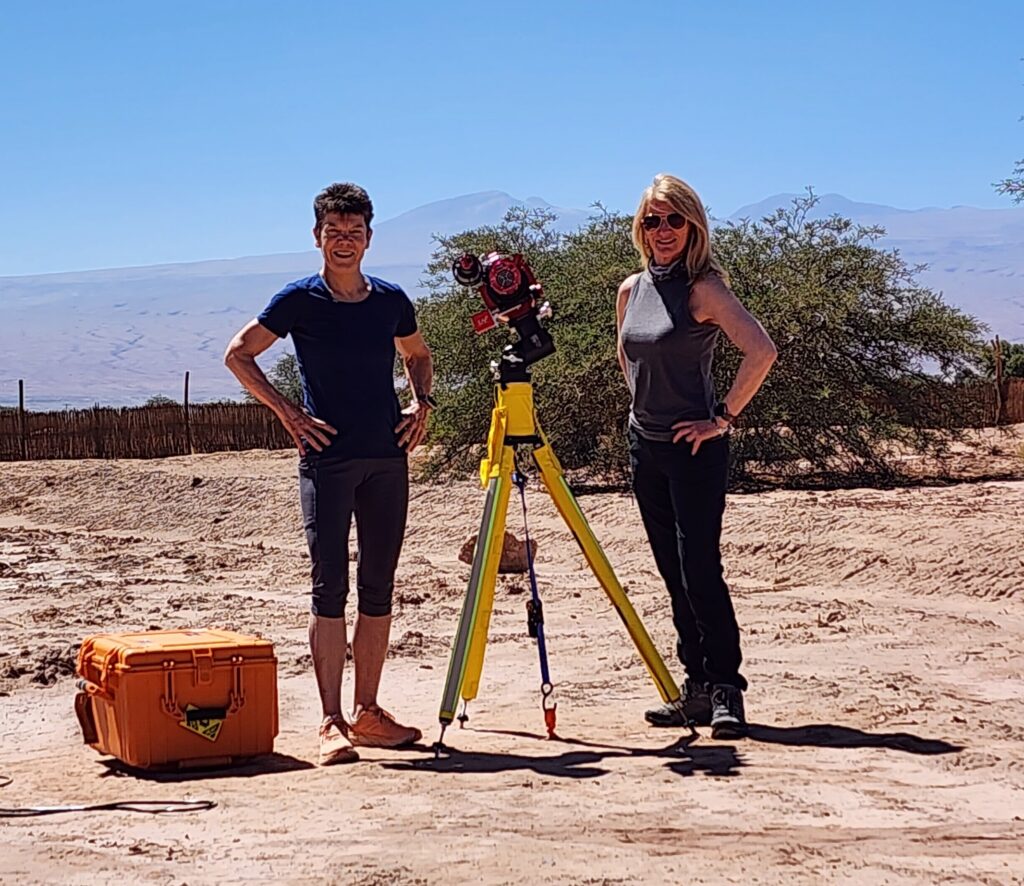
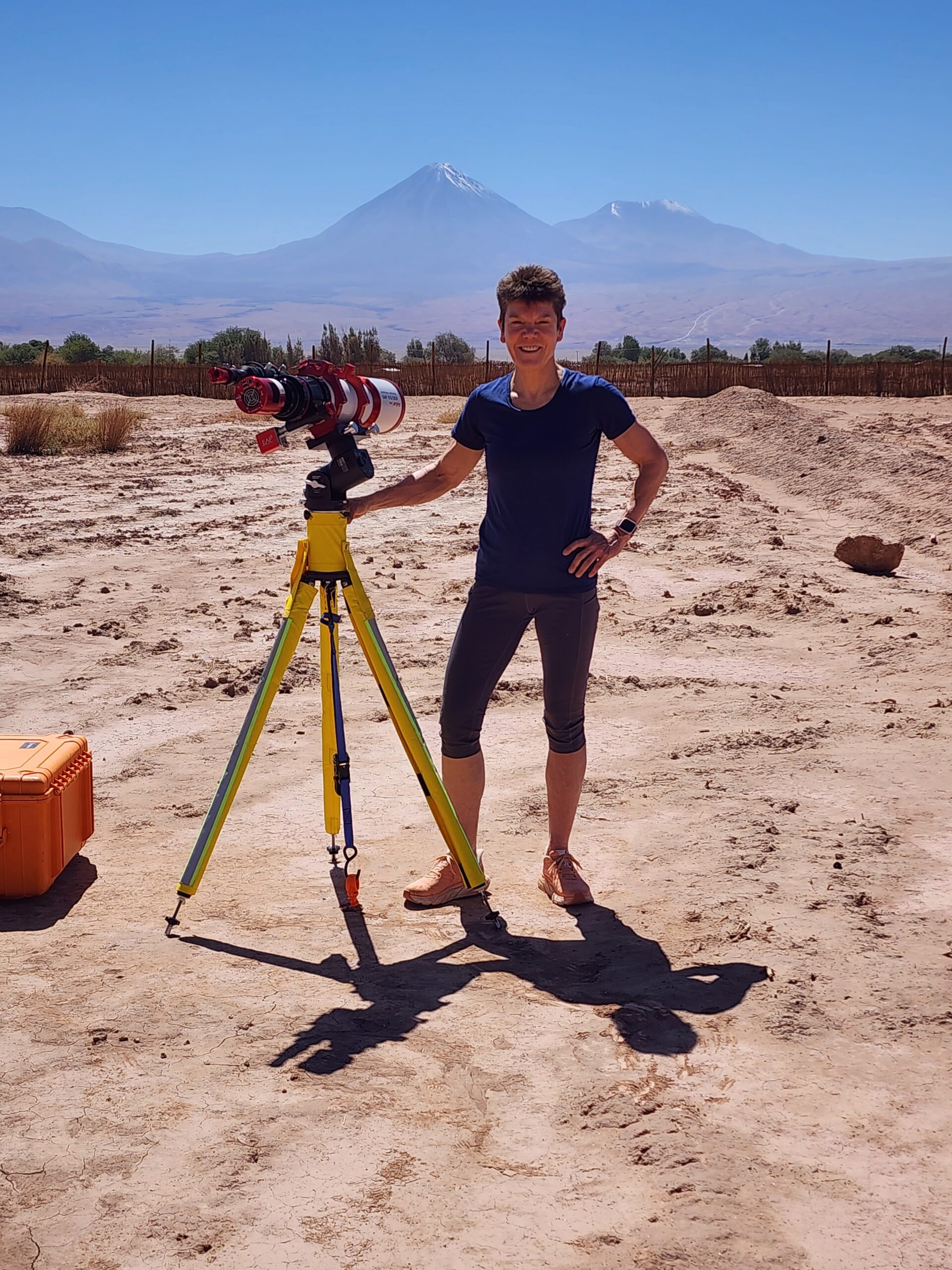
The third annual Atacama Desert astrophotography trip was just as amazing as the previous two! Even though Victoria and I did everything in our our power (i.e., 8+ hour layover in Houston), the travel was again FUBAR – including losing my battery along the way (thank goodness for the nightmare I’d had prior to departure that had provisioned a Plan B). Once we finally arrived the skies, the sites, the warm people of San Pedro de Atacama, and the Pisco Sours did not disappoint!
The travel…
The trip in 2024 with Danita, when all the travel went smoothly, is proving to be the outlier for this event. This year, I booked our flights giving us PLENTY of time in Houston (8+ hours) to make the connection. We made the connection, but United was having gate availability (and apparently cleaning and inspection crew) issues that made us three hours late departing and thus, three hours late arriving in Santiago.
That delayed arrival landed us in the midst of a demonstration of LATAM’s lack of resiliency – once you miss your original flight (11:15 departure) your trip requires a complete do-over! We had to go to the Customer Service counter to buy new tickets (losing the Premier Economy seats I originally booked), along with all the rest of the people who were coming from Houston on that flight, then get in another line to check our bags and get boarding passes.
The battery (a gel cell, non-spillable battery that is approved for transport in the cargo hold per FAA regulations (a copy of which I carry with me at all times)) is always a problem. This year, the problem that I’ve always been able to talk my way past by showing the documentation and the safety precautions we’ve taken, became an unmovable barrier. After about 90 minutes of talking to the ticket counter agent (Valorie), something happened, and she relented…we took the battery to the oversize baggage security point, they inspected it and gave us the thumbs up. With about 45 minutes before the (now 15:30 departure) flight was going to board we cleared security and headed to the gate, thinking, “disaster averted!” Until…I was paged by the gate agent, “There’s been a luggage emergency, you need to return to the ticket counter to resolve it.” I said, “Just leave the battery behind.” He said, “No, ALL your luggage has been taken off the plane, you must return to the ticket counter.” Not to belabor this point…we missed the 15:30 departure and my battery stayed in the Santiago airport’s international terminal’s secure (paid) storage for the trip, and we were rebooked (with another amazingly long conversation/ordeal with the ticket counter (Valorie had left for the day)) on the 17:30 departure…in the last two seats in the very last row (next to a very large gentleman).
We and all of the luggage luggage that made it onto that flight (i.e., not the battery) arrived at the Calama airport at about 19:45 (original arrival time was to be 13:00). I approached the Avis counter (I’d communicated with their “bot” while we were waiting for the 15:30 departure and was told they “usually hold reservations for 24 hours, you should be fine.”) to find that the reservation had been cancelled shortly after 13:00 (i.e., the bot lied). I may have let my bottom lip quiver, I may have teared up a bit…it had already been a very long two travel days. The agent showed a bit of compassion and asked if I could drive a stick-shift? “YES!” Do you mind a pick-up truck? “NO” It’s not clean. “I don’t care!” …and we were escorted out (after buying the insurance AND paying an exorbitant deposit) to a nice crew cab pick-up truck and were finally on the road to San Pedro de Atacama…just as the sun was beginning to set.
I probably scared the heck out of Victoria on the drive. Not only are the skies dark, so are the roads! We made it to the Atacama Lodge (with a tour through the middle of San Pedro de Atacama when we missed the cut-off that eliminates that excursion) by about 21:30. There was NO way, I had the mental or physical energy to set up my equipment – so we dropped our stuff in the lodge and headed into town for dinner and Victoria’s first Pisco Sour.
Okay, you made it, tell me about the imaging…
Just like the last two years’ trips – the clear, dark skies of the Atacama Desert were phenomenal! While I’m sure I offended my family by not splitting my time between AP and visiting with them, I decided this trip was going to be all about me and time spent in those glorious dark skies. I imaged eight nights, capturing fourteen deep sky objects! One night while Victoria was still with me (she only stayed for a week), we set up to image the Milky Way so she could see that process. Then on the last night before my departure, even though I probably had enough time to image DSOs, pack up all my equipment, and make it to the airport in time; I decided to image the Milky Way that night too. That turned out to be the right decision – I didn’t seem to have a lot of spare time in the morning with only the MW equipment to pack – packing up all the AP equipment would have been a bridge too far. I certainly wouldn’t have wanted to miss my Calama to Santiago flight through complete fault of my own!
So…if you want to just cut to the chase and see the images, I built a Southern Hemisphere gallery. All the gallery pages of the images I captured during this trip (and previous trips) are in that gallery: https://beersastrophotography.com/deep_space_objects/southern-hemisphere/
A summary of the highlights (and one big low-light!) of the imaging experience is below. I’ll describe the major focus (no pun intended) areas of my imaging plan, show you my favorite image from each of those deep sky regions, and provide you with the link to the galleries where you’ll find each target’s fun facts, capture and processing notes, sequence statistics, and equipment information.
First, an update on my Southern Hemisphere polar alignment adventure…
If you’ve been with me for the last two years, you know that polar alignment using the Southern Hemisphere’s almost invisible Sigma Octantis pole star has been a big problem. Made an even bigger problem because both of the last two years, once I finally got the mount aligned after a 2-hour struggle on the first night, I was stupid enough to move it (wildly) on the second night searching in search of the pole star (because it didn’t recognize it, sitting there right in front of me where I left it the night before)…and spending SIX hours on the second night getting the mount aligned!
I am VERY pleased to tell you that did not happen this year!
First, I discovered a “new” (for me) control program, N.I.N.A. (Nighttime Imaging ‘N Astronomy, https://nighttime-imaging.eu/) that has a 3-point polar alignment plug-in. The plug-in uses plate solving (the same process the mount uses to find and precisely zero in on the target location) on the pole star and tells you how much and in which direction you need to correct the mount’s position to polar align it. I used N.I.N.A. to get the mount within a few seconds of alignment and then switched to my Polemaster. When I brought up the Polemaster screen, I assured myself that the pole star WAS in the F.O.V. and that I would stare at the screen until I found it without touching the mount’s knobs until I did.
The first night’s cold start to the completion of the first 5-minute subframe’s capture took me 44 minutes! That, my friends, is a new land-speed record for me!! Subsequent nights, including the second night took less than 10 minutes!! The full story is in the Capture & Processing Notes section of the Chamaeleon II Haast Eagle & Possum Nebulae gallery (the first night’s first image) at: https://beersastrophotography.com/gallery/chamaeleon-ii-haast-eagle-possum-nebulae/
Eight nights, three planned deep sky regions, a game-day pivot, and some stragglers to fill in the dark hours…
This year’s planning focused on three primary deep sky regions – Chamaeleon, Vela Supernova, and the Large Magellanic Cloud. I also felt the need to revisit my 2025 trip favorite, the Rho Ophiuchi Nebula with this year’s expanded field of view from my “new” 0.7x reducer (purchased shortly after returning from last year’s trip). After seeing Victoria’s reaction to the Southern Cross, I made a last-minute plan to spend some time imaging the smallest of all constellations and its famous member. Finally, I filled the remaining dark hours before/after the primary targets rose/set with a couple of new dark nebulae and repeats of previous trips’ targets.
Since I’m having a very hard time deciding on a single trip favorite this year, I’ll describe the primary groupings, give you the link to each of the images captured within them, and show you my favorite from the group.
Chamaeleon Region
The Chamaeleon Region was visible all night long, so I spent a good portion of three nights imaging portions of that the Chamaeleon constellation’s beautiful dark and dusty nebulae. The problem with this area, is the objects are not well catalogued or documented. I’ve been using the Stephen Chadwick and Ian Cooper book “Imaging the Southern Sky” as a guide, which gives RA/Dec coordinates for each object and a description of the FOV of the book’s included image. Neither the book nor the sky atlases I use for my shot planning provide a precise means for determining how much of the desired object will fit into my FOV. So, you’ll probably notice, there is some (okay, a lot) of overlap in the images, and likely a great deal of the area left unexplored. Ah well, must leave targets for next year’s trip, right? …and I have almost a year to figure out a better way to create the target plans. From the Chamaeleon constellation, I imaged:
Chamaeleon II: Haast Eagle & Possum Nebulae on 15 March 2026 (https://beersastrophotography.com/gallery/chamaeleon-ii-haast-eagle-possum-nebulae/)
Chamaeleon III: Moa Nebula on 18 March 2026 (https://beersastrophotography.com/gallery/chamaeleon-iii-moa-nebula/)
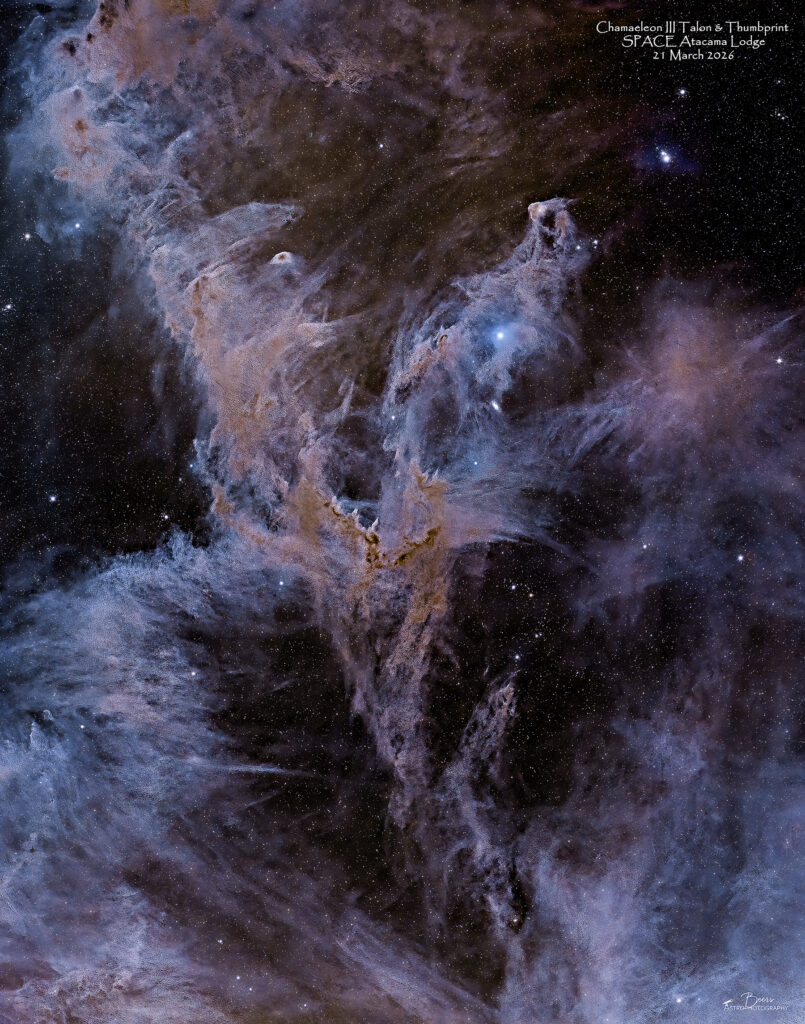
Chamaeleon III: Talon & Thumbprint Nebulae on 21 March 2026 (https://beersastrophotography.com/gallery/chamaeleon-ii-haast-eagle-possum-nebulae-chamaeleon-iii-talon-and-thumbprint-nebulae/)
My favorite of the Chamaeleon DSOs is the Talon & Thumbprint. I would love to hear from you which you prefer!
Vela Supernova Remnant
The Vela SNR is described in the Chadwick and Cooper book as an “astrophotographer’s paradise” – and they aren’t kidding! Take a look at any of the galleries below where I show their overall image and reference chart to the SNR’s pieces to whet your appetite. Again, the problem is, Chadwick & Cooper made up the names and the dissection of the overall image (based upon their imaging of the area) – so, again as with Chamaeleon, trying to plan the images became a challenge. I could use the RA/Dec provided in the book, but it wasn’t clear to me how many of the objects would fit into my FOV. If you look closely (actually you probably don’t need to look all that closely) at the Crest & Bridge and the Highway & Spur images – you’ll see that I spent two night capturing almost exactly the same image!
Worse than that (the low-light that I mentioned at the beginning of this story) I had a 4-tile mosaic planned of the entire 9 degree x 6 degree region that I spent the full night of 21 March capturing data on. The problem was – I got creative and changed the plan from a 90 degree camera angle (that my control software does a good job of understanding where it’s pointing) to a 50 degree camera angle (that my control software has an known (at least known to me!) issue understanding where it’s pointing – and directs you to rotate the camera 90 degrees away from the correct angle. So I ended up with data collected on 4 tiles in “portrait” framing, while they needed to be in “landscape” framing to be able to mosaic them together! I haven’t given up completely – I’m planning to throw all the images that I captured of this region (both this year and in 2024) at the mosaic software to see if there’s enough data in the gap to create an image of the entire region. …and I have vowed to find a way to do a better job of planning next year’s targets to ensure full coverage (of both Vela and Chamaeleon). I imaged:
16 March 2026: Vela SNR Crest and the Bridge ( https://beersastrophotography.com/gallery/vela-supernova-remnant-snr-crest-bridge/ )
19 March 2026: Vela SNR Highway and the Spur ( https://beersastrophotography.com/gallery/vela-supernova-remnant-snr-highway-spur/ )
21 March 2026: Vela XYZ (TBD on what Frankenstein image may result from that!)
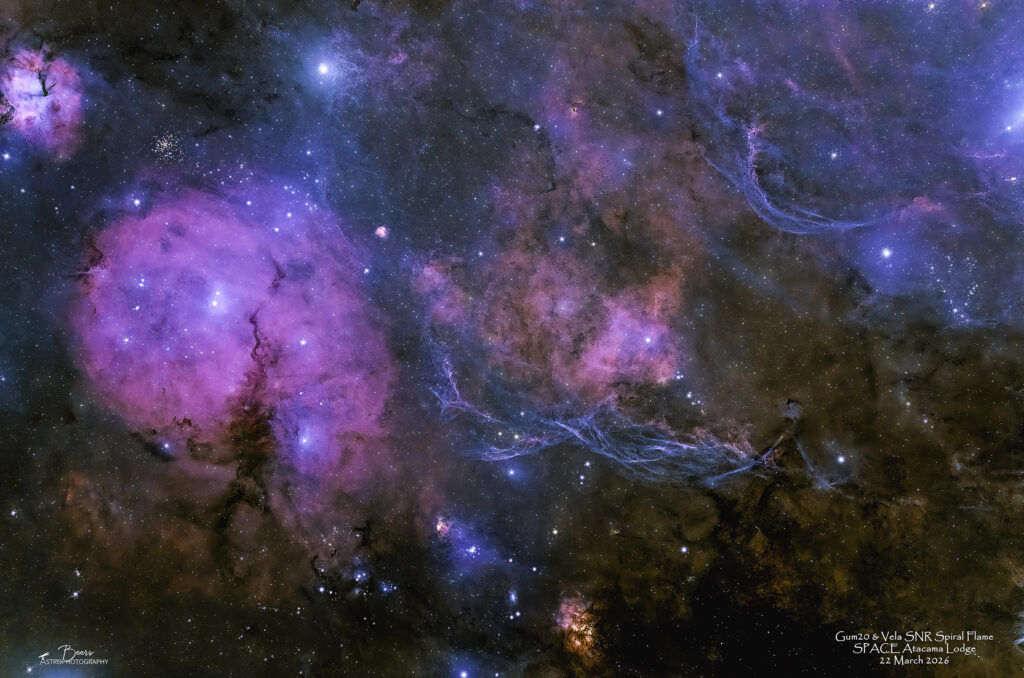
22 March 2026: Gum 20 Vela SNR Spiral Flame Nebula ( https://beersastrophotography.com/gallery/vela-supernova-remnant-snr-spiral-flame/ )
Perhaps because the Spiral Flame is the “different” image is the reason that it’s become my favorite. Let me know what you think…
Large Magellanic Cloud
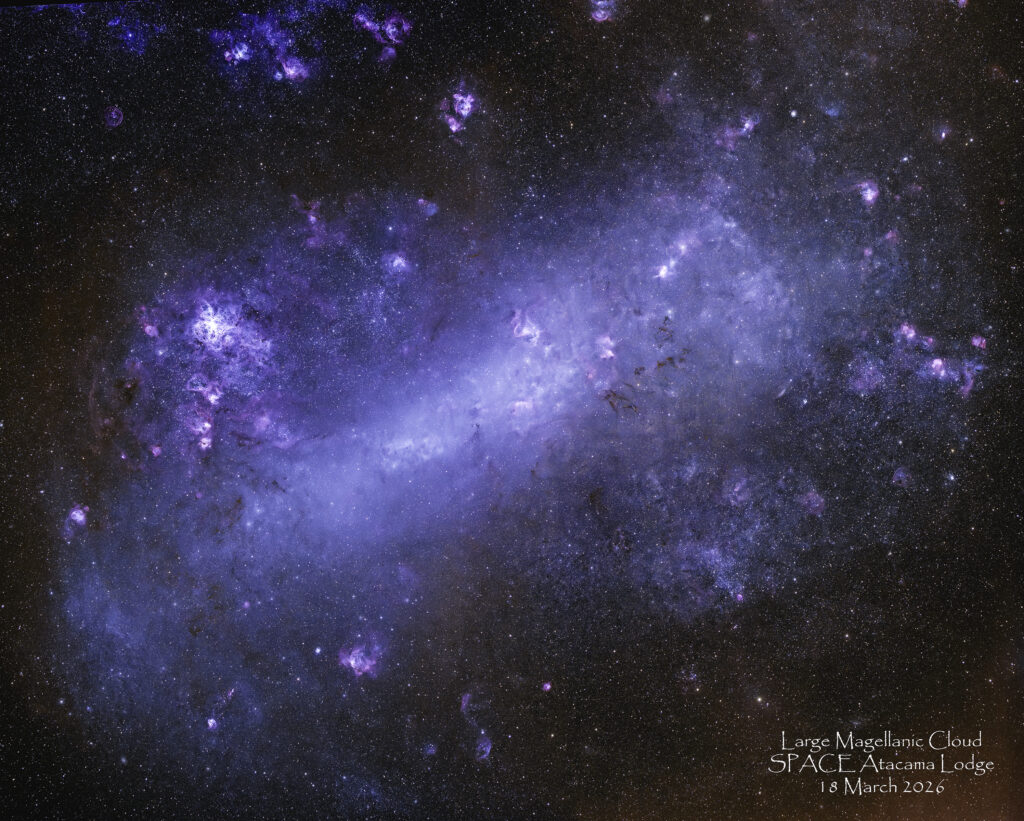
In 2024 I imaged a small portion of the LMC with the Tarantula Nebula, but it has always intrigued me as that “easy to pick out” object in the Southern sky. So, I spent part of the night of 18 March 2026 capturing it in a two tile mosaic. As you can probably see, even with the 0.7x reducer’s expanded FOV (420mm focal length giving me a 4°55’ x 3°16’ FOV) – the LMC fills the frame. The tiles of the mosaic didn’t come together cleanly, so cropping was a challenge that will keep this target on the list for imaging during future trips with a larger mosaic to capture the LMC galaxy with some breathing room around it’s edges.
The Blond-Haired, Blue Bearded Man…
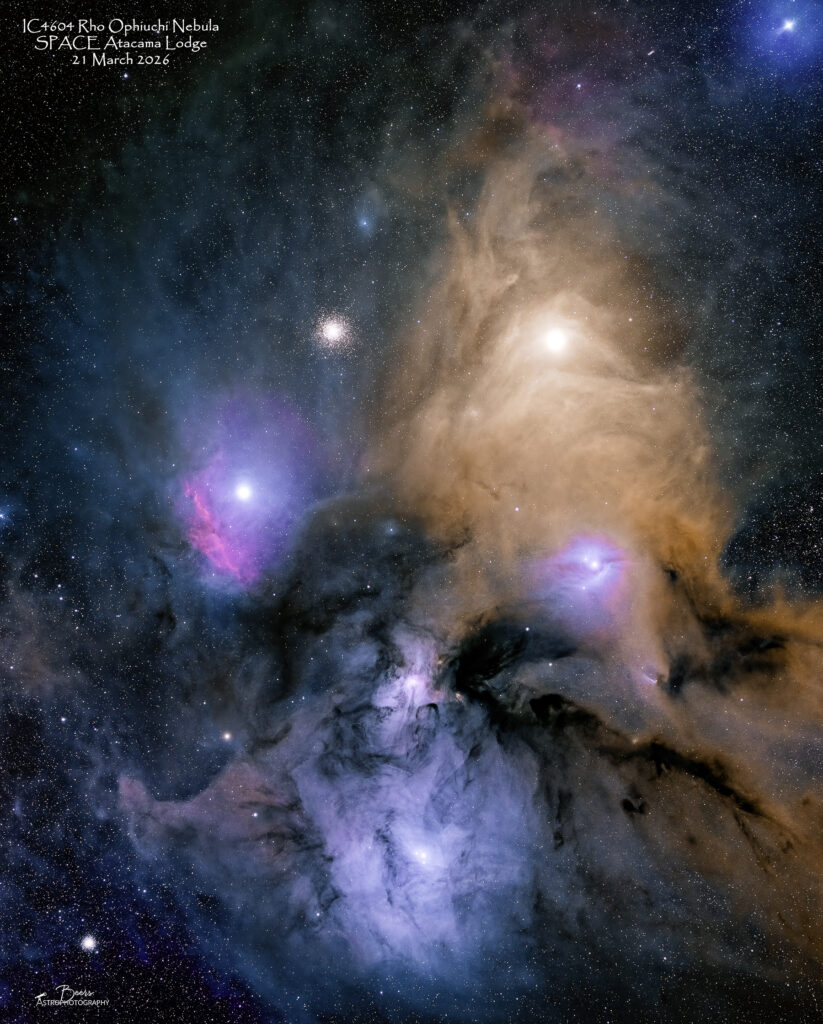
I couldn’t let this year’s trip go by without revisiting my favorite DSO from last year, the Rho Ophiuchi Nebula, which I have nicknamed (if Chadwick & Cooper can make up names, why can’t I??) the Blond-Haired, Blue Bearded Man. This year, as an added bonus from the extended FOV the 2-tile mosaic perspective also shows his “pineapple ponytail”!!
16 March 2026: I imaged a single tile at a 90 degree camera angle, so although it’s hard to “unsee” the man, it’s more of a colorful landscape than his portrait.
21 March 2026: I imaged the 2-tile mosaic with the camera at zero degree angle that shows the Blond-Haired, Pineapple Ponytailed, Blue-Bearded Man in all his glory. Yes, I am obsessed with this DSO!
Both the single tile and the 2-tile mosaic are in the IC4606 Rho Ophiuchi Nebula gallery at: https://beersastrophotography.com/gallery/ic4604-rho-ophiuchi-nebula/
The Southern Cross game day pivot…
As you’ll read in the gallery post, a couple of things motivated me to plan an image of the Southern Cross (i.e., the Crux constellation) once we arrived in Chile. First, my AP motivator Pat Swanson mentioned how much she loves the Southern Cross and hopes to see it again “some day.” Second, Victoria became infatuated with it when I pointed it out to her while we were outside imaging the Milky Way. The next morning she introduced/reminded me of the song written in its honor (YouTube links to Crosby, Still & Nash and Jimmy Buffet versions provided in the gallery for your listening pleasure)! It’s a constellation (albeit the smallest of the 88 constellations) – so it took a 4-tile mosaic to capture it all. ( https://beersastrophotography.com/gallery/the-southern-cross/ )
The Dark Nebulae
I “filled in” the time after primary targets set with a couple of dark nebulae in the Ophiuchus constellation.
15 March 2026: I imaged LDN1773 Pipe Nebula and Barnard 78 Bowl of the Pipe after I felt I’d collected enough data on the Chamaeleon II Haast Eagle & Possum Nebulae (https://beersastrophotography.com/gallery/ldn1773-pipe-stem-bowl-nebulae/ ).
19 March 2026: I imaged Barnard 72 Snake Nebula after the Vela SNR Highway & Spur set ( https://beersastrophotography.com/gallery/barnard-72-snake-nebula/ )
…and the Repeat Performers
Finally, I felt like I couldn’t let any of the glorious dark, clear skies go to waste, so I had a list of “other priority 1” targets that I’d imaged on previous trips to fill in the gaps so as not to let a dark moment be wasted! Because they were gap-fillers, they didn’t have a lot of data collected on them this year – so no pixel-peeping, please! I imaged:
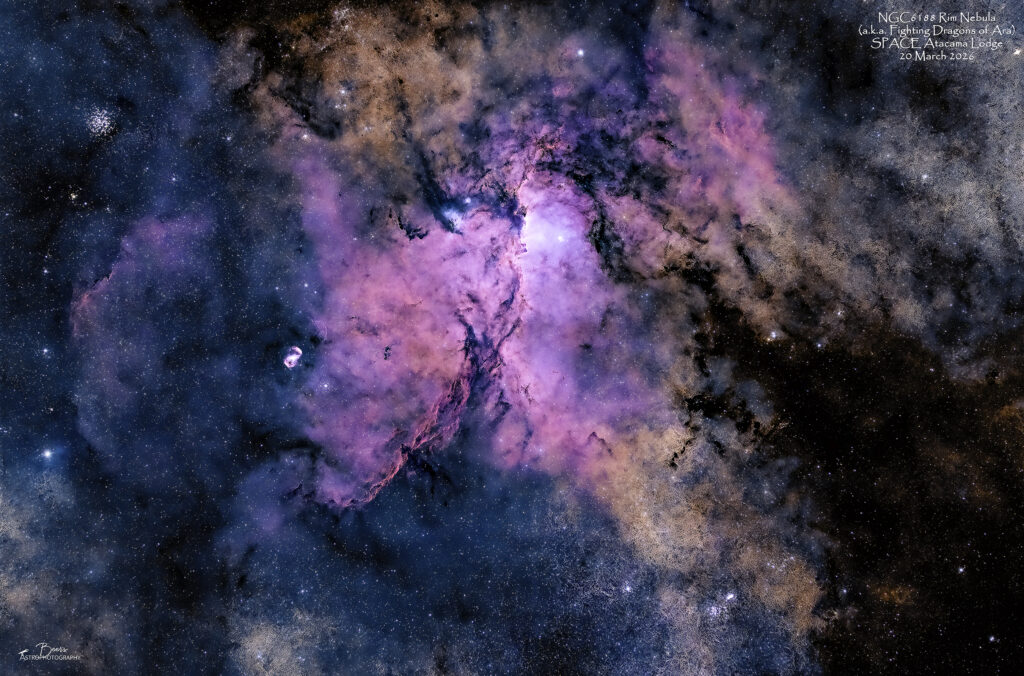
20 March 2026: NGC 6188 Rim Nebula (a.k.a. Fighting Dragons of Ara) ( https://beersastrophotography.com/gallery/ngc6188-rim-nebula-a-k-a-fighting-dragons-of-ara/ )
22 March 2026: NGC3372 Carina Nebula ( https://beersastrophotography.com/gallery/ngc3372-eta-carina-nebula/ )
22 March 2026: IC2944 Running Chicken Nebula as the last (boo-hoo) image of the trip ( https://beersastrophotography.com/gallery/ic2944-running-chicken-nebula/ )
They are all fun targets, thus their revisit for a second (or third in the Carina Nebula’s case) time during this trip, so hard to pick a favorite. So, even though it was my first sighting of an image of the Carina Nebula that originally piqued my interest and drew me to the Southern Hemisphere, I still have a fondness for the Fighting Dragons and all that is going on in that region of the sky. So, it will close out this blog…let me know your favorite of the images I captured this year, please!